Amazing Heroes Issue #108 Table of Contents
Dublin Core
Title
Amazing Heroes Issue #108 Table of Contents
Subject
Periodical
Comics Strips
Comics Strips
Description
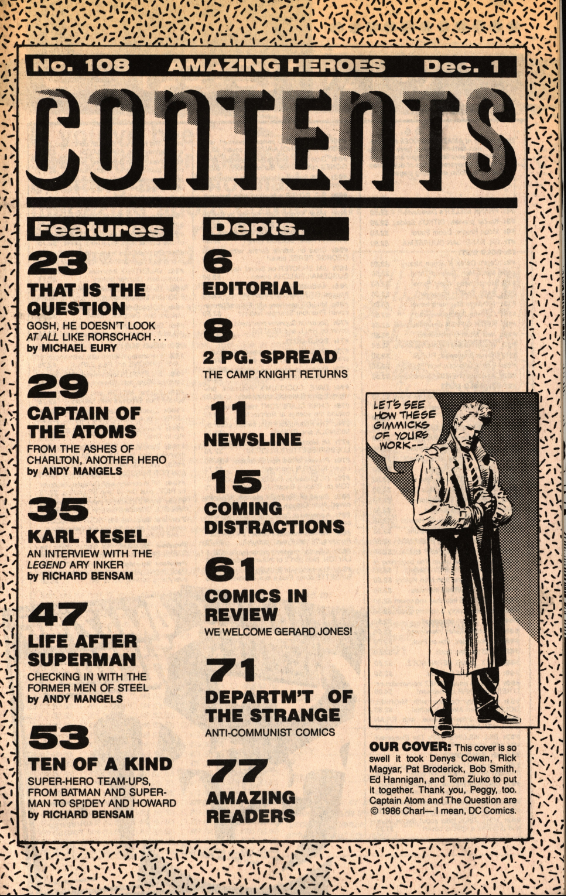
The table of contents of Amazing Heroes Issue #108 contains an image of Vic Sage, otherwise known as the superhero character The Question, holding his coat and saying, “Let’s see how these gimmicks of yours work.” The featured articles of the fanzine include: “That Is The Question” and “Captain of the Atoms,” an explanation of the revitalization of Charlton Comics characters Vic Sage and Captain Atom; “Karl Kesel,” an interview with the comic book inker; “Life After Superman,” a story about all of the men who have played Superman on radio and in television; and “Ten of a Kind,” an anthology of some of the most notable superhero team-ups. The other articles, which seemingly appear regularly in each issue of Amazing Heroes, are: “Editorial,” a “2 Pg. Spread” of the Camp Knight, “Newsline,” “Coming Distractions,” “Comics in Review,” “Departm’t of the Strange” about anti-communist comic books, and “Amazing Readers.” Unlike in most of the fanzine’s other issues, the staff and publication info does not appear in the table of contents, instead of showing up beside the editorial.
The many articles in this issue of the fanzine are representative of the culture of creators in the comic book industry. Thanks to innovators like Stan Lee at Marvel, comic book creators were made more visible to the readership. Writers, pencilers, inkers, and editors all received credit on the title page of a comic book, and fans soon developed favorite writers and artists, often purchasing a comic book because a specific writer or artist had worked on it. The image of one or two creative geniuses sitting together in a room and thinking up characters and storylines. Creators such as Steve Ditko and inkers like Karl Kesel were admired for their talent and contributions to the superhero genre. However, the reality of comic book production is often quite different. A team of editors shaping the storyline that they want for a comic book, then an artist draws the panels and a writer adds captions and dialogue, then the pencil drawings are colored by another artist, and the editor approves the comic. Much of comic book production is done alone, with each contributor doing his or her part without consulting the others. This contrasts greatly with creators’ characterization in the greater comic book culture.
The many articles in this issue of the fanzine are representative of the culture of creators in the comic book industry. Thanks to innovators like Stan Lee at Marvel, comic book creators were made more visible to the readership. Writers, pencilers, inkers, and editors all received credit on the title page of a comic book, and fans soon developed favorite writers and artists, often purchasing a comic book because a specific writer or artist had worked on it. The image of one or two creative geniuses sitting together in a room and thinking up characters and storylines. Creators such as Steve Ditko and inkers like Karl Kesel were admired for their talent and contributions to the superhero genre. However, the reality of comic book production is often quite different. A team of editors shaping the storyline that they want for a comic book, then an artist draws the panels and a writer adds captions and dialogue, then the pencil drawings are colored by another artist, and the editor approves the comic. Much of comic book production is done alone, with each contributor doing his or her part without consulting the others. This contrasts greatly with creators’ characterization in the greater comic book culture.
Creator
Editor: Mark Wald
Art Director: Dale Crain
Production Manager: Kim Thompson
News Correspondent: J. Collier
Production Assistant: Teresa Moore
Typesetting: L.M Gorell & Ariene Easter
Circulation: Rachel Enger
Art Director: Dale Crain
Production Manager: Kim Thompson
News Correspondent: J. Collier
Production Assistant: Teresa Moore
Typesetting: L.M Gorell & Ariene Easter
Circulation: Rachel Enger
Source
MSU Special Collection Comic Art, PN6725.A47
Publisher
Fantagraphics Books Inc.
Date
1986-12
Contributor
Sarah M Geist
Rights
Rights Restrictions Apply
Format
6 5/8 inches by 10 1/4 inches
Language
English
Type
Periodical
Coverage
1981-1992
Files
Citation
Editor: Mark Wald
Art Director: Dale Crain
Production Manager: Kim Thompson
News Correspondent: J. Collier
Production Assistant: Teresa Moore
Typesetting: L.M Gorell & Ariene Easter
Circulation: Rachel Enger, “Amazing Heroes Issue #108 Table of Contents,” Critical Fanscape, accessed October 17, 2026, https://chambl91.msu.domains/CriticalFanscape/items/show/28.