Amazing Heroes Issue #03- pg.#25
Dublin Core
Title
Amazing Heroes Issue #03- pg.#25
Subject
Periodical
Comic Strips
Comic Strips
Description
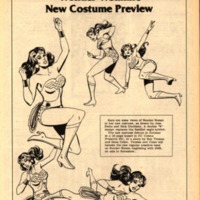
Page twenty-five of issue 3 in Amazing Heroes is titled “Wonder Woman’s New Costume Preview,” written in bold lettering at the top of the page. above that is the header of the comic with “DC News” in all capital letters to the very right, indicating this page is in the news section. The entire content is within a box that is transparent on the inside and outlined in black within the outline, there is an even smaller box containing only text explaining the new outfit choices. Five different sketches of Wonder Woman are surrounding the text box. Each of them are her in different action positions. Starting at the top right going counter-clockwise, she is on one hand and one leg, reaching up. The second illustration is turned to the left in a defensive position. The largest drawing is of her on one knee, her lasso drawn with pointed squiggles around it to indicate activity and power. Below that graphic is Wonder Woman with her hands up and the last is her diving across the page. The bottom two drawings have her lasso in the same outline as the main and central drawing. Wonder Woman’s new outfit has the new double “W” in replace of the eagle. In each drawing of her, her hair is dark and voluptuous, flowing behind her. Her costume is a bodysuit, leotard type outfit that has stars on the bottom part and the top with the flying “W” across the chest. She has high heeled boots that go just below her knee that are designed with a stripe up the front. She has two bands, one around each wrist, and a crown-type headband with a star in the middle.
Wonder Woman was created in 1941 by a psychologist named William Moulton Marston. She came into the comic world as an Axis-Power agent to fight in WWII and defend America. During this comic, the beginning of the end of the Cold War had started and new, more modern icons were needed for America. For comics in general, a new market was surging at this time. Large publishers like DC and Marvel were now up against independent publishers, for example Fantagraphics which publishes Amazing Heroes. These independent publishers were targeting the direct market by offering royalties to artists. The artists for independent publishers had more freedom for creative range than they did with big companies, so they were ultimately attracted to the smaller, independent publishers. The market economy for comic books was changing, and with that change came changes in designs, like this page on Wonder Woman’s costume. This preview piece in Amazing Heroes is for DC, meaning this comic’s publishing company worked with DC, oftentimes displaying comics from the larger corporations.
For Wonder Woman’s costume change as a whole, many factors play into her “new and improved” look. First of all, Wonder Woman as a character deals with psychological themes of dominance and subservience. She is an inspiration and strong female role model for girls and women alike, yet she is sexualized for the male gaze. Her bullet-deflecting bracelets are often seen as bracelets of submission and her golden lasso can be interpreted as a fetishistic sex toy. On the other hand, she is an empowering icon and is often times noted as a woman young girls look up to as their first feminist figure, inspiring ideals of empowerment for women as a whole and themselves as individuals. Her outfit change is a result of social standards of a new wave of feminism as well as the economic changes comics as a whole were facing. Throughout the years, Wonder Woman became increasingly less popular. She went through costume changes in the past to try to boost sales. In the 1970s, artists drew her in a mod jumpsuit, but switched back to a closer version of her short bodysuit in the 1980s. These were mostly an attempt to raise sales on the comic industry side of the story, yet Wonder Woman still stood as an example of feminist hope for women while at the same time was a sexualized hero for male readers, so changes in costumes were necessary for changing times for this female character.
Wonder Woman was created in 1941 by a psychologist named William Moulton Marston. She came into the comic world as an Axis-Power agent to fight in WWII and defend America. During this comic, the beginning of the end of the Cold War had started and new, more modern icons were needed for America. For comics in general, a new market was surging at this time. Large publishers like DC and Marvel were now up against independent publishers, for example Fantagraphics which publishes Amazing Heroes. These independent publishers were targeting the direct market by offering royalties to artists. The artists for independent publishers had more freedom for creative range than they did with big companies, so they were ultimately attracted to the smaller, independent publishers. The market economy for comic books was changing, and with that change came changes in designs, like this page on Wonder Woman’s costume. This preview piece in Amazing Heroes is for DC, meaning this comic’s publishing company worked with DC, oftentimes displaying comics from the larger corporations.
For Wonder Woman’s costume change as a whole, many factors play into her “new and improved” look. First of all, Wonder Woman as a character deals with psychological themes of dominance and subservience. She is an inspiration and strong female role model for girls and women alike, yet she is sexualized for the male gaze. Her bullet-deflecting bracelets are often seen as bracelets of submission and her golden lasso can be interpreted as a fetishistic sex toy. On the other hand, she is an empowering icon and is often times noted as a woman young girls look up to as their first feminist figure, inspiring ideals of empowerment for women as a whole and themselves as individuals. Her outfit change is a result of social standards of a new wave of feminism as well as the economic changes comics as a whole were facing. Throughout the years, Wonder Woman became increasingly less popular. She went through costume changes in the past to try to boost sales. In the 1970s, artists drew her in a mod jumpsuit, but switched back to a closer version of her short bodysuit in the 1980s. These were mostly an attempt to raise sales on the comic industry side of the story, yet Wonder Woman still stood as an example of feminist hope for women while at the same time was a sexualized hero for male readers, so changes in costumes were necessary for changing times for this female character.
Creator
Illustrators: Jose Delbo & Dick Guidano
Executive Editor: J. Michael Catron
Art Director: Peppy White
Editorial Assistant: Laura K. Beal
Cover: Joe Staton
Contributing Writer: Richard Morrissey
Contributing Artists: Bill Anderson, Rich Buckler, Willie Blyberg, Sam DeLaRosa, Fred Hembeck, Gary Kwapsz, Mike O'Neal, Carl Taylor
Executive Editor: J. Michael Catron
Art Director: Peppy White
Editorial Assistant: Laura K. Beal
Cover: Joe Staton
Contributing Writer: Richard Morrissey
Contributing Artists: Bill Anderson, Rich Buckler, Willie Blyberg, Sam DeLaRosa, Fred Hembeck, Gary Kwapsz, Mike O'Neal, Carl Taylor
Source
MSU Special Collection Comic Art, PN6725.47
Publisher
DC
Date
August 1982
Contributor
Tiffany McIntyre
Rights
Rights Restrictions Apply
Relation
http://chambl91.msu.domains/CriticalFanscape/items/show/7
http://chambl91.msu.domains/CriticalFanscape/items/show/1
http://chambl91.msu.domains/CriticalFanscape/items/show/1
Format
8-1/2 & 11 in.
Language
English
Type
Periodical
Coverage
1982-1991
Files
Collection
Citation
Illustrators: Jose Delbo & Dick Guidano
Executive Editor: J. Michael Catron
Art Director: Peppy White
Editorial Assistant: Laura K. Beal
Cover: Joe Staton
Contributing Writer: Richard Morrissey
Contributing Artists: Bill Anderson, Rich Buckler, Willie Blyberg, Sam DeLaRosa, Fred Hembeck, Gary Kwapsz, Mike O'Neal, Carl Taylor, “Amazing Heroes Issue #03- pg.#25,” Critical Fanscape, accessed October 17, 2026, https://chambl91.msu.domains/CriticalFanscape/items/show/10.