Amazing Heroes Issue #149- pg. #41
Dublin Core
Title
Amazing Heroes Issue #149- pg. #41
Subject
Periodical
Comic Strips
Comic Strips
Description
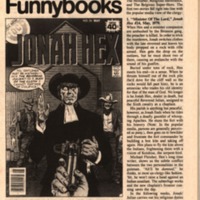
Page 41 of issue 149 of Amazing Heroes is titled “Faith and the Funnybooks.” The text takes up two-thirds of the page horizontally. The text is centered with “faith” in gothic font and “funnybooks” in a rounded font. Beneath the title is a picture of the cover of Jonah Hex No. 24. The illustration on the front is of a zombie reverend in which half of his face is human and half is falling off. He is being handed a gun by a hand whose arm is going off the bottom of the page. Two intimidating-looking cowboy men are in the back, in front of a building and a tall fence. The reverend is refusing the gun. The rest of the page is the article discussing how religion is presented and handled in comic books.
When religion is brought into any pop culture genre, it is usually not to to agree one way or the other or try to preach to the general audiences what the creator's beliefs and practices are (and aren’t). Religion is present to raise awareness and spur on an analysis or a critique of whatever is being proposed. Here, the proposal is to see how faith is shaped in comics, here referred to as “funnybooks” by the article’s author Gary D. Robinson, as well as see how freedom and openness to the discussion of religion has been present in comics and what the implications of that are. In comics, particularly the comics being analyzed in this “Faith and the Funnybooks” article, religion is westernized and modernized. Either the story of God is told with a modern twist, or the practice of religion, especially Christianity, is in the narrative of a western tone. God and Christianity are mentioned because those are the two main themes, icons, and practices of western culture. There is mention of other religions such as Judaism and Hinduism in the article, but many comics circulate around Christianity as the main monotheistic religion to write about. Many times, when God is mentioned in comics, there is a want to present the moral question of religion and the engage human response. The age of reading comics increased, thus interests change as age changes, making the presentation of religion in comics more of a question of value for the reader to ask themselves.
In the context of Amazing Heroes, the amazing part of heroes comes with the non-human qualities. Heroes are seen as godlike figures existing outside of religious doctrines. Religion, when present in comics and the heroes within comics, are sometimes a metaphor for a shift and development in culture and community. During 1988 in America, when this comic was published, President Bush was implementing a new approach to foreign affairs by directly communicating with foreign leaders himself. In this historical context, Robinson’s article is seen as questioning patriarchal, authoritarian values that comic books oftentimes present religion to uphold.
When religion is brought into any pop culture genre, it is usually not to to agree one way or the other or try to preach to the general audiences what the creator's beliefs and practices are (and aren’t). Religion is present to raise awareness and spur on an analysis or a critique of whatever is being proposed. Here, the proposal is to see how faith is shaped in comics, here referred to as “funnybooks” by the article’s author Gary D. Robinson, as well as see how freedom and openness to the discussion of religion has been present in comics and what the implications of that are. In comics, particularly the comics being analyzed in this “Faith and the Funnybooks” article, religion is westernized and modernized. Either the story of God is told with a modern twist, or the practice of religion, especially Christianity, is in the narrative of a western tone. God and Christianity are mentioned because those are the two main themes, icons, and practices of western culture. There is mention of other religions such as Judaism and Hinduism in the article, but many comics circulate around Christianity as the main monotheistic religion to write about. Many times, when God is mentioned in comics, there is a want to present the moral question of religion and the engage human response. The age of reading comics increased, thus interests change as age changes, making the presentation of religion in comics more of a question of value for the reader to ask themselves.
In the context of Amazing Heroes, the amazing part of heroes comes with the non-human qualities. Heroes are seen as godlike figures existing outside of religious doctrines. Religion, when present in comics and the heroes within comics, are sometimes a metaphor for a shift and development in culture and community. During 1988 in America, when this comic was published, President Bush was implementing a new approach to foreign affairs by directly communicating with foreign leaders himself. In this historical context, Robinson’s article is seen as questioning patriarchal, authoritarian values that comic books oftentimes present religion to uphold.
Creator
Writer: Gary D. Robinson
Editor Evermore: Kevin Dooley
Art Director: Lynette Alcorn-McCubbin
Associate Editor: Bruce Walrad
Editors in the Wings: Kim Thompson & Chris McCubbin
News Correspondent: Michael Johnson
Production Assistants: Mark Thompson & Jason Jeffers
Typesetting: Linda Gorell & Arlene Easter
Circulation: Rachel Enger & Carol Kovinick-Hernandez
Publisher: Fantagraphics Books, Inc.
Printed at: Port Publications, WI
Editor Evermore: Kevin Dooley
Art Director: Lynette Alcorn-McCubbin
Associate Editor: Bruce Walrad
Editors in the Wings: Kim Thompson & Chris McCubbin
News Correspondent: Michael Johnson
Production Assistants: Mark Thompson & Jason Jeffers
Typesetting: Linda Gorell & Arlene Easter
Circulation: Rachel Enger & Carol Kovinick-Hernandez
Publisher: Fantagraphics Books, Inc.
Printed at: Port Publications, WI
Source
MSU Special Collection Comic Art, PN6725.47
Publisher
Fantagraphics Books, Inc.
Date
September 15, 1988
Contributor
Tiffany McIntyre
Rights
Rights Restrictions Apply
Relation
http://chambl91.msu.domains/CriticalFanscape/items/show/9
http://chambl91.msu.domains/CriticalFanscape/items/show/6
http://chambl91.msu.domains/CriticalFanscape/items/show/6
Format
6-5/8 & 10-1/4 in.
Language
English
Type
Periodical
Coverage
1982-1991
Files
Collection
Citation
Writer: Gary D. Robinson
Editor Evermore: Kevin Dooley
Art Director: Lynette Alcorn-McCubbin
Associate Editor: Bruce Walrad
Editors in the Wings: Kim Thompson & Chris McCubbin
News Correspondent: Michael Johnson
Production Assistants: Mark Thompson & Jason Jeffers
Typesetting: Linda Gorell & Arlene Easter
Circulation: Rachel Enger & Carol Kovinick-Hernandez
Publisher: Fantagraphics Books, Inc.
Printed at: Port Publications, WI, “Amazing Heroes Issue #149- pg. #41,” Critical Fanscape, accessed October 17, 2026, https://chambl91.msu.domains/CriticalFanscape/items/show/12.