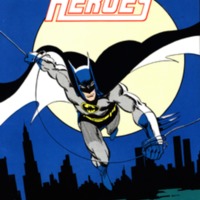
Amazing Heroes Issue #27 Cover
Dublin Core
Title
Amazing Heroes Issue #27 Cover
Subject
Periodical
Comic Strips
Comic Strips
Description
This is the cover of issue 27 of the comic fanzine Amazing Heroes. Issue 27 was released on July 15, 1983 and was priced at $1.95 in the United States and $2.50 in Canada. In the bottom right corner, there is text denoting that this is a “Special Batman Issue!” Batman is the figure on the cover and he is depicted mid-cable swing in the night. The full moon and what can be presumed to be the Gotham skyline are behind him. Batman is wearing a mostly grey suit, blue gloves, blue boots, blue pelvic-wear, a blue mask, a cape colored by shadow, and a yellow utility belt. On his chest, there is his bat chevron which is an oval with a black bat in the center surrounded by yellow. There is shading and shadowing on Batman, primarily on his face and cape. Batman’s facial expression can be described as a scowl as his brows are furrowed and his mouth is in a near-frown. Cover illustrator Jim Aparo’s signature is near the bottom right corner of the page, above the dock. The darkness of the illustration makes the bat chevron and the moon stick out.
Debuting in 1939 in Detective Comics #27, Batman was one of the first superheroes created. That this cover was published over forty years after that debut helps illustrate the staying power, the cultural significance, and the importance to comic book history that Batman has. Part of the mission of this issue was to recognize the importance of Batman even though it has been more than forty years since his debut. Batman evolved from the gritty urban detective protagonists found in the pages of the pulp magazines that preceded comic books. In the Golden Age, Batman was one of the most popular superheroes in comic books, and at some points, he was the most popular in terms of sales numbers. Because of his influences, a lot of Batman’s nameless foes are urban villains. This would include members of the mob, corporate fat-cats, crooks, and the like. Later, superpowered foes like the Joker, Scarecrow, and the Penguin are introduced to challenge Batman. These foes and the stories around them fit within the framework of the dark and gritty urban space of Gotham during the Golden Age. The introduction of the Comics Code Authority in 1954 helped to brighten up the stories told in Gotham, but Batman still had that urban detective edge. However, something strange began in 1966. The Batman television series only ran from 1966 to 1968, but the flavor it brought to Batman had an impact on everything Batman related. The Batman comics of the 1970s onward were a reaction to this with writers like Frank Englehart helping to return Batman to his gritty urban roots. Many writers used Batman to tell artistically complex and mature stories. The desire to move away from the colorful camp Batman of the 1960s is reflected in the darkness of the cover done by a prominent Batman artist of the time. The muted night stands in direct contrast to the psychedelic days found in the television series.
Debuting in 1939 in Detective Comics #27, Batman was one of the first superheroes created. That this cover was published over forty years after that debut helps illustrate the staying power, the cultural significance, and the importance to comic book history that Batman has. Part of the mission of this issue was to recognize the importance of Batman even though it has been more than forty years since his debut. Batman evolved from the gritty urban detective protagonists found in the pages of the pulp magazines that preceded comic books. In the Golden Age, Batman was one of the most popular superheroes in comic books, and at some points, he was the most popular in terms of sales numbers. Because of his influences, a lot of Batman’s nameless foes are urban villains. This would include members of the mob, corporate fat-cats, crooks, and the like. Later, superpowered foes like the Joker, Scarecrow, and the Penguin are introduced to challenge Batman. These foes and the stories around them fit within the framework of the dark and gritty urban space of Gotham during the Golden Age. The introduction of the Comics Code Authority in 1954 helped to brighten up the stories told in Gotham, but Batman still had that urban detective edge. However, something strange began in 1966. The Batman television series only ran from 1966 to 1968, but the flavor it brought to Batman had an impact on everything Batman related. The Batman comics of the 1970s onward were a reaction to this with writers like Frank Englehart helping to return Batman to his gritty urban roots. Many writers used Batman to tell artistically complex and mature stories. The desire to move away from the colorful camp Batman of the 1960s is reflected in the darkness of the cover done by a prominent Batman artist of the time. The muted night stands in direct contrast to the psychedelic days found in the television series.
Creator
Jim Aparo - Illustrator
Mr. Mace - Colors and Separation
Kim Thompson - Executive Editor
Tom Mason - Art Director
Kevin McConnell - Managing Editor
Lori Bendetto - Typesetting
Janet Toombs - More Typesetting
J. Michael Catron - Advertising
Mike Raub - Archivist
Mr. Mace - Colors and Separation
Kim Thompson - Executive Editor
Tom Mason - Art Director
Kevin McConnell - Managing Editor
Lori Bendetto - Typesetting
Janet Toombs - More Typesetting
J. Michael Catron - Advertising
Mike Raub - Archivist
Source
MSU Special Collection Comic Art, PN6725.A47
Publisher
Redbeard, Inc.
Date
1983-07
Contributor
Gregory McClure
Rights
Rights Restrictions Apply
Format
6 5/8" x 10 1/4", color
Language
English
Type
Periodical
Coverage
1981-1992
Still Image Item Type Metadata
Original Format
Periodical
Physical Dimensions
6 5/8" x 10 1/4"
Files
Collection
Citation
Jim Aparo - Illustrator
Mr. Mace - Colors and Separation
Kim Thompson - Executive Editor
Tom Mason - Art Director
Kevin McConnell - Managing Editor
Lori Bendetto - Typesetting
Janet Toombs - More Typesetting
J. Michael Catron - Advertising
Mike Raub - Archivist, “Amazing Heroes Issue #27 Cover,” Critical Fanscape, accessed October 17, 2026, https://chambl91.msu.domains/CriticalFanscape/items/show/67.