Amazing Heroes Issue #41 Cover
Dublin Core
Title
Amazing Heroes Issue #41 Cover
Subject
Periodical
Comics Strips
Comics Strips
Description
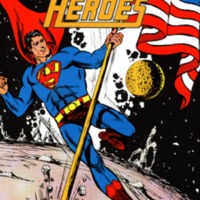
The vibrant-covered forty-first issue of Amazing Heroes was released in February, 1984. The cover features a black sky, with white dots here and there representing stars. In the background, there is a long white streak in the sky as well, behind a yellow, pock-marked planet. In the foreground of the image, penned by Wayne Boring in 1983, is a large beige-colored planet, taking up the bottom quarter of the page. Standing on top of this planet is Superman, in his traditional red-yellow-blue suit, boots, and cape combination, the red “S” prominent on his chest. He is planting an American flag in the ground, and rocks are coming up where he is pushing the flagpole through the ground. Above him, in a muted orange, is the title – Amazing Heroes – and above that in the same color is a single line that reads “No. 41”, followed by “Feb. 15” and “$1.95 ($2.50 in Canada)”. At the very top of the cover is a highlighter-yellow strip with the words “SPECIAL SUPERMAN ISSUE!” over top it in a black font. There is no other text or explanations of what can be found within this issue; Superman is clearly meant to be the star of the show.
Superman’s status is one of legendary proportions; he is arguably the most well-known superhero and comic book figure of all time. From a stronger-than-average alien to a larger-than-life American icon, Superman has endured the test of the time and become engrained in popular culture to epic proportions. This issue of Amazing Heroes was released in the beginning of 1984, towards the end of the Bronze Age of comics, when current events like the Vietnam War, the Berlin Wall, and the presidency of Ronald Reagan were interlaced intrinsically with popular culture. This time period, spanning from roughly 1970 to 1986, was marked with political and social upheaval, along with shifting technological standards and developments. As one of the most blatant examples of American popular culture, Superman’s place on the cover of Amazing Heroes – particularly his symbolic planting of an American flag in the ground of this planet – suggests that he is more than just a beloved character; he is the embodiment of many American ideologies and standards. His creation echoed as much; early editions of Superman comics pointed to him as a moral defender and upstanding citizen. Additionally, his status as a literal alien makes this move on the cover even more meaningful; anyone, immigrant or native, can promote American values and interests. In this time period, within the midst of comics full of anti-heroes, an anti-authoritarian worldview, and increasingly complex philosophies and moral codes, Superman was able to adapt and retain his position as America’s defender. While at this point, Superman’s status as a movie star was debatably more culturally significant than his comic book ties, this cover focuses on his roots: the traditional suit, the America-centrism, and the animation. Wayne Boring’s Amazing Heroes cover is a reminder of where comic culture originated from, and the way it has evolved over time.
Superman’s status is one of legendary proportions; he is arguably the most well-known superhero and comic book figure of all time. From a stronger-than-average alien to a larger-than-life American icon, Superman has endured the test of the time and become engrained in popular culture to epic proportions. This issue of Amazing Heroes was released in the beginning of 1984, towards the end of the Bronze Age of comics, when current events like the Vietnam War, the Berlin Wall, and the presidency of Ronald Reagan were interlaced intrinsically with popular culture. This time period, spanning from roughly 1970 to 1986, was marked with political and social upheaval, along with shifting technological standards and developments. As one of the most blatant examples of American popular culture, Superman’s place on the cover of Amazing Heroes – particularly his symbolic planting of an American flag in the ground of this planet – suggests that he is more than just a beloved character; he is the embodiment of many American ideologies and standards. His creation echoed as much; early editions of Superman comics pointed to him as a moral defender and upstanding citizen. Additionally, his status as a literal alien makes this move on the cover even more meaningful; anyone, immigrant or native, can promote American values and interests. In this time period, within the midst of comics full of anti-heroes, an anti-authoritarian worldview, and increasingly complex philosophies and moral codes, Superman was able to adapt and retain his position as America’s defender. While at this point, Superman’s status as a movie star was debatably more culturally significant than his comic book ties, this cover focuses on his roots: the traditional suit, the America-centrism, and the animation. Wayne Boring’s Amazing Heroes cover is a reminder of where comic culture originated from, and the way it has evolved over time.
Creator
Editorial: Dave Olbrich
Writers: Archie Goodwin, Al Williamson, Steve Freitag, Richard Pachter, Lynn Woolley, Mark Waid, Dwight R. Decker, R.A. Jones, Mark Worden
Cover: Wayne Boring, Mr. Mace
Writers: Archie Goodwin, Al Williamson, Steve Freitag, Richard Pachter, Lynn Woolley, Mark Waid, Dwight R. Decker, R.A. Jones, Mark Worden
Cover: Wayne Boring, Mr. Mace
Source
MSU Special Collection Comic Art, PN6725.A47
Publisher
Redbeard, Inc.
Date
1984-02
Contributor
Holly Simon
Rights
Rights Restriction Apply
Format
10 1/4 x 6 1/8 in.
Language
English
Type
Periodical
Identifier
OMIT
Coverage
1981-1992
Files
Collection
Citation
Editorial: Dave Olbrich
Writers: Archie Goodwin, Al Williamson, Steve Freitag, Richard Pachter, Lynn Woolley, Mark Waid, Dwight R. Decker, R.A. Jones, Mark Worden
Cover: Wayne Boring, Mr. Mace, “Amazing Heroes Issue #41 Cover,” Critical Fanscape, accessed October 17, 2026, https://chambl91.msu.domains/CriticalFanscape/items/show/89.