Amazing Heroes Issue #41 Page 34
Dublin Core
Title
Amazing Heroes Issue #41 Page 34
Subject
Periodical
Comic Strips
Comic Strips
Description
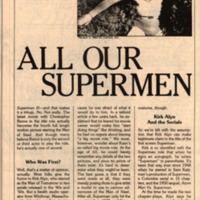
The representative article from the forty-first issue of Amazing Heroes is one that describes the history of Superman in cinema. The top right-hand corner of the page shows a photograph of actor Kirk Alyn, the supposed “first on-screen Superman”, dressed in his iconic costume and looking away from the camera, coming out of some bushes. Below this, the title is written in the center of the page, in a very large font, reading: “ALL OUR SUPERMEN”. This is followed by three paragraphs outlining the origins of Superman on the big screen, setting it up by addressing the latest Superman flick, starring Christopher Reeve, Superman III. It dives into the controversy surrounding who the true “first” Superman was, and in later pages it talked about Superman in other mediums, like television cartoons and on Broadway. Below these three columns, the tagline is in italics and reads “The Man of Steel From Mayo Kaan to Chris Reeve”, with the following line giving us the author – “by Lynn Woolley”. On the lower left-hand side, the page number, 34, is written, and the right-hand side simply says “Amazing Heroes #41”. The entire page is in black and white, with two vertical lines encasing the entirety of the article.
Superman is one of the most well-known and iconic superheroes in the history of comic books. For many people, he is the first character to come to mind when they think of either comics or superheroes. His history, both within and outside of the pages of comic books, is detailed and complex. For many fans, his entire history was unknown; instead, they knew large snippets of his past or the more recent movies. Woolley’s article seeks to provide a comprehensive history of the non-comic book variants of the character, from his time on the Broadway stage to the newly-released Superman III. This thorough overview of the cinematic Superman is a great tool for informing readers, especially younger ones, of the history of this famed hero. It even addresses decades-old controversies, like who the first on-screen Superman was. However, this also paved the way for the popularization of “fanboy”/fandom culture, where fans are tested on their knowledge of their chosen fandom and gatekeeping is rampant. Amazing Heroes itself is a publication geared toward “true fans” – it is purchased by more die-hard fans, whereas many people that viewed the movies were more casual fans of the superhero. The publication and its description/analysis of Superman’s legacy are demonstrative of the origins of “fan culture”, where knowing everything about a character is seen as being of vital importance, and not knowing a certain fact makes one an inferior fan. The issue also features the “toughest” Superman quiz, another move meant to get readers more absorbed into Superman lore and more entrenched in the fan culture. Oftentimes, in addition to often being hostile and “know-it-all”-y, this pervasive culture can be less than welcoming to women; similarly, throughout the article, there are very few references to women involved in the Superman legacy, save for a few references to Lois Lane, his fictional love interest. By excluding women from both these pieces of media and the histories of them, the male-heavy “fanboy” trope becomes more and more closely associated with both Superman and, more broadly, comic books as a whole.
Superman is one of the most well-known and iconic superheroes in the history of comic books. For many people, he is the first character to come to mind when they think of either comics or superheroes. His history, both within and outside of the pages of comic books, is detailed and complex. For many fans, his entire history was unknown; instead, they knew large snippets of his past or the more recent movies. Woolley’s article seeks to provide a comprehensive history of the non-comic book variants of the character, from his time on the Broadway stage to the newly-released Superman III. This thorough overview of the cinematic Superman is a great tool for informing readers, especially younger ones, of the history of this famed hero. It even addresses decades-old controversies, like who the first on-screen Superman was. However, this also paved the way for the popularization of “fanboy”/fandom culture, where fans are tested on their knowledge of their chosen fandom and gatekeeping is rampant. Amazing Heroes itself is a publication geared toward “true fans” – it is purchased by more die-hard fans, whereas many people that viewed the movies were more casual fans of the superhero. The publication and its description/analysis of Superman’s legacy are demonstrative of the origins of “fan culture”, where knowing everything about a character is seen as being of vital importance, and not knowing a certain fact makes one an inferior fan. The issue also features the “toughest” Superman quiz, another move meant to get readers more absorbed into Superman lore and more entrenched in the fan culture. Oftentimes, in addition to often being hostile and “know-it-all”-y, this pervasive culture can be less than welcoming to women; similarly, throughout the article, there are very few references to women involved in the Superman legacy, save for a few references to Lois Lane, his fictional love interest. By excluding women from both these pieces of media and the histories of them, the male-heavy “fanboy” trope becomes more and more closely associated with both Superman and, more broadly, comic books as a whole.
Creator
This piece written by Lynn Woolley.
Editorial: Dave Olbrich
Writers: Archie Goodwin, Al Williamson, Steve Freitag, Richard Pachter, Lynn Woolley, Mark Waid, Dwight R. Decker, R.A. Jones, Mark Worden
Cover: Wayne Boring, Mr. Mace
Editorial: Dave Olbrich
Writers: Archie Goodwin, Al Williamson, Steve Freitag, Richard Pachter, Lynn Woolley, Mark Waid, Dwight R. Decker, R.A. Jones, Mark Worden
Cover: Wayne Boring, Mr. Mace
Source
MSU Special Collection Comic Art, PN6725.A47
Publisher
Redbeard, Inc.
Date
1984-02
Contributor
Holly Simon
Rights
Rights Restriction Apply
Format
10 1/4 x 6 1/8 in.
Language
English
Type
Periodical
Identifier
OMIT
Coverage
1981-1992
Files
Collection
Citation
This piece written by Lynn Woolley.
Editorial: Dave Olbrich
Writers: Archie Goodwin, Al Williamson, Steve Freitag, Richard Pachter, Lynn Woolley, Mark Waid, Dwight R. Decker, R.A. Jones, Mark Worden
Cover: Wayne Boring, Mr. Mace, “Amazing Heroes Issue #41 Page 34,” Critical Fanscape, accessed October 17, 2026, https://chambl91.msu.domains/CriticalFanscape/items/show/91.