Amazing Heroes Issue #5 Pg. 34
Dublin Core
Title
Amazing Heroes Issue #5 Pg. 34
Subject
Periodical
Comic Strips
Comic Strips
Description
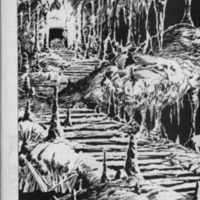
This representative page of issue 5 of the Amazing Heroes fanzine series relates to the issue’s focus on Ka-Zar. It is the first page of Michael Catron’s article, “Exploring Ka-Zar’s Brave New World” (some of the text is cut off because it spans over two pages). In the illustration that completely covers the first page of its two-page spread, a large group of people enters a massive cave, one individual (presumably Ka-Zar) holding a torch high above their head. The dark cave descends into a pool of water at the bottom of a curved staircase. Stalagmites and Stalactites cover the landscape of the cave, causing it to appear more grand and treacherous. The article itself explores Marvel’s reinvention of the hero Ka-Zar and Marvel’s risk-taking in the comics realm, citing the decision to sell Ka-Zar comics exclusively through comics shops (bypassing traditional newsstand distribution) as an example. In discussing the new Ka-Zar (spanning from page thirty-five to page forty-two), Catron provides an interview with Bruce Jones, the new writer, and Brent Anderson, the artist, as well as a very brief history of Ka-Zar, an analysis of the characters of the comics, a look into some of the changes involved, and an introduction of the new settings.
Here, Catron celebrates and criticizes the changes enacted for Ka-Zar comics, providing a fan’s perspective about the gradual transition of the state of comics from the bronze age to the modern age. With the new possibilities resulting from the prospect of direct marketing (allowing comic creators to bypass strict comic codes), creators and fans can move into the new age of comics. Anderson even claims that he wants more feedback and participation from fans, and Amazing Heroes reflects both feedback and participation; the fans have a chance to expand upon content creatively, critique superhero content, and share their ideas in a space specifically organized for them to do so, allowing for cultural and content production that arises from more than just the mainstream comic writers and artists. The exclusivity of comic book and superhero culture is still maintained, but the transfer of information through a purchasable magazine at least opens up the publically transformative realm to fans who may otherwise be unheard or unseen, additionally opening up communication between fans. Fanzines such as Amazing Heroes are also able to introduce critical conversations to the public about content that does not usually receive recognition, like the abundantly available yet lesser discussed works surrounding Ka-Zar, even allowing readers to interact with their favorite content creators through the interviews they conduct. Because the fanzines are not a physical space that people must occupy to participate in, they can be an initial stage in a new fan’s process to more thoroughly understanding fan culture and the comic subjects in which they are interested. Overall, the Amazing Heroes fanzine series provides a look back into the fandom landscape of superhero production and reception of the past, acting as a tool for the progression of fan studies and content reinvention.
Here, Catron celebrates and criticizes the changes enacted for Ka-Zar comics, providing a fan’s perspective about the gradual transition of the state of comics from the bronze age to the modern age. With the new possibilities resulting from the prospect of direct marketing (allowing comic creators to bypass strict comic codes), creators and fans can move into the new age of comics. Anderson even claims that he wants more feedback and participation from fans, and Amazing Heroes reflects both feedback and participation; the fans have a chance to expand upon content creatively, critique superhero content, and share their ideas in a space specifically organized for them to do so, allowing for cultural and content production that arises from more than just the mainstream comic writers and artists. The exclusivity of comic book and superhero culture is still maintained, but the transfer of information through a purchasable magazine at least opens up the publically transformative realm to fans who may otherwise be unheard or unseen, additionally opening up communication between fans. Fanzines such as Amazing Heroes are also able to introduce critical conversations to the public about content that does not usually receive recognition, like the abundantly available yet lesser discussed works surrounding Ka-Zar, even allowing readers to interact with their favorite content creators through the interviews they conduct. Because the fanzines are not a physical space that people must occupy to participate in, they can be an initial stage in a new fan’s process to more thoroughly understanding fan culture and the comic subjects in which they are interested. Overall, the Amazing Heroes fanzine series provides a look back into the fandom landscape of superhero production and reception of the past, acting as a tool for the progression of fan studies and content reinvention.
Creator
Executive Editor: Michael Catron
Art Director: Peppy White
Contributing Writers: Bob Sodaro and David M. Singer
Contributing Artists: Willie Blyberg, Rudi Franke, Mark Heike, Sam de la Rosa, Mark Lamport, Jim McGreal, Mike O'neil, Dan Reed, and Brian James Riedel
Cover Art: Brent Anderson
Art Director: Peppy White
Contributing Writers: Bob Sodaro and David M. Singer
Contributing Artists: Willie Blyberg, Rudi Franke, Mark Heike, Sam de la Rosa, Mark Lamport, Jim McGreal, Mike O'neil, Dan Reed, and Brian James Riedel
Cover Art: Brent Anderson
Source
MSU Special Collection Comic Art, PN6725.A47
Publisher
Zam, Inc.
Date
1981-10
Contributor
Rowan Giffel
Rights
Rights Restrictions Apply
Format
8 3/8" x 10 7/8"
Language
English
Type
Periodical
Coverage
1981-1992
Files
Collection
Citation
Executive Editor: Michael Catron
Art Director: Peppy White
Contributing Writers: Bob Sodaro and David M. Singer
Contributing Artists: Willie Blyberg, Rudi Franke, Mark Heike, Sam de la Rosa, Mark Lamport, Jim McGreal, Mike O'neil, Dan Reed, and Brian James Riedel
Cover Art: Brent Anderson, “Amazing Heroes Issue #5 Pg. 34,” Critical Fanscape, accessed October 17, 2026, https://chambl91.msu.domains/CriticalFanscape/items/show/106.