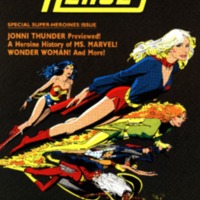
Amazing Heroes Issue #56 Cover
Dublin Core
Title
Amazing Heroes Issue #56 Cover
Subject
Periodical
Comic Strips
Comic Strips
Description
The cover of issue number 56 of the Amazing Heroes fanzine series, illustrated by Kevin Nowlan, features prominent female superheroes soaring across a forest green backdrop, some angled up, some down, and some flying fairly horizontally. The heroines appear to be flying from the left of the page to the right as a pack. Among those included in flight are DC Comics' Wonder Woman, Hawkgirl, Wonder Girl, Power Girl, and Supergirl as well as Marvel Comics Group's Ms. Marvel, Storm, and Spider-Woman. Supergirl secures the foreground, illustrated to be the largest as well as the most centered on the page, while Wonder Woman flies slightly behind her, more isolated than the rest of the heroines. Supergirl's gaze seems to be transfixed on the viewer, and Wonder Woman appears to be glancing at Supergirl, but the others seem to be looking forward in the direction in which they are flying. The other heroines are pictured below Wonder Woman and Supergirl. Yellow “Amazing Heroes” text rests in bold at the top of the page. The cover promises to be a “Special Superheroines Issue” that previews Jonni Thunder and the Supergirl movie and presents a “heroine history” of Ms. Marvel, Wonder Woman, and more.
This issue was published at a time in which the heroines described were mostly well-established in mainstream comics (many of them having emerged in the 1970s), and though comics have consistently lacked female representation (especially positive female representation), there is (and was) clearly an audience for comics and other superhero content for women, by women, and/or about women. Heroes like Wonder Woman, for example, became identified with the feminist movement, providing a role model for young women and girls and reflecting an emphasis on female power. However, Wonder Woman does not address many concerns of what would now be considered third wave feminism. Much of the superhero content during the time of this issue’s publication (in the 1980s), including Wonder Woman, lacked an emphasis on intersectionality, neglecting to accurately and diversely represent Black women, Latina women, LGBTQ+ people, and other intersectional minorities, frequently using oppressed minorities as a tool for displaying the heroes’ dedication to saving the “less fortunate.” Occasionally, though, some progressive ideology would arise (even if it was not exactly ideal), like with Wonder Woman’s activism or with Storm’s inclusion in the X-Men. However, even though most Marvel teams had at least one female member, the female members were always subordinate to the team’s male heroes, and many comics of the time (Wonder Woman included) reinforced racism. This white, hegemonic feminism was distributed commonly among not just comics, but also films, novels, shows, and the news during this time. Second wave feminism led to the media that praises these hegemonies (creators pander to fans’ cultural values) while the media further support the movement (fans learn about these movements through their favorite pieces).
This issue was published at a time in which the heroines described were mostly well-established in mainstream comics (many of them having emerged in the 1970s), and though comics have consistently lacked female representation (especially positive female representation), there is (and was) clearly an audience for comics and other superhero content for women, by women, and/or about women. Heroes like Wonder Woman, for example, became identified with the feminist movement, providing a role model for young women and girls and reflecting an emphasis on female power. However, Wonder Woman does not address many concerns of what would now be considered third wave feminism. Much of the superhero content during the time of this issue’s publication (in the 1980s), including Wonder Woman, lacked an emphasis on intersectionality, neglecting to accurately and diversely represent Black women, Latina women, LGBTQ+ people, and other intersectional minorities, frequently using oppressed minorities as a tool for displaying the heroes’ dedication to saving the “less fortunate.” Occasionally, though, some progressive ideology would arise (even if it was not exactly ideal), like with Wonder Woman’s activism or with Storm’s inclusion in the X-Men. However, even though most Marvel teams had at least one female member, the female members were always subordinate to the team’s male heroes, and many comics of the time (Wonder Woman included) reinforced racism. This white, hegemonic feminism was distributed commonly among not just comics, but also films, novels, shows, and the news during this time. Second wave feminism led to the media that praises these hegemonies (creators pander to fans’ cultural values) while the media further support the movement (fans learn about these movements through their favorite pieces).
Creator
Executive Editor: Kim Thompson
Art Director: Peppy White
Contributing Writers: Dave Olbrich, Archie Goodwin, Al Williamson, J. Collier, Dan Deusche, Steve Freitag, R.A. Jones, Thomas Long, and Lon M. Rovner
Cover Art: Kevin Nowlan
Art Director: Peppy White
Contributing Writers: Dave Olbrich, Archie Goodwin, Al Williamson, J. Collier, Dan Deusche, Steve Freitag, R.A. Jones, Thomas Long, and Lon M. Rovner
Cover Art: Kevin Nowlan
Source
MSU Special Collection Comic Art, PN6725.A47
Publisher
Redbeard, Inc.
Date
1984-10
Contributor
Rowan Giffel
Rights
Rights Restrictions Apply
Format
6 5/8 x 10 1/4 in., color
Language
English
Type
Periodical
Coverage
1981-1992
Files
Collection
Citation
Executive Editor: Kim Thompson
Art Director: Peppy White
Contributing Writers: Dave Olbrich, Archie Goodwin, Al Williamson, J. Collier, Dan Deusche, Steve Freitag, R.A. Jones, Thomas Long, and Lon M. Rovner
Cover Art: Kevin Nowlan, “Amazing Heroes Issue #56 Cover,” Critical Fanscape, accessed October 17, 2026, https://chambl91.msu.domains/CriticalFanscape/items/show/107.