Amazing Heroes Issue #56 Table of Contents
Dublin Core
Title
Amazing Heroes Issue #56 Table of Contents
Subject
Periodical
Comic Strips
Comic Strips
Description
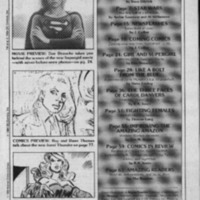
The table of contents of issue 56 of the Amazing Heroes fanzine depicts three feature articles for the issue: Dan Deusche's movie preview of the new (at the time) Supergirl movie on page 24 (in the top left of the table of contents), A comics preview of Jonni Thunder with Roy and Dann Thomas on page 77 (in the middle left), and the main feature article in which Thomas Long discusses Marvel's “mightiest” super-heroines, which also begins on page 77 (in the bottom left). The featured articles' table of contents lines are further explained by an art panel above each, the foremost a photograph of the actress portraying Supergirl in the movie, the latter two relevant clips of comic panels. The other articles listed include an editorial about Star Wars, Star Hawks, and more by Dave Olbrich, a mini-epic of Star Wars by Archie Goodwin and Al Williamson, newsflashes and comics previews by J. Collier, an examination of Carol Danvers by R.A. Jones, a look at Marvel's heroines by Thomas Long, a review of Wonder Woman by Lon M. Rovner, comic reviews by R.A. Jones, and a section of write-ins from readers. The date of publication (October 1, 1984) can be found in the upper right corner of the page.
The culture surrounding these comics is contradictorily encapsulated by both second-wave feminism and by a resistance to feminism altogether. Whereas this issue’s superheroine focus displays an appreciation for attempts to be inclusive and representative, the superhero comics and films (and fan responses to the comics/films) are still lacking in female diversity and in racial representation, sometimes maintaining hegemonic white feminism at the expense of multiracial or intersectional feminism. According to historian and critic Jennifer K. Stuller, female superheroes are often differentiated from male superheroes on the three premises of collaboration, love, and mentorship. This construction places limits on female heroes that are not prevalent in the same ways for male heroes, often reinforcing harmful stereotypes and limiting the superhero genre overall. One of the ways in which this is true can be seen through one of the works featured in this issue; in the Supergirl film of 1984, Supergirl is mentored by a man named Peter O’Toole (who has more influence over her than even her parents). Rather than being mentored by other women, many of the instances of mentorship (which is common for female superheroes) involve men leading women, making female superheroes subordinate to a male higher in the manufactured hierarchy. A review of the film published shortly after the film’s release in 1984 highlights the aforementioned three premises in explaining aspects of the film related to the heroine herself, depicting Supergirl’s mentorship and companionship with O’Toole and her love with Ethan. Though Supergirl was somewhat of an attempt to reach young female readers (in which it arguably succeeded), the representation aligns best, still, with the second wave feminism frequently associated with the time period.
The culture surrounding these comics is contradictorily encapsulated by both second-wave feminism and by a resistance to feminism altogether. Whereas this issue’s superheroine focus displays an appreciation for attempts to be inclusive and representative, the superhero comics and films (and fan responses to the comics/films) are still lacking in female diversity and in racial representation, sometimes maintaining hegemonic white feminism at the expense of multiracial or intersectional feminism. According to historian and critic Jennifer K. Stuller, female superheroes are often differentiated from male superheroes on the three premises of collaboration, love, and mentorship. This construction places limits on female heroes that are not prevalent in the same ways for male heroes, often reinforcing harmful stereotypes and limiting the superhero genre overall. One of the ways in which this is true can be seen through one of the works featured in this issue; in the Supergirl film of 1984, Supergirl is mentored by a man named Peter O’Toole (who has more influence over her than even her parents). Rather than being mentored by other women, many of the instances of mentorship (which is common for female superheroes) involve men leading women, making female superheroes subordinate to a male higher in the manufactured hierarchy. A review of the film published shortly after the film’s release in 1984 highlights the aforementioned three premises in explaining aspects of the film related to the heroine herself, depicting Supergirl’s mentorship and companionship with O’Toole and her love with Ethan. Though Supergirl was somewhat of an attempt to reach young female readers (in which it arguably succeeded), the representation aligns best, still, with the second wave feminism frequently associated with the time period.
Creator
Executive Editor: Kim Thompson
Art Director: Peppy White
Contributing Writers: Dave Olbrich, Archie Goodwin, Al Williamson, J. Collier, Dan Deusche, Steve Freitag, R.A. Jones, Thomas Long, and Lon M. Rovner
Cover Art: Kevin Nowlan
Art Director: Peppy White
Contributing Writers: Dave Olbrich, Archie Goodwin, Al Williamson, J. Collier, Dan Deusche, Steve Freitag, R.A. Jones, Thomas Long, and Lon M. Rovner
Cover Art: Kevin Nowlan
Source
MSU Special Collection Comic Art, PN6725.A47
Publisher
Redbeard, Inc.
Date
1984-10
Contributor
Rowan Giffel
Rights
Rights Restrictions Apply
Format
6 5/8 x 10 1/4 in.
Language
English
Type
Periodical
Coverage
1981-1992
Files
Collection
Citation
Executive Editor: Kim Thompson
Art Director: Peppy White
Contributing Writers: Dave Olbrich, Archie Goodwin, Al Williamson, J. Collier, Dan Deusche, Steve Freitag, R.A. Jones, Thomas Long, and Lon M. Rovner
Cover Art: Kevin Nowlan, “Amazing Heroes Issue #56 Table of Contents,” Critical Fanscape, accessed October 17, 2026, https://chambl91.msu.domains/CriticalFanscape/items/show/108.