Amazing Heroes Issue #181 Pg. 27
Dublin Core
Title
Amazing Heroes Issue #181 Pg. 27
Subject
Periodical
Comic Strips
Comic Strips
Description
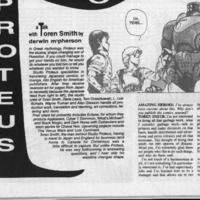
This page of Amazing Heroes (issue 181) begins Darwin McPherson’s article, “Inside Studio Proteus: a Talk with Toren Smith.” In the interview, McPherson and Toren discuss Toren’s work and interests, particularly Toren’s comic production strategies and the manga and comics in which he is interested. Toren mentions, for one, that he has little to no interest in publishing comics himself -- His interests are in production and, though he does not wish to enter into a business situation, writing. In fact, Toren finds publishing to be a boring process. When asked about superheroes, a common general theme of the fanzine series, Toren revealed that he thinks that a lot of interesting things can be done with superhero comics, though he does not read them much (particularly not the mainstream ones). Toren does explain, though, that he finds origin stories important, even if the first one is not up to the highest standards (as long as the story after is well written, drawn, and produced), and the two briefly discuss Japanese superhero comics. Also mentioned is the language barrier that comes from reading manga as someone who struggles with reading Japanese (though Toren likes to read in both Japanese and English), along with the sentiment that reading in English is more relaxing for Toren for this reason.
A conclusion to be drawn from this discussion is the change in content through translation. With anime and manga becoming more popular in the United States, translation forms and production teams like that of Toren are important to consider. What is not discussed in the interview, however, is the extent to which the translation of Japanese manga can become problematic. Though Studio Proteus is a production company, many fans (such as the audience to which Amazing Heroes is addressed) of manga perform scanlation or fan translations, which they then redistribute online for free. While this action is not inherently problematic (with capitalist ethics and copyright laws aside), it does raise questions of who translates the work. There are many ways in which the translation can go awry, especially without cultural awareness of Japan, While there are techniques for comics’ translation in existence (such as Klaus Kaindl’s typology), these are not exactly applicable to scanlations. Essentially, the question of cultural awareness is a big one in translation, especially for content that is being translated for consumption by a country that has historically either stereotyped and defamed or exoticized and commodified the culture of the language being translated. With the shift from Japanese manga from the comics category (as it appears to be a part of at the time of this publication) to the book genre, the works become less exclusive. They are no longer hidden within an exclusive community, and their accessibility has aided their popularity. Since genres guide interpretation, though, and fans have become more involved in the culture, translations have likely shifted as well.
A conclusion to be drawn from this discussion is the change in content through translation. With anime and manga becoming more popular in the United States, translation forms and production teams like that of Toren are important to consider. What is not discussed in the interview, however, is the extent to which the translation of Japanese manga can become problematic. Though Studio Proteus is a production company, many fans (such as the audience to which Amazing Heroes is addressed) of manga perform scanlation or fan translations, which they then redistribute online for free. While this action is not inherently problematic (with capitalist ethics and copyright laws aside), it does raise questions of who translates the work. There are many ways in which the translation can go awry, especially without cultural awareness of Japan, While there are techniques for comics’ translation in existence (such as Klaus Kaindl’s typology), these are not exactly applicable to scanlations. Essentially, the question of cultural awareness is a big one in translation, especially for content that is being translated for consumption by a country that has historically either stereotyped and defamed or exoticized and commodified the culture of the language being translated. With the shift from Japanese manga from the comics category (as it appears to be a part of at the time of this publication) to the book genre, the works become less exclusive. They are no longer hidden within an exclusive community, and their accessibility has aided their popularity. Since genres guide interpretation, though, and fans have become more involved in the culture, translations have likely shifted as well.
Creator
Executive Editor: Kim Thompson
Managing Editor: Thomas Harrington
Art Director: Mark Thompson
News Correspondent: George Kaplan
Production Assistance: Roberta Gregory
Typesetting/Proofreading: Craig Maynard
Circulation: Michelle Byrd and Sharon Kingsford
Contributing Writers: Joe Filice, Andy Mangels, Korkis and Cawley, Hal Hargit, Adam-Troy Castro, Dave Strom, Darwin McPherson, Steven Miller, and Robert T. Jeschonek
Cover Art: Yoshikazu Yasuhiko
Managing Editor: Thomas Harrington
Art Director: Mark Thompson
News Correspondent: George Kaplan
Production Assistance: Roberta Gregory
Typesetting/Proofreading: Craig Maynard
Circulation: Michelle Byrd and Sharon Kingsford
Contributing Writers: Joe Filice, Andy Mangels, Korkis and Cawley, Hal Hargit, Adam-Troy Castro, Dave Strom, Darwin McPherson, Steven Miller, and Robert T. Jeschonek
Cover Art: Yoshikazu Yasuhiko
Source
MSU Special Collection Comic Art, PN6725.A47
Publisher
Fantagraphics Books, Inc.
Date
1990-07
Contributor
Rowan Giffel
Rights
Rights Restrictions Apply
Format
6 5/8 x 10 1/4 in.
Language
English
Type
Periodical
Coverage
1981-1992
Files
Collection
Citation
Executive Editor: Kim Thompson
Managing Editor: Thomas Harrington
Art Director: Mark Thompson
News Correspondent: George Kaplan
Production Assistance: Roberta Gregory
Typesetting/Proofreading: Craig Maynard
Circulation: Michelle Byrd and Sharon Kingsford
Contributing Writers: Joe Filice, Andy Mangels, Korkis and Cawley, Hal Hargit, Adam-Troy Castro, Dave Strom, Darwin McPherson, Steven Miller, and Robert T. Jeschonek
Cover Art: Yoshikazu Yasuhiko, “Amazing Heroes Issue #181 Pg. 27,” Critical Fanscape, accessed October 17, 2026, https://chambl91.msu.domains/CriticalFanscape/items/show/112.