Amazing Heroes Issue #10 Cover
Dublin Core
Title
Amazing Heroes Issue #10 Cover
Subject
Periodical
Comic Strips
Comic Strips
Description
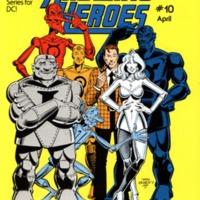
The cover of Amazing Heroes Issue #10 displays a drawing by Terry Austin of the DC superhero group known as the Metal Men. There is a solid yellow background. The team’s leader, Gold, and the other members Mercury, Platinum, Lead, Iron, and Tin, are shown, along with the groups’ scientist creator, Doc Magnus. The robots are all standing in heroic positions, except for Tin, who is much smaller and peeks out from behind Lead’s leg. There is only one female robot, Platinum, who, unlike her teammates, has a full head of hair and wears high heels. The caption/headline states “This Issue: The History of the Metal Men,” implying that the fanzine will include a special article featuring the superhero team’s creative development in addition to descriptions of their various appearances in different comics. There is also an announcement saying that comic book creator Frank Miller will do a new series for DC comics.
The evolution of the Metal Men is reflective of changes in the comic book industry at large. The group was first created in one weekend by Robert Kanigher and Ross Andru in 1962, after another story was canceled. During this period, the comics industry was focused on creating characters that seemed like real people, with emotions and problems. The Metal Men had different personalities that often clashed, which audience found both relatable and entertaining. Platinum dealt with her unreciprocated love for Doc Magnus, conforming to depictions of female superheroes as associated with love. In the 1970s, America entered a period of social and political turmoil, and comic book companies were focused on releasing titles that were “relevant” to the issues of society. The Metal Men were a DC publication, which was the more conservative of the two big comics publishing companies, and thus did not make explicit commentary on the world’s problems. The team was funded by the US government and often went on missions at the military’s request. However, new editor Mike Sekowsky changed the tone of the series, writing stories with more dark and unexplainable supernatural elements, and the series was canceled shortly thereafter. The series dealt with the question of technology, dealing with circumstances in which science was used for both good and evil purposes. Doc Magnus, the team’s creator, wanted to give the robot’s human characteristics. However, due to the nature of Aurora Borealis at the time of their creation, the robots ended up with human emotions as well. This leads to a lot of bickering between the different characters and creates questions about whether the Metal Men should be considered robots or humans. Additionally, many of the villains that the superhero group battles, such as Chemo, are also results of technology, therefore depicting the negative side of scientific experimentation. DC’s Metal Men are important because they reflected trends in the comic book industry and questions about technological advancements.
The evolution of the Metal Men is reflective of changes in the comic book industry at large. The group was first created in one weekend by Robert Kanigher and Ross Andru in 1962, after another story was canceled. During this period, the comics industry was focused on creating characters that seemed like real people, with emotions and problems. The Metal Men had different personalities that often clashed, which audience found both relatable and entertaining. Platinum dealt with her unreciprocated love for Doc Magnus, conforming to depictions of female superheroes as associated with love. In the 1970s, America entered a period of social and political turmoil, and comic book companies were focused on releasing titles that were “relevant” to the issues of society. The Metal Men were a DC publication, which was the more conservative of the two big comics publishing companies, and thus did not make explicit commentary on the world’s problems. The team was funded by the US government and often went on missions at the military’s request. However, new editor Mike Sekowsky changed the tone of the series, writing stories with more dark and unexplainable supernatural elements, and the series was canceled shortly thereafter. The series dealt with the question of technology, dealing with circumstances in which science was used for both good and evil purposes. Doc Magnus, the team’s creator, wanted to give the robot’s human characteristics. However, due to the nature of Aurora Borealis at the time of their creation, the robots ended up with human emotions as well. This leads to a lot of bickering between the different characters and creates questions about whether the Metal Men should be considered robots or humans. Additionally, many of the villains that the superhero group battles, such as Chemo, are also results of technology, therefore depicting the negative side of scientific experimentation. DC’s Metal Men are important because they reflected trends in the comic book industry and questions about technological advancements.
Creator
Editor: Kim Thompson
Assistant Editor: J. Collier
Contributing Writers: Dwight R. Decker, George Guay, Jim Korkis, Mindy McAdams, Gene Reed
Consulting Editor: Dwight R. Decker
Art Director: Peppy White
Contributing Artists: Bret Blevins, Denys Cowan, Nequi Dharsee, Rudi Franke, Pat Gabriele, 'Bert Hernandez, Gary Kwapisz, Branko Matkovic, Kevin Nowlan, Sam de la Rosa, Don Rosa
Advertising: J. Michael Catron
Assistant Editor: J. Collier
Contributing Writers: Dwight R. Decker, George Guay, Jim Korkis, Mindy McAdams, Gene Reed
Consulting Editor: Dwight R. Decker
Art Director: Peppy White
Contributing Artists: Bret Blevins, Denys Cowan, Nequi Dharsee, Rudi Franke, Pat Gabriele, 'Bert Hernandez, Gary Kwapisz, Branko Matkovic, Kevin Nowlan, Sam de la Rosa, Don Rosa
Advertising: J. Michael Catron
Source
MSU Special Collection Comic Art, PN6725.A47
Publisher
Redbeard Inc.
Date
1982-04
Contributor
Sarah M Geist
Rights
Rights Restriction Apply
Format
8 3/8 inches by 10 7/8 inches
Language
English
Type
Periodical
Coverage
1981-1992
Files
Collection
Citation
Editor: Kim Thompson
Assistant Editor: J. Collier
Contributing Writers: Dwight R. Decker, George Guay, Jim Korkis, Mindy McAdams, Gene Reed
Consulting Editor: Dwight R. Decker
Art Director: Peppy White
Contributing Artists: Bret Blevins, Denys Cowan, Nequi Dharsee, Rudi Franke, Pat Gabriele, 'Bert Hernandez, Gary Kwapisz, Branko Matkovic, Kevin Nowlan, Sam de la Rosa, Don Rosa
Advertising: J. Michael Catron, “Amazing Heroes Issue #10 Cover,” Critical Fanscape, accessed October 17, 2026, https://chambl91.msu.domains/CriticalFanscape/items/show/15.