Amazing Heroes Issue #10 Table of Contents
Dublin Core
Title
Amazing Heroes Issue #10 Table of Contents
Subject
Periodical
Comic Strips
Comic Strips
Description
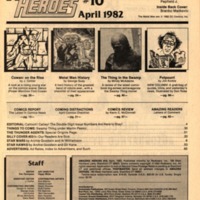
The table of contents of Amazing Heroes Issue #10 contains thumbnails of the featured articles in addition to a traditional list of the other items within the fanzine. The featured pieces include: an article titled “Cowan: on the Rise,” about the up and coming comic book writer Denys Cowan and accompanied by a small image of the character Iron Fist; “Metal Men History,” picturing the superhero team engaged in battle with lead having become much larger than the other characters; “The Thing in the Swamp,” a review of the upcoming movie and an image of the film’s main character; and “Potpourri,” a new column with fun facts and quotes about comics, showing a cartoon man-eating both a sandwich and a comic book. The items that are included in each issue are “Comics Report,” “Coming Distractions,” “Comics Review,” and “Amazing Readers.” The rest of the table of contents includes the editorial, “Callooh! Callay! The Double Digit Issue Numbers Are Here to Stay!” and other pieces like “Things to Come: Swamp Thing under Martin Pasko,” “The Thunder Agents: Special Origins Page,” “Silly Cover #23 ½: Our Readers Are Sick,” “Star Wars” and “Star Hawks” comic strips, and “Advertising.” The articles do not appear in order. The bottom of the page contains staff information.
Vertigo’s Swamp Thing is representative of the comic book industry’s efforts to expand into other genres beyond superheroes. In the film based on the comic, “The Thing in the Swamp,” a woman falls in love with a monster that is part plant and part human. Both the comic and the film draw upon the horror genre, particularly taking advantage of the repulsion and fear that people experience upon seeing plant life become humanoid and/or life-like. In particular, plant horror monsters so terrify society because they blur the lines between the animate and the inanimate and have the potential to grow almost limitlessly. The comic book character was part of DC’s Vertigo line, which was directed at more mature audiences and disregarded most of the requirements of the Comics Code Authority. Many publishers were able to avoid the restrictions because buyers of comic books were increasingly becoming specialized fans rather than the average person at a newsstand. The T.H.U.N.D.E.R. Agents are also representative of the expansion of the industry. The T.H.U.N.D.E.R. Agents belonged to a small publishing company called Tower Comics, one of the many smaller companies that attempted to enter the comic book market during the 1960s. Unfortunately, it was Tower’s only successful title and the company canceled its last comic book in 1970, leading to a debate between many different publishers over the rights to the superhero team. This is reflective of the comic book industry’s focus on profit and capitalism, in addition to its ability to reuse and redevelop titles throughout the years. Several publishers attempted to take advantage of and profit from the T.H.U.N.D.E.R. Agents, with a high of eight different titles by five different publishers being produced at the same time. Vertigo’s Swamp Thing and Tower’s T.H.U.N.D.E.R. Agents are important because they represent the growth of the comic book industry.
Vertigo’s Swamp Thing is representative of the comic book industry’s efforts to expand into other genres beyond superheroes. In the film based on the comic, “The Thing in the Swamp,” a woman falls in love with a monster that is part plant and part human. Both the comic and the film draw upon the horror genre, particularly taking advantage of the repulsion and fear that people experience upon seeing plant life become humanoid and/or life-like. In particular, plant horror monsters so terrify society because they blur the lines between the animate and the inanimate and have the potential to grow almost limitlessly. The comic book character was part of DC’s Vertigo line, which was directed at more mature audiences and disregarded most of the requirements of the Comics Code Authority. Many publishers were able to avoid the restrictions because buyers of comic books were increasingly becoming specialized fans rather than the average person at a newsstand. The T.H.U.N.D.E.R. Agents are also representative of the expansion of the industry. The T.H.U.N.D.E.R. Agents belonged to a small publishing company called Tower Comics, one of the many smaller companies that attempted to enter the comic book market during the 1960s. Unfortunately, it was Tower’s only successful title and the company canceled its last comic book in 1970, leading to a debate between many different publishers over the rights to the superhero team. This is reflective of the comic book industry’s focus on profit and capitalism, in addition to its ability to reuse and redevelop titles throughout the years. Several publishers attempted to take advantage of and profit from the T.H.U.N.D.E.R. Agents, with a high of eight different titles by five different publishers being produced at the same time. Vertigo’s Swamp Thing and Tower’s T.H.U.N.D.E.R. Agents are important because they represent the growth of the comic book industry.
Creator
Editor: Kim Thompson
Assistant Editor: J. Collier
Contributing Writers: Dwight R. Decker, George Guay, Jim Korkis, Mindy McAdams, Gene Reed
Consulting Editor: Dwight R. Decker
Art Director: Peppy White
Contributing Artists: Bret Blevins, Denys Cowan, Nequi Dharsee, Rudi Franke, Pat Gabriele, 'Bert Hernandez, Gary Kwapisz, Branko Matkovic, Kevin Nowlan, Sam de la Rosa, Don Rosa
Advertising: J. Michael Catron
Assistant Editor: J. Collier
Contributing Writers: Dwight R. Decker, George Guay, Jim Korkis, Mindy McAdams, Gene Reed
Consulting Editor: Dwight R. Decker
Art Director: Peppy White
Contributing Artists: Bret Blevins, Denys Cowan, Nequi Dharsee, Rudi Franke, Pat Gabriele, 'Bert Hernandez, Gary Kwapisz, Branko Matkovic, Kevin Nowlan, Sam de la Rosa, Don Rosa
Advertising: J. Michael Catron
Source
MSU Special Collection Comic Art, PN6725.A47
Publisher
Redbeard Inc.
Date
1982-04
Contributor
Sarah M Geist
Rights
Rights Restriction Apply
Format
8 3/8 inches by 10 7/8 inches
Language
English
Type
Periodical
Coverage
1981-1992
Files
Collection
Citation
Editor: Kim Thompson
Assistant Editor: J. Collier
Contributing Writers: Dwight R. Decker, George Guay, Jim Korkis, Mindy McAdams, Gene Reed
Consulting Editor: Dwight R. Decker
Art Director: Peppy White
Contributing Artists: Bret Blevins, Denys Cowan, Nequi Dharsee, Rudi Franke, Pat Gabriele, 'Bert Hernandez, Gary Kwapisz, Branko Matkovic, Kevin Nowlan, Sam de la Rosa, Don Rosa
Advertising: J. Michael Catron, “Amazing Heroes Issue #10 Table of Contents,” Critical Fanscape, accessed October 17, 2026, https://chambl91.msu.domains/CriticalFanscape/items/show/16.