Amazing Heroes Issue #12— Cover
Dublin Core
Title
Amazing Heroes Issue #12— Cover
Subject
Periodical
Comic Strips
Comic Strips
Description
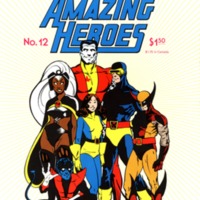
The cover of Amazing Heroes issue 12 has “Amazing Heroes” centered on the top of the page in large blue letters. Directly above it in red, it says “This Issue: An Exclusive, Illustrated Interview with The X-Men’s New Superstar Artist: Paul Smith!” On the sides of it in red, it says “No. 12” and denotes that it costs $1.50 in the United States and $1.75 in Canada. The background of the cover is white with yellow lines bursting out from the middle. The central focus of the cover is the X-Men themselves. It features Wolverine, Cyclops, Storm, and Beast, among other heroes as well. They’re all dressed in their respective uniforms, which are in printed in the vibrant colors of blue, yellow, orange, red, and some brown. There are six of them total, and they’re standing in a way that makes them look as if they are team prepared to fight. There is a small, orange box in the bottom left part of the image that says “PMS 4-82.” The cover is relatively simply, letting the X-Men stand alone with little distraction.
The purpose of having the X-Men on the cover is to show diversity. In the beginning of the Amazing Heroes series, many of the issues were not specifically tailored to a specific audience of people. Putting the X-Men on the cover is a strategic choice to cater to all audiences, being that in the article “The Racial Politics of X-Men” by Mikhail Lyubansky, he discusses how the series connects the ideas of oppressed mutants and those of marginalized groups, along with bringing into discussion the ideas of tolerance and inclusivity. The second portion of the last sentence is key— pressing the importance of those two makes all readers feel welcomed when they first view this comic. Additionally, in the journal article titled “’A Choice of Weapons’: The X-Men and the Metaphor for Approaches to Racial Equality,” authors Gregory S. Parks and Matthew W. Hughey discusses how the X-Men series brings the topic of race in America into question, and how they portray the “otherness” that society feels others are deemed if they’re not specifically white. Representing a minority group may help Asian, black, Latinx, etc. readers feel welcomed— but because some of the X-Men are white too, it does still make white readers feel welcomed. Proving this point further, in “Who Gets To Be A Superhero? Race and Identity In Comics” by Gene Demby through NPR, Demby initially discusses the cultural importance of the X-Men, and how they’ve often been redrawn to be presented as different races— a form of race-bending. Done by professional comic drawers and fans alike, both feel as if they can connect with the X-Men due to their general adaptability and connection to isolated groups. In Comic Book Nation: The Transformation of Youth Culture in America by Bradford W. Wright, Wright notes how the mutants were faced with the issue of being feared by the society they most deeply sought to defend (and had low sales, especially at its inception), but that this actually fit the Marvel formula perfectly. Bringing in strong female characters, like Storm, in the X-Men series appealed to the female crowd of readers as well. The undermined and repressed found consolation in the X-Men, so putting them on the cover of an initial issue was a smart move to draw new (and old) readers in.
The purpose of having the X-Men on the cover is to show diversity. In the beginning of the Amazing Heroes series, many of the issues were not specifically tailored to a specific audience of people. Putting the X-Men on the cover is a strategic choice to cater to all audiences, being that in the article “The Racial Politics of X-Men” by Mikhail Lyubansky, he discusses how the series connects the ideas of oppressed mutants and those of marginalized groups, along with bringing into discussion the ideas of tolerance and inclusivity. The second portion of the last sentence is key— pressing the importance of those two makes all readers feel welcomed when they first view this comic. Additionally, in the journal article titled “’A Choice of Weapons’: The X-Men and the Metaphor for Approaches to Racial Equality,” authors Gregory S. Parks and Matthew W. Hughey discusses how the X-Men series brings the topic of race in America into question, and how they portray the “otherness” that society feels others are deemed if they’re not specifically white. Representing a minority group may help Asian, black, Latinx, etc. readers feel welcomed— but because some of the X-Men are white too, it does still make white readers feel welcomed. Proving this point further, in “Who Gets To Be A Superhero? Race and Identity In Comics” by Gene Demby through NPR, Demby initially discusses the cultural importance of the X-Men, and how they’ve often been redrawn to be presented as different races— a form of race-bending. Done by professional comic drawers and fans alike, both feel as if they can connect with the X-Men due to their general adaptability and connection to isolated groups. In Comic Book Nation: The Transformation of Youth Culture in America by Bradford W. Wright, Wright notes how the mutants were faced with the issue of being feared by the society they most deeply sought to defend (and had low sales, especially at its inception), but that this actually fit the Marvel formula perfectly. Bringing in strong female characters, like Storm, in the X-Men series appealed to the female crowd of readers as well. The undermined and repressed found consolation in the X-Men, so putting them on the cover of an initial issue was a smart move to draw new (and old) readers in.
Creator
Kim Thompson, Peppy White, J. Collier, Tom Mason, Dwight R. Decker, Jim Korkis, Mindy McAdams, Lou Mougin, Gene Reed, Jeff Albrecht, Mike Cogliandro, Nequi Dharsee, Rudi Franke, Gary Kwapisz, Kevin Nowlan, Sam de la Rosa, Don Rosa, J. Michael Catron
Source
MSU Special Collections Comic Art, PN6725.A47
Publisher
Redbeard, Inc.
Date
June 1982
Contributor
Autumn Miller
Rights
All rights reserved
Relation
-http://chambl91.msu.domains/CriticalFanscape/items/show/25 (Table of Contents)
-http://chambl91.msu.domains/CriticalFanscape/items/show/26 (Representative Page)
-http://chambl91.msu.domains/CriticalFanscape/items/show/26 (Representative Page)
Format
Comic (Magazine size), 8.5x11 inches, color
Language
English
Type
Periodical
Coverage
1981-1992
Files
Collection
Citation
Kim Thompson, Peppy White, J. Collier, Tom Mason, Dwight R. Decker, Jim Korkis, Mindy McAdams, Lou Mougin, Gene Reed, Jeff Albrecht, Mike Cogliandro, Nequi Dharsee, Rudi Franke, Gary Kwapisz, Kevin Nowlan, Sam de la Rosa, Don Rosa, J. Michael Catron, “Amazing Heroes Issue #12— Cover,” Critical Fanscape, accessed October 17, 2026, https://chambl91.msu.domains/CriticalFanscape/items/show/24.