Amazing Heroes Issue #12— Table of Contents
Dublin Core
Title
Amazing Heroes Issue #12— Table of Contents
Subject
Periodical
Comic Strips
Comic Strips
Description
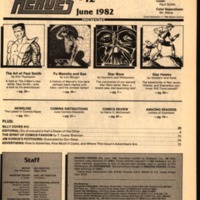
The table of contents of Amazing Heroes issue 12 features a header in the top left-hand corner that says “Amazing Heroes” in bolded letters. Next to it, it has “#12” to denote that it’s issue 12, and below the this it says “June 1982,” denoting when it was published. Below this header, there’s a row consisting of four small drawings that go along with articles in the comic. Along with the drawing, it says the name of the article, the article, a brief description of the article, and the page number it can be found on. The four articles are “The Art of Paul Smith” by Kim Thompson, “Fu Manchu and Son” by Lou Mougin, “Star Wars” by Goodwin and Williamson, and “Star Hawks” by Goodwin and Kane. Below these featured articles, there’s a bolded line dividing the page. Directly below this line, four other articles are listed in a line, with the author/article type and page number listed below it. Below this section, it says “Plus:” with other, smaller articles that are featured in the comic as well. On the bottom of the page in two greyed-out boxes, it has a section where all of the staff who helped create the comic is listed, along with publishing and distribution information. The entire page is printed in black and white.
The Contents page is a perfect representation of what the comic you’ll be reading will contain. The headlining articles I mentioned before are crucial in shaping this page into what it is. One of the headlining articles on the Contents page is “The Art of Paul Smith” by Kim Thompson. In further research on Smith, according to his website, paulmartinsmith.com, Smith was involved in working on a final chapter of an X-Men story, and eventually worked on the art for both Uncanny X-Men, issues #165-#175 of X-Men, and had his work reprinted in Essential X-men, Vol. 4. He would also revisit X-Men later on too. His importance within the series makes this article relevant in the Contents section, being that it’s highly connected to the cover. Including an artist who was crucial in the X-Men series creates for an ideal article in this issue, serving as a connector, especially when Amazing Heroes still hadn’t begun tailoring its issues on certain topics. There is also a headlining article titled “Star Hawks” by Goodwin and Kane. Looking into this series further due to having no knowledge about it prior, Star Hawks' page on Penguin Random House revealed that the series hailed from the 1970s and was a science fiction newspaper strip created by Ron Goulart and Gil Kane (one of the authors of the Amazing Heroes articles as well). Being that not many comics are based in science fiction, having an article about one that is, and especially advertising it on the Contents page, draws in a whole entire niche of readers who may not find that their interests are catered to in other comics. This, in turn, is a great marketing strategy. Another headlining article is “Fu Manchu and Son” by Lou Mougin, which discusses the history of a martial arts hero. Though noting that Manchu is a hero, his description in the St. James Encyclopedia of Popular Culture, 2nd Edition published by St. James Press denotes him as a classic Chinese villain, one who appears as a stereotype for Asians as well. Though this seems to go against the comic’s overarching theme of inclusivity, it does bring in the element of the “villain” character, and some comic fans may be interested in reading the view that opposes the hero. Additionally, the article “Why Are Comics Still in Search of Cultural Legitimization?” by Thierry Groensteen argues the idea that comics have trouble with being seen as legitimate, but are beginning to be seen as so. This specific Contents page proves that, exposing different parts of the comics world, from villains to heroes to different races, proving that they can be mature and real.
The Contents page is a perfect representation of what the comic you’ll be reading will contain. The headlining articles I mentioned before are crucial in shaping this page into what it is. One of the headlining articles on the Contents page is “The Art of Paul Smith” by Kim Thompson. In further research on Smith, according to his website, paulmartinsmith.com, Smith was involved in working on a final chapter of an X-Men story, and eventually worked on the art for both Uncanny X-Men, issues #165-#175 of X-Men, and had his work reprinted in Essential X-men, Vol. 4. He would also revisit X-Men later on too. His importance within the series makes this article relevant in the Contents section, being that it’s highly connected to the cover. Including an artist who was crucial in the X-Men series creates for an ideal article in this issue, serving as a connector, especially when Amazing Heroes still hadn’t begun tailoring its issues on certain topics. There is also a headlining article titled “Star Hawks” by Goodwin and Kane. Looking into this series further due to having no knowledge about it prior, Star Hawks' page on Penguin Random House revealed that the series hailed from the 1970s and was a science fiction newspaper strip created by Ron Goulart and Gil Kane (one of the authors of the Amazing Heroes articles as well). Being that not many comics are based in science fiction, having an article about one that is, and especially advertising it on the Contents page, draws in a whole entire niche of readers who may not find that their interests are catered to in other comics. This, in turn, is a great marketing strategy. Another headlining article is “Fu Manchu and Son” by Lou Mougin, which discusses the history of a martial arts hero. Though noting that Manchu is a hero, his description in the St. James Encyclopedia of Popular Culture, 2nd Edition published by St. James Press denotes him as a classic Chinese villain, one who appears as a stereotype for Asians as well. Though this seems to go against the comic’s overarching theme of inclusivity, it does bring in the element of the “villain” character, and some comic fans may be interested in reading the view that opposes the hero. Additionally, the article “Why Are Comics Still in Search of Cultural Legitimization?” by Thierry Groensteen argues the idea that comics have trouble with being seen as legitimate, but are beginning to be seen as so. This specific Contents page proves that, exposing different parts of the comics world, from villains to heroes to different races, proving that they can be mature and real.
Creator
Kim Thompson, Peppy White, J. Collier, Tom Mason, Dwight R. Decker, Jim Korkis, Mindy McAdams, Lou Mougin, Gene Reed, Jeff Albrecht, Mike Cogliandro, Nequi Dharsee, Rudi Franke, Gary Kwapisz, Kevin Nowlan, Sam de la Rosa, Don Rosa, J. Michael Catron
Source
MSU Special Collections Comic Art, PN6725.A47
Publisher
Redbeard, Inc
Date
June 1982
Contributor
Autumn Miller
Rights
All rights reserved
Relation
-http://chambl91.msu.domains/CriticalFanscape/items/show/24 (Cover)
-http://chambl91.msu.domains/CriticalFanscape/items/show/26 (Representative Page)
-http://chambl91.msu.domains/CriticalFanscape/items/show/26 (Representative Page)
Format
Comic (Magazine size), 8.5x11 inches, black and white
Language
English
Type
Periodical
Coverage
1981-1992
Files
Collection
Citation
Kim Thompson, Peppy White, J. Collier, Tom Mason, Dwight R. Decker, Jim Korkis, Mindy McAdams, Lou Mougin, Gene Reed, Jeff Albrecht, Mike Cogliandro, Nequi Dharsee, Rudi Franke, Gary Kwapisz, Kevin Nowlan, Sam de la Rosa, Don Rosa, J. Michael Catron, “Amazing Heroes Issue #12— Table of Contents,” Critical Fanscape, accessed October 17, 2026, https://chambl91.msu.domains/CriticalFanscape/items/show/25.