Amazing Heroes Issue #12— Page 73
Dublin Core
Title
Amazing Heroes Issue #12— Page 73
Subject
Periodical
Comic Strips
Comic Strips
Description
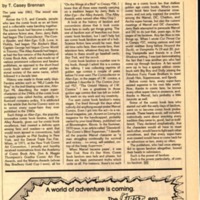
This representative article in Amazing Heroes issue 12 is called “The Spirit of Comics Fandom” by T. Casey Brennan. The article is broken up into three columns divided by visible lines with the title, “The Spirit of Comics Fandom” in centered, bold letters at the top. At the beginning of the first column, it gives the author’s name. At the bottom of the page, a graphic runs horizontally and reads in the middle: “A world of adventure is coming. The First,” and “first” is in clunky, bold, capital letters. Each of the three columns contains the article, which goes into detail about the livelihood of the comic fandom. It’s written in a first person point-of-view from the author, T. Casey Brennan. He discusses his own personal experiences in the comic world, and the importance that comic fandoms brought to the industry. The very bottom of the bottom of the page has “June 1982” featured on the lower left-hand corner and “73” on the lower right-hand corner. The entirety of the page is in black and white and doesn’t have any graphics of superheroes.
“The Spirit of Comics Fandom” by T. Casey Brennan perfectly encompasses what issue 12 of Amazing Heroes is all about— the fans, and how to appeal to them. Essentially, it showcases the history and importance of comic fans on the comic book industry. In an article titled “An Interview with Fansplaining’s Flourish Klink and Elizabeth Minkel (Part Two)” by Henry Jenkins, Minkel mentions how fandoms, in their fan works, often bring the concepts of queer shipping, queer representation, and topics including racism into their works. Essentially, fans bring in topics that are important to them into their favorite comics, making them even more personal than they already are— which in turn makes the comic’s industry rooted within the fans. Additionally, in the article “Fandom and Participatory Culture” through Grinnell College discusses the element of participatory culture that fandoms focus on— being that they’re not just consumers, but creators. This, again, supports the idea that this beginning issue was targeted toward the fans. Amazing Heroes wanted to connect with their fans on a deeper level, and what better way to do that than through acknowledging the fans as creators themselves? Adding on to the importance of fandoms and how fans are essentially the entire industry itself, the article “The Super Politics of Comic Book Fandom” by Matthew J. Costello mentions how fans not only transform the characters they write about in the worlds they create, but also the comic industry and art form itself. Putting in an article about fans, who are so crucial in the creation of comics, and legitimizing fandom culture is a great way to draw readers in, especially in a beginning issue. Examining one more article on fandom culture, “Fandoms: Subcultures on the Rise!” by Amy Alessio, Katie LaMantia, and Emily Vinci revealed that fandom culture helps keep comics up-to-date and relatively “hip.” Being that many superheroes have been around since the 1940s and 1950s, fandom culture helps rewrite their tales and keep them relevant— once again, proving how important fandoms are and making fans feel valid.
“The Spirit of Comics Fandom” by T. Casey Brennan perfectly encompasses what issue 12 of Amazing Heroes is all about— the fans, and how to appeal to them. Essentially, it showcases the history and importance of comic fans on the comic book industry. In an article titled “An Interview with Fansplaining’s Flourish Klink and Elizabeth Minkel (Part Two)” by Henry Jenkins, Minkel mentions how fandoms, in their fan works, often bring the concepts of queer shipping, queer representation, and topics including racism into their works. Essentially, fans bring in topics that are important to them into their favorite comics, making them even more personal than they already are— which in turn makes the comic’s industry rooted within the fans. Additionally, in the article “Fandom and Participatory Culture” through Grinnell College discusses the element of participatory culture that fandoms focus on— being that they’re not just consumers, but creators. This, again, supports the idea that this beginning issue was targeted toward the fans. Amazing Heroes wanted to connect with their fans on a deeper level, and what better way to do that than through acknowledging the fans as creators themselves? Adding on to the importance of fandoms and how fans are essentially the entire industry itself, the article “The Super Politics of Comic Book Fandom” by Matthew J. Costello mentions how fans not only transform the characters they write about in the worlds they create, but also the comic industry and art form itself. Putting in an article about fans, who are so crucial in the creation of comics, and legitimizing fandom culture is a great way to draw readers in, especially in a beginning issue. Examining one more article on fandom culture, “Fandoms: Subcultures on the Rise!” by Amy Alessio, Katie LaMantia, and Emily Vinci revealed that fandom culture helps keep comics up-to-date and relatively “hip.” Being that many superheroes have been around since the 1940s and 1950s, fandom culture helps rewrite their tales and keep them relevant— once again, proving how important fandoms are and making fans feel valid.
Creator
Kim Thompson, Peppy White, J. Collier, Tom Mason, Dwight R. Decker, Jim Korkis, Mindy McAdams, Lou Mougin, Gene Reed, Jeff Albrecht, Mike Cogliandro, Nequi Dharsee, Rudi Franke, Gary Kwapisz, Kevin Nowlan, Sam de la Rosa, Don Rosa, J. Michael Catron
Source
MSU Special Collections Comic Art, PN6725.A47
Publisher
Redbeard, Inc
Date
June 1982
Contributor
Autumn Miller
Rights
All rights reserved
Relation
-http://chambl91.msu.domains/CriticalFanscape/items/show/24 (Cover)
-http://chambl91.msu.domains/CriticalFanscape/items/show/25 (Table of Contents)
-http://chambl91.msu.domains/CriticalFanscape/items/show/25 (Table of Contents)
Format
Comic (Magazine size), 8.5x11 inches, black and white
Language
English
Type
Periodical
Coverage
1981-1992
Files
Collection
Citation
Kim Thompson, Peppy White, J. Collier, Tom Mason, Dwight R. Decker, Jim Korkis, Mindy McAdams, Lou Mougin, Gene Reed, Jeff Albrecht, Mike Cogliandro, Nequi Dharsee, Rudi Franke, Gary Kwapisz, Kevin Nowlan, Sam de la Rosa, Don Rosa, J. Michael Catron, “Amazing Heroes Issue #12— Page 73,” Critical Fanscape, accessed October 17, 2026, https://chambl91.msu.domains/CriticalFanscape/items/show/26.