Amazing Heroes Issue #160 Cover
Dublin Core
Title
Amazing Heroes Issue #160 Cover
Subject
Periodical
Comics Strips
Comics Strips
Description
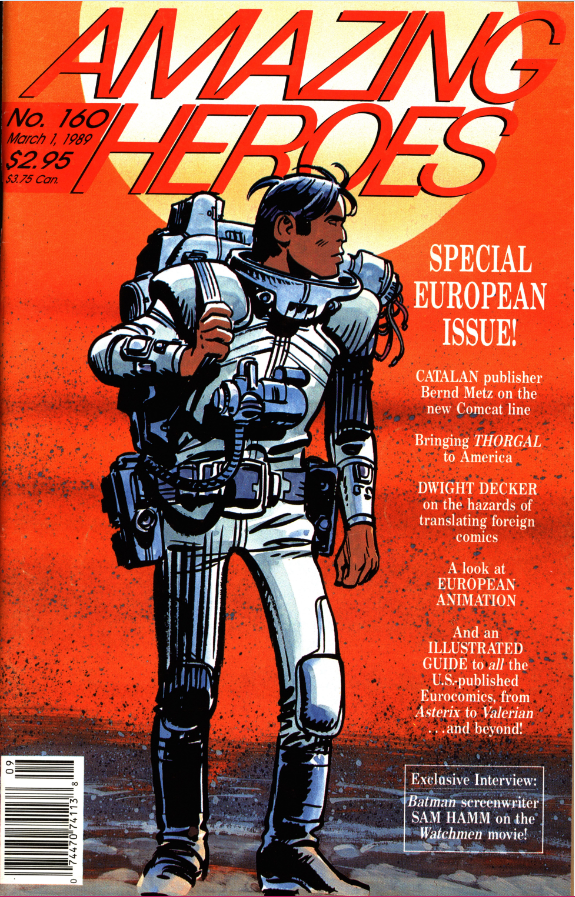
The cover of Amazing Heroes Issue #160 depicts an image of the French comic book character Valerian standing on a rocky terrain with a red atmosphere and a yellow sun in the background. He is wearing a spacesuit and holding a backpack as he gazes toward the right side of the page. Along the right side of the fanzine, a title states “Special European Issue,” indicating that the issue will include several articles about European comics. There are also a list of some of the items inside the magazine, including “Catalan publisher Bernd Metz on the New Comcat Line,” “Bringing Thorgal to America,” “Dwight Decker on the Hazards of Translating Foreign Comics,” “A Look at European Animation,” and “An Illustrated Guide to All the U.S. Published Eurocomics, from Asterix to Valerian . . . and Beyond!” In the bottom right corner of the page, an announcement for an “Exclusive Interview: Batman Screenwriter Sam Hamm of the Watchmen Movie” is in a box, separating from the articles that go along with the European theme.
The character Valerian, created by Pierre Cristin and Jean-Claude Mezieres, is reflective of France’s comic book culture and its differences from the American comic book culture. Valerian tells the story of a boy named Valerian and his friend Laureline, going on adventures throughout space. The comic pulls from the science fiction genre and has been compared to space operas like Star Wars. It has won numerous awards and experiences a wide readership in France, including those with high levels of education. This sets the series apart from comic books in America, which are often viewed as cheap entertainment and are enjoyed by a smaller audience with a focus on fandom. In France, on the other hand, many people read and appreciate comics, with some artists receiving subsidies from the government. The comic industry in France was able to flourish and develop independently from American comics largely due to World War 2, in which both France and Belgium were occupied by Germany. The scarcity of materials like paper and wartime bans prevented the importation of American comics, and when the war ended, the government extended restrictions on American comics, choosing to prioritize nationalism and the preservation of a distinct French culture. Comics are widely appreciated and are seen as the ninth art in France. Thus, the superhero genre is less developed, with more serious comics and graphic novels being distributed. Valerian is not considered a superhero, but his comics are adventure stories, which might explain why that specific French comic is more well known in America than others. It is also significant because its creators continued working on the comic series until its end, with no other head writers or artists. This is very different from the American assembly line model, with contributors coming and going frequently. Cristin’s and Meziere’s Valerian is very representative of the distinct French comic book culture.
The character Valerian, created by Pierre Cristin and Jean-Claude Mezieres, is reflective of France’s comic book culture and its differences from the American comic book culture. Valerian tells the story of a boy named Valerian and his friend Laureline, going on adventures throughout space. The comic pulls from the science fiction genre and has been compared to space operas like Star Wars. It has won numerous awards and experiences a wide readership in France, including those with high levels of education. This sets the series apart from comic books in America, which are often viewed as cheap entertainment and are enjoyed by a smaller audience with a focus on fandom. In France, on the other hand, many people read and appreciate comics, with some artists receiving subsidies from the government. The comic industry in France was able to flourish and develop independently from American comics largely due to World War 2, in which both France and Belgium were occupied by Germany. The scarcity of materials like paper and wartime bans prevented the importation of American comics, and when the war ended, the government extended restrictions on American comics, choosing to prioritize nationalism and the preservation of a distinct French culture. Comics are widely appreciated and are seen as the ninth art in France. Thus, the superhero genre is less developed, with more serious comics and graphic novels being distributed. Valerian is not considered a superhero, but his comics are adventure stories, which might explain why that specific French comic is more well known in America than others. It is also significant because its creators continued working on the comic series until its end, with no other head writers or artists. This is very different from the American assembly line model, with contributors coming and going frequently. Cristin’s and Meziere’s Valerian is very representative of the distinct French comic book culture.
Creator
Artist: Jean-Claude Mezieres
Executive Editor: Kim Thompson
Managing Editor: Chris McCubbin
Art Director: Lynette Alcorn-McCubbin
Editorial Assistance: Rudy Minger
News Correspondent: Darren Cranston
Production Assistant: Mark Thompson
Typesetting: Linda Gorell & Arlene Easter
Circulation: Rachel Enger & Carol Kovinick-Hernandez
Executive Editor: Kim Thompson
Managing Editor: Chris McCubbin
Art Director: Lynette Alcorn-McCubbin
Editorial Assistance: Rudy Minger
News Correspondent: Darren Cranston
Production Assistant: Mark Thompson
Typesetting: Linda Gorell & Arlene Easter
Circulation: Rachel Enger & Carol Kovinick-Hernandez
Source
MSU Special Collection Comic Art, PN6725.A47
Publisher
Fantagraphics Books Inc.
Date
1989-03
Contributor
Sarah M Geist
Rights
Rights Restrictions Apply
Format
6 5/8 inches by 10 1/4 inches
Language
English
Type
Periodical
Coverage
1981-1992
Files
Collection
Citation
Artist: Jean-Claude Mezieres
Executive Editor: Kim Thompson
Managing Editor: Chris McCubbin
Art Director: Lynette Alcorn-McCubbin
Editorial Assistance: Rudy Minger
News Correspondent: Darren Cranston
Production Assistant: Mark Thompson
Typesetting: Linda Gorell & Arlene Easter
Circulation: Rachel Enger & Carol Kovinick-Hernandez, “Amazing Heroes Issue #160 Cover,” Critical Fanscape, accessed October 17, 2026, https://chambl91.msu.domains/CriticalFanscape/items/show/31.