Amazing Heroes Issue #108 Pg. 53
Dublin Core
Title
Amazing Heroes Issue #108 Pg. 53
Subject
Periodical
Comics Strips
Comics Strips
Description
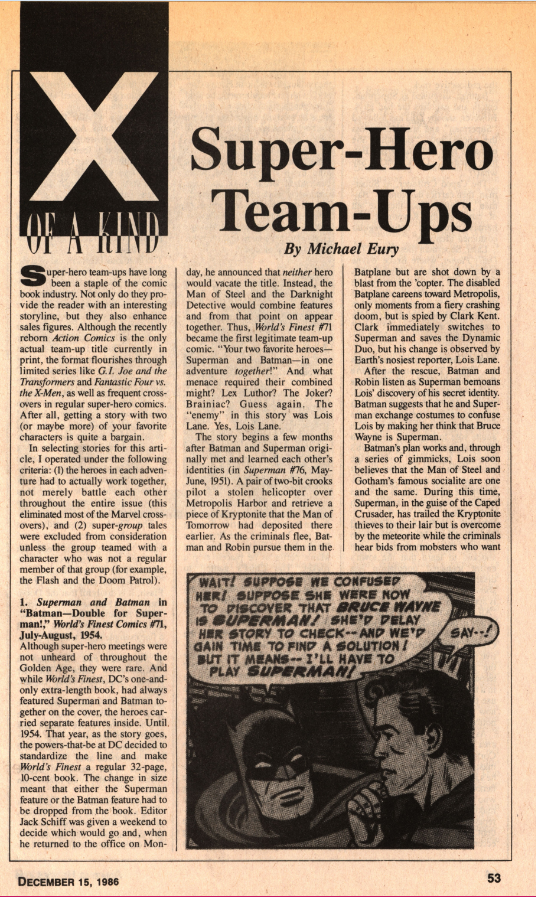
Page 53 of Amazing Heroes Issue #108 is the first page to an article written by Michael Eury, titled “Super-Hero Team-Ups.” It is part of a regular column called “X of a Kind.” The article lists and describes ten significant superhero team-ups, explain that comic publishers released the crossovers and team-ups in order to boost the sales of one or more characters. The team-ups included the piece are “Superman and Batman in ‘Batman—Double for Superman!”, “Kid Flash, Aqualad, and Robin in ‘The Thousand-and-One Dooms of Mr. Twister,” “The Flash and the Doom Patrol in ‘Alias Negative Man,” “Superman and the Flash in ‘Superman’s Race With the Flash,” “Batman and Deadman in ‘The Track of the Hook,” “Green Lantern and Green Arrow in ‘No Evil Shall Escape My Sight,” “Superman and Spider-Man in ‘The Battle of the Century!”, “Spider-Man and Howard the Duck in ‘Panic in the Park,” “Batman and the Hawk and the Dove in ‘Time, See What’s Become of Me. . .”, and “The Thing and Sandman in ‘Time Runs Like Sand!”. The first page of the article displays an image of Batman and Superman coming up with a way to trick Lois Lane into thinking that Bruce Wayne is Superman.
The motivations for superhero team-ups mentioned in this article are reflective of the market focus of the comic book industry and the search for ways to satisfy the fans. Because of the growth of the direct market in the 1970s and 1980s, comic books were increasingly marketed toward a niche culture of fans in comic book specialty stores instead of the general newsstand audience. The people who bought one comic book were likely to buy more. Superhero team-ups and crossovers became a trend in the comic book industry during this period. In an effort to increase profits, publishers released more and more team-up titles and crossovers, sometimes having the characters work together and sometimes having them battle each other. Fans loved rooting for their favorite characters in these battles and debating who would win. Additionally, superhero team-ups often resulted in very large sales because fans of one character and fans of the other character would both buy the comic, sometimes increasing the sales of both characters’ individual titles. Publishers also used team-ups to introduce new superhero characters. Pairing a new character with a well-established one was a great way of exposing the superhero to a large audience that might not otherwise have known about it. It was risky to give a new character his or her own comic book title without seeing how readers would react to the hero, so team-ups offered a testing ground for them. Characters that were experiencing a decline in popularity among fans would be featured in the comic title of one the company’s most popular characters. For example, Marvel often used Spider-Man to boost the sales of new and less well-loved superheroes. Comic book companies used team-ups to increase sales and subsequently profits, taking advantage of the new audience of niche fans and the collecting culture that resulted from direct distribution.
The motivations for superhero team-ups mentioned in this article are reflective of the market focus of the comic book industry and the search for ways to satisfy the fans. Because of the growth of the direct market in the 1970s and 1980s, comic books were increasingly marketed toward a niche culture of fans in comic book specialty stores instead of the general newsstand audience. The people who bought one comic book were likely to buy more. Superhero team-ups and crossovers became a trend in the comic book industry during this period. In an effort to increase profits, publishers released more and more team-up titles and crossovers, sometimes having the characters work together and sometimes having them battle each other. Fans loved rooting for their favorite characters in these battles and debating who would win. Additionally, superhero team-ups often resulted in very large sales because fans of one character and fans of the other character would both buy the comic, sometimes increasing the sales of both characters’ individual titles. Publishers also used team-ups to introduce new superhero characters. Pairing a new character with a well-established one was a great way of exposing the superhero to a large audience that might not otherwise have known about it. It was risky to give a new character his or her own comic book title without seeing how readers would react to the hero, so team-ups offered a testing ground for them. Characters that were experiencing a decline in popularity among fans would be featured in the comic title of one the company’s most popular characters. For example, Marvel often used Spider-Man to boost the sales of new and less well-loved superheroes. Comic book companies used team-ups to increase sales and subsequently profits, taking advantage of the new audience of niche fans and the collecting culture that resulted from direct distribution.
Creator
Writer: Michael Eury
Editor: Mark Wald
Art Director: Dale Crain
Production Manager: Kim Thompson
News Correspondent: J. Collier
Production Assistant: Teresa Moore
Typesetting: L.M Gorell & Ariene Easter
Circulation: Rachel Enger
Editor: Mark Wald
Art Director: Dale Crain
Production Manager: Kim Thompson
News Correspondent: J. Collier
Production Assistant: Teresa Moore
Typesetting: L.M Gorell & Ariene Easter
Circulation: Rachel Enger
Source
MSU Special Collection Comic Art, PN6725.A47
Publisher
Fantagraphics Books Inc.
Date
1986-12
Contributor
Sarah M Geist
Rights
Rights Restrictions Apply
Format
6 5/8 inches by 10 1/4 inches
Language
English
Type
Periodical
Coverage
1981-1992
Files
Collection
Citation
Writer: Michael Eury
Editor: Mark Wald
Art Director: Dale Crain
Production Manager: Kim Thompson
News Correspondent: J. Collier
Production Assistant: Teresa Moore
Typesetting: L.M Gorell & Ariene Easter
Circulation: Rachel Enger, “Amazing Heroes Issue #108 Pg. 53,” Critical Fanscape, accessed October 17, 2026, https://chambl91.msu.domains/CriticalFanscape/items/show/30.