Amazing Heroes Issue #160 Pg. 71
Dublin Core
Title
Amazing Heroes Issue #160 Pg. 71
Subject
Periodical
Comics Strips
Comics Strips
Description
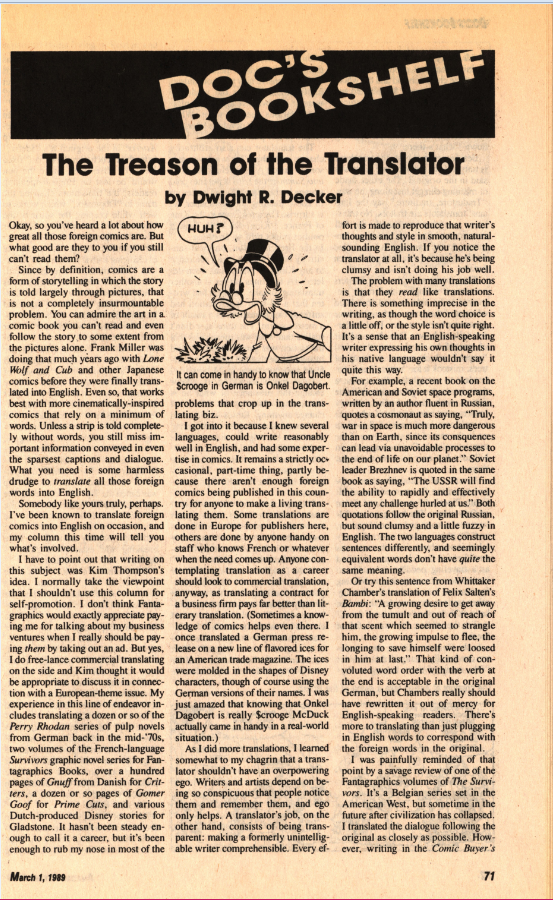
Page 71 of Amazing Heroes Issue #160 is the first page to an article written by Dwight Decker, titled “The Treason of the Translator.” It is part of a regular column called “Doc’s Bookshelf.” The article describes the many different challenges to translating foreign comic books into English. These include sounding natural and not like a translation, avoiding errors between words that are similar in one language but not in another, dealing with puns and cultural references that would be unintelligible for foreign readers, national standards for length and word count, words unique to a language that do not have exact translations, speech bubbles needing to remain the same size, and above all, honoring the original authors intentions. Decker describes his personal experiences being criticized for an unnatural sounding comic book translation and maintains that somebody is very unlikely to be able to make a living solely by translating comic books. This is because the volume of foreign comic books being sold in the United States is very low and those that available are often translated by the original publisher. An image of the Disney character $crooge McDuck yelling in confusion accompanies the article.
Decker’s explanation of the difficulties in translating foreign comics reveals the differences between the various national comic book cultures throughout the world. Each country that reads comic books has different standards for book size and length, content, artistic style, and much more. The comic book is unique for translators because it depends on the interaction of words and images, not just on one or the other, and because the style of publication varies so greatly. Some comic book cultures emphasize the serial magazine, while others produce primarily short strips or graphic novels. When comic books are translated from one language to another, their size and style of publication may be changed, therefore challenging the translator to include the entire story and the intentions of the original creators within the new length. Additionally, differences between expectations of content can also inform what the translator does with the comic book. Some countries expect comic books to have literary merit, so the translator may change the tone to fit the new audience’s desires. Other nations have strict rules about gender roles, meaning that an American comic might not align with those rules or a foreign comic might not conform to American expectations. Many comics depicting scantily clad women have been censored in Europe, with the translator and the publisher adding more clothing to the image. This all depends on the culture of the country in which the comic is being published. Decker describes instances in which certain cultural references in one comic book would not have made sense in another country or language, and so the translator had to choose between honoring the original and making the comic understandable. Ultimately, comic book translators are forced to choose between copying the comic book exactly and pandering to the new foreign audience. This leads to questions about whether internationally available comics are really translations or if they are adaptations. The many challenges that come with translating a comic book change depending on the language and culture of the new country it is to be published in.
Decker’s explanation of the difficulties in translating foreign comics reveals the differences between the various national comic book cultures throughout the world. Each country that reads comic books has different standards for book size and length, content, artistic style, and much more. The comic book is unique for translators because it depends on the interaction of words and images, not just on one or the other, and because the style of publication varies so greatly. Some comic book cultures emphasize the serial magazine, while others produce primarily short strips or graphic novels. When comic books are translated from one language to another, their size and style of publication may be changed, therefore challenging the translator to include the entire story and the intentions of the original creators within the new length. Additionally, differences between expectations of content can also inform what the translator does with the comic book. Some countries expect comic books to have literary merit, so the translator may change the tone to fit the new audience’s desires. Other nations have strict rules about gender roles, meaning that an American comic might not align with those rules or a foreign comic might not conform to American expectations. Many comics depicting scantily clad women have been censored in Europe, with the translator and the publisher adding more clothing to the image. This all depends on the culture of the country in which the comic is being published. Decker describes instances in which certain cultural references in one comic book would not have made sense in another country or language, and so the translator had to choose between honoring the original and making the comic understandable. Ultimately, comic book translators are forced to choose between copying the comic book exactly and pandering to the new foreign audience. This leads to questions about whether internationally available comics are really translations or if they are adaptations. The many challenges that come with translating a comic book change depending on the language and culture of the new country it is to be published in.
Creator
Writer: Dwight R. Decker
Executive Editor: Kim Thompson
Managing Editor: Chris McCubbin
Art Director: Lynette Alcorn-McCubbin
Editorial Assistance: Rudy Minger
News Correspondent: Darren Cranston
Production Assistant: Mark Thompson
Typesetting: Linda Gorell & Arlene Easter
Circulation: Rachel Enger & Carol Kovinick-Hernandez
Executive Editor: Kim Thompson
Managing Editor: Chris McCubbin
Art Director: Lynette Alcorn-McCubbin
Editorial Assistance: Rudy Minger
News Correspondent: Darren Cranston
Production Assistant: Mark Thompson
Typesetting: Linda Gorell & Arlene Easter
Circulation: Rachel Enger & Carol Kovinick-Hernandez
Source
MSU Special Collection Comic Art, PN6725.A47
Publisher
Fantagraphics Books Inc.
Date
1989-03
Contributor
Sarah M Geist
Rights
Rights Restrictions Apply
Format
6 5/8 inches by 10 1/4 inches
Language
English
Type
Periodical
Coverage
1981-1992
Files
Collection
Citation
Writer: Dwight R. Decker
Executive Editor: Kim Thompson
Managing Editor: Chris McCubbin
Art Director: Lynette Alcorn-McCubbin
Editorial Assistance: Rudy Minger
News Correspondent: Darren Cranston
Production Assistant: Mark Thompson
Typesetting: Linda Gorell & Arlene Easter
Circulation: Rachel Enger & Carol Kovinick-Hernandez, “Amazing Heroes Issue #160 Pg. 71,” Critical Fanscape, accessed October 17, 2026, https://chambl91.msu.domains/CriticalFanscape/items/show/33.