Amazing Heroes Issue #7 Table of Contents
Dublin Core
Title
Amazing Heroes Issue #7 Table of Contents
Subject
comic books, strips
Superheroes
Women Superheroes
Time Travel
Superheroes
Women Superheroes
Time Travel
Description
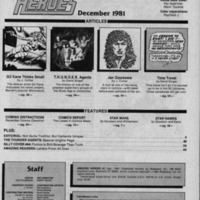
This image represents the table of contents for the #7 issue of Amazing Heroes. On the utmost top, there is a title, ‘Amazing Heroes December 1981” Directly underneath it simply states ‘articles’. In the top right corner, it has some of the editorial team, stating ‘front cover: Gil Kane’, Inside back Cover: Pat Gabriele, Mark Texeira’, and ‘Color Separations: Pepfield J.’ underneath ‘articles’ it has 4 boxes, each with representative images of the article that will be discussed. On the left, there is an image depicting the female figure from the Micronauts. Underneath the box is the title “Gil Kane Thinks Small” by J. Collier. Underneath that is a quick description of what the article is going to discuss and the page number of where to find it (page 30). The second to left box depicts the T.H.U.N.D.E.R. Agents running forward. The title underneath is “T.H.U.N.D.E.R. Agents” by David Singer with a quick description of the article and again, the page number of where to find it (page 34). The 3rd to left box shows an image of a sketched face, below titled “Jan Duursema” by J. Collier. Again, a description is below with the page number (page 50). The final box shows thought bubbles discussing ‘time travel’, which happens to be the title of the article, by David Singer. A description is placed below with page 54 being the location of where to find it. Below the articles are the features, them being “Editorial: Not Quite Truthful, But Certainly Unique” on page 4, “The T.H.U.N.D.E.R. Agents: Special Origins Page” on 49, “Silly Cover #44: Fiction is Still Stranger Than Truth” page 24, and “Amazing Readers: Letters From All Over” page 65. In the left bottom corner is the list of the editorial team members. On the right are two boxes, one dedicated to the publication information and another for contributor’s information.
This serves as a good reflection of the comic book culture at the time. One of the main articles in this periodical discusses the impact of Micronauts and its interaction with the sci-fi genre. Prior to the 1980s, America had been in a competitive technological race with Russia, as each was racing to explore space first. This emphasis on technology in society would ultimately be reflected in comics, as shown by the topics discussed in this periodical. For instance, the Micronauts were deeply ingrained in the science fiction genre of the time. This is reinforced as well by the ‘Time Travel’ article, which explains the continuity of time travel in comics. This tells a historical narrative though— how science and technology of the technological race opened the world of literature to endless possibilities. In this way, literature used science fiction as a way to work through these new advancements— just think, this is the beginning of our research concerning space, something that seemed almost impossible for decades. Science fiction gave words to how we could come to understand this growing technology around us. This genre worked well with superheroes since superheroes have been historically used to contextualize social advancements and changes. Amazing Superheroes issue #7 is interesting in that it shows the relationship between superheroes and sci-fi to work out issues concerning drastic technological changes. This periodical also discusses current interactions between comics and the fanbase, as made evident by the “Time Travel” article, which serves as a place for fans to comment on inconsistencies amongst timelines in certain comics. This interaction between fans and creators was a key aspect of the comic book culture at the time, as many fans craved a space in which they were able to actually be a part of the discussion. Also embedded in this interaction between text and fans is this idea of class, as one was only able to contribute to the discussion if they were able to buy a periodical like this one, comic books, and mailing material. Capitalism is then seen as a big factor in the fan’s interaction, which is something to be considered. This table of contents delves into the melting of sci-fi and superheroes into one, while also having this underlying theme of capitalism underneath.
This serves as a good reflection of the comic book culture at the time. One of the main articles in this periodical discusses the impact of Micronauts and its interaction with the sci-fi genre. Prior to the 1980s, America had been in a competitive technological race with Russia, as each was racing to explore space first. This emphasis on technology in society would ultimately be reflected in comics, as shown by the topics discussed in this periodical. For instance, the Micronauts were deeply ingrained in the science fiction genre of the time. This is reinforced as well by the ‘Time Travel’ article, which explains the continuity of time travel in comics. This tells a historical narrative though— how science and technology of the technological race opened the world of literature to endless possibilities. In this way, literature used science fiction as a way to work through these new advancements— just think, this is the beginning of our research concerning space, something that seemed almost impossible for decades. Science fiction gave words to how we could come to understand this growing technology around us. This genre worked well with superheroes since superheroes have been historically used to contextualize social advancements and changes. Amazing Superheroes issue #7 is interesting in that it shows the relationship between superheroes and sci-fi to work out issues concerning drastic technological changes. This periodical also discusses current interactions between comics and the fanbase, as made evident by the “Time Travel” article, which serves as a place for fans to comment on inconsistencies amongst timelines in certain comics. This interaction between fans and creators was a key aspect of the comic book culture at the time, as many fans craved a space in which they were able to actually be a part of the discussion. Also embedded in this interaction between text and fans is this idea of class, as one was only able to contribute to the discussion if they were able to buy a periodical like this one, comic books, and mailing material. Capitalism is then seen as a big factor in the fan’s interaction, which is something to be considered. This table of contents delves into the melting of sci-fi and superheroes into one, while also having this underlying theme of capitalism underneath.
Creator
Editor: Kim Thompson
Art Director: Peppy White
Assistant Editor: J. Collier
Contributing Writers: Dwight R. Decker, Jim Korkis, Rich Morrissey, Gene Reed, David Singer
Contributing Artists: Bill Anderson, Willie Blyberg, Rudi Franke, Doug Hazelwood, Mark Helke, Bert Hernandez, Jaime Hernandez, Gary Kwapisz, Mark Lamport, Kevin Nowlan, Mike O'Neal
Editor Emeritus: J. Michael Catron
Published by: REdbeard, Inc.
Advertising: J. Michael Catron
Art Director: Peppy White
Assistant Editor: J. Collier
Contributing Writers: Dwight R. Decker, Jim Korkis, Rich Morrissey, Gene Reed, David Singer
Contributing Artists: Bill Anderson, Willie Blyberg, Rudi Franke, Doug Hazelwood, Mark Helke, Bert Hernandez, Jaime Hernandez, Gary Kwapisz, Mark Lamport, Kevin Nowlan, Mike O'Neal
Editor Emeritus: J. Michael Catron
Published by: REdbeard, Inc.
Advertising: J. Michael Catron
Source
MSU Special Collection Comic Art, PN6725.A47
Publisher
Redbeard, Inc.
Date
1981-12
Contributor
Hannah Boyd
Rights
Rights Restrictions Apply
Relation
Cover Page: http://chambl91.msu.domains/CriticalFanscape/items/show/14
Representative Image: http://chambl91.msu.domains/CriticalFanscape/items/show/35
Representative Image: http://chambl91.msu.domains/CriticalFanscape/items/show/35
Format
10 and 1/4 inches by 6 and 5/8 inches
Language
English
Type
Periodical
Coverage
1981-1992
Files
Collection
Citation
Editor: Kim Thompson
Art Director: Peppy White
Assistant Editor: J. Collier
Contributing Writers: Dwight R. Decker, Jim Korkis, Rich Morrissey, Gene Reed, David Singer
Contributing Artists: Bill Anderson, Willie Blyberg, Rudi Franke, Doug Hazelwood, Mark Helke, Bert Hernandez, Jaime Hernandez, Gary Kwapisz, Mark Lamport, Kevin Nowlan, Mike O'Neal
Editor Emeritus: J. Michael Catron
Published by: REdbeard, Inc.
Advertising: J. Michael Catron , “Amazing Heroes Issue #7 Table of Contents,” Critical Fanscape, accessed October 17, 2026, https://chambl91.msu.domains/CriticalFanscape/items/show/34.