Amazing Heroes Issue # 7 Representative Image
Dublin Core
Title
Amazing Heroes Issue # 7 Representative Image
Subject
comic books, strips
Superheroes
Women Superheroes
Costume
Superheroes
Women Superheroes
Costume
Description
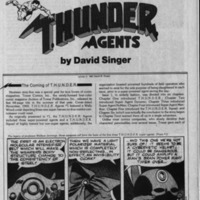
This is a scan from page 35 in Issue #7 of Amazing Superheroes. It is the beginning of one of the main articles in this periodical. The top half of the page has in large letters “The History of the T.H.U.N.D.E.R. Agents”. In the top left of the title, there is a small figure of a man who appears to be falling over the title letters. In smaller letters below the title is the credit to the author, “David Singer”. The middle section of the page is dedicated to the actual article itself, starting off with the header “The Coming of T.H.U.N.D.E.R.”. The bottom section of the page is dedicated to 3 comic book panels, which can be assumed to be from a T.H.U.N.D.E.R. Agents comic book. The comic strips appear to be depicting the pieces of a costume, as it describes an “electron molecular intensifier belt”, a “light polarizing” robe, and a “cybernetic” helmet, each item being given their own column. Each piece of the apparent costume appears to have a circle within a circle, which could possibly be an identifier for the character. This page, like all the other internal pages, is in black and white. On the bottom is the date of the release of the periodical, which is December 1981.
This image is a good representation of what is important in the overall periodical because it shows one of the main things it aims to discuss, that being the T.H.U.N.D.E.R. Agents. This comic book series is interesting in that it explores several ideas that were very prevalent in the 1980s. One of the most important historical narratives was the technological arms race America had been symbolically fighting with Russia. Both were fighting to see who would be the one to explore space first, which would somehow result in the crowning of one nation superior over the other. This technological focus would ultimately lead to a stress of technology in the arts as well. Consider the “electron molecular intensifier belt”, which clearly shows how technology was used to mix science fiction with superheroes. Another important historical concept of the time was the idea of representation of other countries and peoples. This is clearly also shown in the T.H.U.N.D.E.R. Agents, as they were from all over and established and organized by the United Nations. The 1980s saw a time in history that called for unity amongst nations— the cold war was slowing down and the general sentiment of peace was felt throughout the nation. These agents were interesting also in the fact that they did not have superpowers. Other than being skilled in certain areas, these agents were like everyone else. This sentiment of simple humanity was also due to the times, as the U.S. strived to remain focused on humanity in the face of growing change. While in the past, superpowers were used to advance in front of technology, as seen in Superman, there was a shift to simplify things and make the heroes abilities more human. In a sense, heroes were seen as agents that used technological tools for their betterment, as opposed to being in opposition with them. In that way, science fiction was used to contextualize America’s relationship with technology as they grew to understand what was possible.
This image is a good representation of what is important in the overall periodical because it shows one of the main things it aims to discuss, that being the T.H.U.N.D.E.R. Agents. This comic book series is interesting in that it explores several ideas that were very prevalent in the 1980s. One of the most important historical narratives was the technological arms race America had been symbolically fighting with Russia. Both were fighting to see who would be the one to explore space first, which would somehow result in the crowning of one nation superior over the other. This technological focus would ultimately lead to a stress of technology in the arts as well. Consider the “electron molecular intensifier belt”, which clearly shows how technology was used to mix science fiction with superheroes. Another important historical concept of the time was the idea of representation of other countries and peoples. This is clearly also shown in the T.H.U.N.D.E.R. Agents, as they were from all over and established and organized by the United Nations. The 1980s saw a time in history that called for unity amongst nations— the cold war was slowing down and the general sentiment of peace was felt throughout the nation. These agents were interesting also in the fact that they did not have superpowers. Other than being skilled in certain areas, these agents were like everyone else. This sentiment of simple humanity was also due to the times, as the U.S. strived to remain focused on humanity in the face of growing change. While in the past, superpowers were used to advance in front of technology, as seen in Superman, there was a shift to simplify things and make the heroes abilities more human. In a sense, heroes were seen as agents that used technological tools for their betterment, as opposed to being in opposition with them. In that way, science fiction was used to contextualize America’s relationship with technology as they grew to understand what was possible.
Creator
Editor: Kim Thompson
Art Director: Peppy White
Assistant Editor: J. Collier
Contributing Writers: Dwight R. Decker, Jim Korkis, Rich Morrissey, Gene Reed, David Singer
Contributing Artists: Bill Anderson, Willie Blyberg, Rudi Franke, Doug Hazelwood, Mark Helke, Bert Hernandez, Jaime Hernandez, Gary Kwapisz, Mark Lamport, Kevin Nowlan, Mike O'Neal
Editor Emeritus: J. Michael Catron
Published by: REdbeard, Inc.
Advertising: J. Michael Catron
Art Director: Peppy White
Assistant Editor: J. Collier
Contributing Writers: Dwight R. Decker, Jim Korkis, Rich Morrissey, Gene Reed, David Singer
Contributing Artists: Bill Anderson, Willie Blyberg, Rudi Franke, Doug Hazelwood, Mark Helke, Bert Hernandez, Jaime Hernandez, Gary Kwapisz, Mark Lamport, Kevin Nowlan, Mike O'Neal
Editor Emeritus: J. Michael Catron
Published by: REdbeard, Inc.
Advertising: J. Michael Catron
Source
MSU Special Collection Comic Art, PN6725.A47
Publisher
Redbeard, Inc.
Date
1981-12
Contributor
Hannah Boyd
Rights
Rights Restrictions Apply
Relation
Cover Page: http://chambl91.msu.domains/CriticalFanscape/items/show/14
Table of Contents: http://chambl91.msu.domains/CriticalFanscape/items/show/34
Table of Contents: http://chambl91.msu.domains/CriticalFanscape/items/show/34
Format
10 and 1/4 inches by 6 and 5/8 inches
Language
English
Type
Periodical
Coverage
1981-1992
Files
Collection
Citation
Editor: Kim Thompson
Art Director: Peppy White
Assistant Editor: J. Collier
Contributing Writers: Dwight R. Decker, Jim Korkis, Rich Morrissey, Gene Reed, David Singer
Contributing Artists: Bill Anderson, Willie Blyberg, Rudi Franke, Doug Hazelwood, Mark Helke, Bert Hernandez, Jaime Hernandez, Gary Kwapisz, Mark Lamport, Kevin Nowlan, Mike O'Neal
Editor Emeritus: J. Michael Catron
Published by: REdbeard, Inc.
Advertising: J. Michael Catron , “Amazing Heroes Issue # 7 Representative Image,” Critical Fanscape, accessed October 17, 2026, https://chambl91.msu.domains/CriticalFanscape/items/show/35.