Amazing Heroes Issue #11 Cover
Dublin Core
Title
Amazing Heroes Issue #11 Cover
Subject
Periodical
Comics Strips
Comics Strips
Description
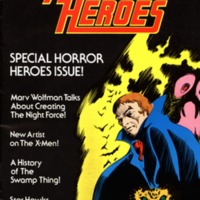
This horror-based, dark-colored comic cover extensively sets the scene for its upcoming pages. With text like “Marv Wolfman Talks About Creating The Night Force!,” “A History of the Swamp Thing!,” and “Star Hawks, Star Wars, News, and Much More!” there is not much content in the actual magazine that the cover leaves behind. But perhaps the two most striking features of the Amazing Heroes #11 cover are the bright, dominant comic art and the large, center-stage text that reads “Special Horror Heroes Issue!” This art and text happen to be deeply intertwined as the cover art displays “The Night Force.” Or, more specifically, Baron Winters and Merlin, two of the main characters that appear in Gene Colan and Marv Wolfman’s psychedelic horror comic.
“The Night Force,” which made its debut several months after the release of this issue, follows Baron Winters, a sorcerer who assembles a team of chosen individuals to fight supernatural threats and horrific evils. After a short 14-issue run, however, “The Night Force” was no more. Although, despite its short publication, “The Night Force” stands as a beacon of hope to past horror comics and is extremely useful when looking at the history of the horror comic.
Starting in the late 1940’s and early 1950’s, crime and horror comics were both on the rise and on the receiving end of increasing public skepticism for their content and potentially harmful effects on children, even obtaining "accusations from several fronts [that] charged comic books with contributing to the rising rates of juvenile delinquency." All of this backlash ultimately culminated in the early 1950s through the hands of Dr. Fredric Werhtam.
With his multiple advocations for legislation to control the comic industry, as well as his release of “Seduction of the Innocent,” Wertham spearheaded the attack on horror and crime comics. In 1954, after Wertham’s numerous publications and attempts to emphasize the harm done by the comic industry, the Senate had a subcommittee investigate the matter. In the end, the comic industry was not blamed for the accusations brought against it. The Senate, however, did recommend the comic industry should voluntarily tone down its content, resulting in the creation of the Comics Code Authority.
In fall of 1954, a new, extremely restrictive code from the Comics Magazine Association of America was released. The code effectively prohibited all of the visual elements and subject matters than defined horror comics, as they were not allowed to even have the words “horror” or “terror” on the cover. Seventeen years later, however, the code was relaxed and longstanding rules restricting horror comics were removed, opening the door to more possibilities for the genre and ultimately allowing for something like an Amazing Heroes #11 or “The Night Force” to be published.
While it may seem like an everyday comic cover, its bright colors and large, center-stage text successfully call out to horror comics of the past and inherently shed light on the previous, longstanding trials of the horror comic genre.
“The Night Force,” which made its debut several months after the release of this issue, follows Baron Winters, a sorcerer who assembles a team of chosen individuals to fight supernatural threats and horrific evils. After a short 14-issue run, however, “The Night Force” was no more. Although, despite its short publication, “The Night Force” stands as a beacon of hope to past horror comics and is extremely useful when looking at the history of the horror comic.
Starting in the late 1940’s and early 1950’s, crime and horror comics were both on the rise and on the receiving end of increasing public skepticism for their content and potentially harmful effects on children, even obtaining "accusations from several fronts [that] charged comic books with contributing to the rising rates of juvenile delinquency." All of this backlash ultimately culminated in the early 1950s through the hands of Dr. Fredric Werhtam.
With his multiple advocations for legislation to control the comic industry, as well as his release of “Seduction of the Innocent,” Wertham spearheaded the attack on horror and crime comics. In 1954, after Wertham’s numerous publications and attempts to emphasize the harm done by the comic industry, the Senate had a subcommittee investigate the matter. In the end, the comic industry was not blamed for the accusations brought against it. The Senate, however, did recommend the comic industry should voluntarily tone down its content, resulting in the creation of the Comics Code Authority.
In fall of 1954, a new, extremely restrictive code from the Comics Magazine Association of America was released. The code effectively prohibited all of the visual elements and subject matters than defined horror comics, as they were not allowed to even have the words “horror” or “terror” on the cover. Seventeen years later, however, the code was relaxed and longstanding rules restricting horror comics were removed, opening the door to more possibilities for the genre and ultimately allowing for something like an Amazing Heroes #11 or “The Night Force” to be published.
While it may seem like an everyday comic cover, its bright colors and large, center-stage text successfully call out to horror comics of the past and inherently shed light on the previous, longstanding trials of the horror comic genre.
Creator
Artist: Gene Colan and John Workman
Editor: Kim Thompson
Art Director: Peppy White
Assistant Editor: J. Collier
Consulting Editor: Dwight R. Decker
Advertising: J. Michael Catron
Contributing Writers: Dwight R. Decker, Jim Korkis, Rich Morrissey, Gene Reed, David Singer
Contributing Artists: Paul Abrams, Bill Anderson, Willie Blyberg, George Bryant, Sam De La Rosa, 'Bert, Hernandez, Matt Horwitz, G. Kracken, Gary Kwapisz, Kevin Nowlan, Bud Perkins
Editor: Kim Thompson
Art Director: Peppy White
Assistant Editor: J. Collier
Consulting Editor: Dwight R. Decker
Advertising: J. Michael Catron
Contributing Writers: Dwight R. Decker, Jim Korkis, Rich Morrissey, Gene Reed, David Singer
Contributing Artists: Paul Abrams, Bill Anderson, Willie Blyberg, George Bryant, Sam De La Rosa, 'Bert, Hernandez, Matt Horwitz, G. Kracken, Gary Kwapisz, Kevin Nowlan, Bud Perkins
Source
MSU Special Collection Comic Art, PN6725.A47
Publisher
Redbeard, Inc.
Date
05-1982
Contributor
Matthew Marshall
Rights
Rights Restrictions Apply
Format
8 inches by 11 inches, Color
Language
English
Type
Periodical, TIFF File
Coverage
1981-1992
Still Image Item Type Metadata
Original Format
Comic Book
Physical Dimensions
8 inches by 11 inches
Files
Collection
Citation
Artist: Gene Colan and John Workman
Editor: Kim Thompson
Art Director: Peppy White
Assistant Editor: J. Collier
Consulting Editor: Dwight R. Decker
Advertising: J. Michael Catron
Contributing Writers: Dwight R. Decker, Jim Korkis, Rich Morrissey, Gene Reed, David Singer
Contributing Artists: Paul Abrams, Bill Anderson, Willie Blyberg, George Bryant, Sam De La Rosa, 'Bert, Hernandez, Matt Horwitz, G. Kracken, Gary Kwapisz, Kevin Nowlan, Bud Perkins, “Amazing Heroes Issue #11 Cover,” Critical Fanscape, accessed October 17, 2026, https://chambl91.msu.domains/CriticalFanscape/items/show/36.