Amazing Heroes Issue #11 Table of Contents
Dublin Core
Title
Amazing Heroes Issue #11 Table of Contents
Subject
Periodical
Comics Strips
Comics Strips
Description
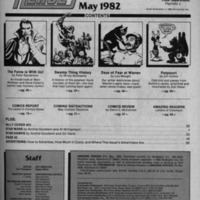
Released in May of 1982, the eleventh issue of Amazing Heroes places a special focus on horror in comics, seen visually in three of the four representative panels on the table of contents. The lead feature, “The Force is With Us!,” takes an inside look at “The Night Force” - Gene Colan and Marv Wolfman’s psychedelic horror comic. Depicted alongside the feature is “The Night Force’s” main character Baron Winters, a nasty, acerbic, and unlikeable sorcerer. Following the lead feature is “Swamp Thing History,” an eight-page article covering “the greatest muck monster of them all” and, accompanying the article, is a panel of a Swamp Thing attacking numerous other characters. Rounding out the main horror pieces of the issue is “Days of Fear at Warren,” where the writers of Amazing Heroes discuss “Warren’s early days - back when Uncle Creepy was great!” The “Warren” this feature is referring to is Warren Publishing, a leader in publishing horror stories during the comic crackdown of the mid-twentieth century.
Warren Publishing was founded in 1957 by James Warren. For its initial seven years, Warren’s biggest success was Monster World, a magazine that published, among other things, “Monster Comics.” In 1964, however, Warren expanded to horror. Approached by Russ Jones with the idea of publishing horror stories, Warren thus created “Creepy.” During this period, however, horror comics were essentially impossible to sell because of the Comics Code Authority (CCA).
What started as an alternative to government censorship, the CCA was a self-regulating company that specialized in deeming comics to be either be denied or approved for official publication (which, if approved, could be seen via a stamp in the top right corner of comic covers). Out of hope to save the comic industry, the CCA banned any and all controversial topics at the time, including everything horror related. In short, “Creepy,” should have been impossible to publish, but it was published nonetheless. The key? “Creepy” self-categorized as a magazine instead of a comic. As James Warren himself explained: “The Comics Code saved the industry from turmoil, but at the same time, it had a cleansing kind of effect on comics, making them clean, proper and family-oriented... We would overcome this by saying to the Code Authority, the industry, the printers, and the distributors: ‘We are not a comic book; we are a magazine. “Creepy” is magazine-sized and will be sold on magazine racks, not comic book racks’.”
By publishing these graphic horror stories in a magazine format to which the Code did not apply, Warren Publishing paved the way for numerous other graphic-story magazines. In the end, Warren halted publishing in 1981. One year later, Amazing Heroes dedicated an entire issue to its style of stories, even including the twenty-page feature reminiscing about Warren’s early pioneer days.
Warren Publishing was founded in 1957 by James Warren. For its initial seven years, Warren’s biggest success was Monster World, a magazine that published, among other things, “Monster Comics.” In 1964, however, Warren expanded to horror. Approached by Russ Jones with the idea of publishing horror stories, Warren thus created “Creepy.” During this period, however, horror comics were essentially impossible to sell because of the Comics Code Authority (CCA).
What started as an alternative to government censorship, the CCA was a self-regulating company that specialized in deeming comics to be either be denied or approved for official publication (which, if approved, could be seen via a stamp in the top right corner of comic covers). Out of hope to save the comic industry, the CCA banned any and all controversial topics at the time, including everything horror related. In short, “Creepy,” should have been impossible to publish, but it was published nonetheless. The key? “Creepy” self-categorized as a magazine instead of a comic. As James Warren himself explained: “The Comics Code saved the industry from turmoil, but at the same time, it had a cleansing kind of effect on comics, making them clean, proper and family-oriented... We would overcome this by saying to the Code Authority, the industry, the printers, and the distributors: ‘We are not a comic book; we are a magazine. “Creepy” is magazine-sized and will be sold on magazine racks, not comic book racks’.”
By publishing these graphic horror stories in a magazine format to which the Code did not apply, Warren Publishing paved the way for numerous other graphic-story magazines. In the end, Warren halted publishing in 1981. One year later, Amazing Heroes dedicated an entire issue to its style of stories, even including the twenty-page feature reminiscing about Warren’s early pioneer days.
Creator
Artist: Gene Colan and John Workman
Editor: Kim Thompson
Art Director: Peppy White
Assistant Editor: J. Collier
Consulting Editor: Dwight R. Decker
Advertising: J. Michael Catron
Contributing Writers: Dwight R. Decker, Jim Korkis, Rich Morrissey, Gene Reed, David Singer
Contributing Artists: Paul Abrams, Bill Anderson, Willie Blyberg, George Bryant, Sam De La Rosa, 'Bert, Hernandez, Matt Horwitz, G. Kracken, Gary Kwapisz, Kevin Nowlan, Bud Perkins
Editor: Kim Thompson
Art Director: Peppy White
Assistant Editor: J. Collier
Consulting Editor: Dwight R. Decker
Advertising: J. Michael Catron
Contributing Writers: Dwight R. Decker, Jim Korkis, Rich Morrissey, Gene Reed, David Singer
Contributing Artists: Paul Abrams, Bill Anderson, Willie Blyberg, George Bryant, Sam De La Rosa, 'Bert, Hernandez, Matt Horwitz, G. Kracken, Gary Kwapisz, Kevin Nowlan, Bud Perkins
Source
MSU Special Collection Comic Art, PN6725.A47
Publisher
Redbeard, Inc.
Date
05-1982
Contributor
Matthew Marshall
Rights
Rights Restrictions Apply
Format
8 inches by 11 inches, B&W
Language
English
Type
Periodical, TIFF File
Coverage
1982-1991
Still Image Item Type Metadata
Original Format
Comic Book
Physical Dimensions
8 inches by 11 inches
Files
Collection
Citation
Artist: Gene Colan and John Workman
Editor: Kim Thompson
Art Director: Peppy White
Assistant Editor: J. Collier
Consulting Editor: Dwight R. Decker
Advertising: J. Michael Catron
Contributing Writers: Dwight R. Decker, Jim Korkis, Rich Morrissey, Gene Reed, David Singer
Contributing Artists: Paul Abrams, Bill Anderson, Willie Blyberg, George Bryant, Sam De La Rosa, 'Bert, Hernandez, Matt Horwitz, G. Kracken, Gary Kwapisz, Kevin Nowlan, Bud Perkins, “Amazing Heroes Issue #11 Table of Contents,” Critical Fanscape, accessed October 17, 2026, https://chambl91.msu.domains/CriticalFanscape/items/show/38.