Amazing Heroes Issue #102 Table of Contents
Dublin Core
Title
Amazing Heroes Issue #102 Table of Contents
Subject
Periodical
Comics Strips
Comics Strips
Description
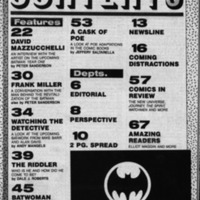
Batman, Batman, Batman. If there is one emphasis for the entire comic book, it’s the caped crusader. Dominating five of the seven featured stories and interviews, as well as taking center stage on the cover, there is no question to why Issue #102 of Amazing Heroes was almost subtitled “Spotlight on the Dark Knight” (see bottom right corner).
The first half of this everything-Batman issue focuses on the future, starting with the lead feature: “David Mazzucchelli: An Interview with the Artist on the Upcoming Batman: Year One,” which is then followed by “Frank Miller: A Conversation With the Man Behind The Revitalization of the Batman,” and ends with “Watching the Detective: A Look at the Upcoming Bat-Work from Mike Barr and Alan Davis.”
The next ten pages turn toward the past. From pages thirty-nine to forty-four, the issue spotlights The Riddler, providing a historical answer to the title of the feature: “Who Is He and How Did He Come To Be?” Then, from pages forty-five to forty-eight, Batwoman is given her own archival piece with “Batwoman: A Fond Remembrance.”
This is where the issue’s focus on Batman ends, however, as the last two features are “Ten of a Kind: The Ten Best Sidekicks,” and “A Cask of Poe: A Look at Poe Adaptations in the Comic Books,” which is then followed by the stereotypical department pieces.
Batman was the second DC Comics character to get a fresh start in 1986, following Superman’s reboot by John Byrne and preceding Wonder Woman’s. To reintroduce the character’s origin story, DC contacted Frank Miller, whose script for the four-issue miniseries “Batman: Year One” was interpreted by artist David Mazzucchelli, whose bold, direct art style (that can be seen on the cover of this issue) perfectly fit with Miller’s reboot. “Batman: Year One” waded in uncharted waters for the hero, so the bold art style and new writing was a tremendously effective way to send the message that this was a new beginning. During this time, Miller wrote another limited series for DC’s dark hero - “Batman: The Dark Knight Returns.” In this series, much like the character in “Batman: Year One,” Bruce is an upset, older right-wing moralist who lives in a corrupted Gotham City.
Throughout the 1980s, Miller led a new movement among comic book writers. More and more, writers were beginning to deconstruct superheroes while simultaneously revitalizing them. While Miller took his hero to the right-wing side of the morality spectrum, Howard Chaykin took the opposing side and examined the world from a leftist perspective through writing “American Flagg,” a satirical caricature of the world at the time. In the end, Miller’s revitalized Batman and Chaykin’s satire were precursors to the ultimate, and possibly most beloved, comic book writer, Alan Moore.
The first half of this everything-Batman issue focuses on the future, starting with the lead feature: “David Mazzucchelli: An Interview with the Artist on the Upcoming Batman: Year One,” which is then followed by “Frank Miller: A Conversation With the Man Behind The Revitalization of the Batman,” and ends with “Watching the Detective: A Look at the Upcoming Bat-Work from Mike Barr and Alan Davis.”
The next ten pages turn toward the past. From pages thirty-nine to forty-four, the issue spotlights The Riddler, providing a historical answer to the title of the feature: “Who Is He and How Did He Come To Be?” Then, from pages forty-five to forty-eight, Batwoman is given her own archival piece with “Batwoman: A Fond Remembrance.”
This is where the issue’s focus on Batman ends, however, as the last two features are “Ten of a Kind: The Ten Best Sidekicks,” and “A Cask of Poe: A Look at Poe Adaptations in the Comic Books,” which is then followed by the stereotypical department pieces.
Batman was the second DC Comics character to get a fresh start in 1986, following Superman’s reboot by John Byrne and preceding Wonder Woman’s. To reintroduce the character’s origin story, DC contacted Frank Miller, whose script for the four-issue miniseries “Batman: Year One” was interpreted by artist David Mazzucchelli, whose bold, direct art style (that can be seen on the cover of this issue) perfectly fit with Miller’s reboot. “Batman: Year One” waded in uncharted waters for the hero, so the bold art style and new writing was a tremendously effective way to send the message that this was a new beginning. During this time, Miller wrote another limited series for DC’s dark hero - “Batman: The Dark Knight Returns.” In this series, much like the character in “Batman: Year One,” Bruce is an upset, older right-wing moralist who lives in a corrupted Gotham City.
Throughout the 1980s, Miller led a new movement among comic book writers. More and more, writers were beginning to deconstruct superheroes while simultaneously revitalizing them. While Miller took his hero to the right-wing side of the morality spectrum, Howard Chaykin took the opposing side and examined the world from a leftist perspective through writing “American Flagg,” a satirical caricature of the world at the time. In the end, Miller’s revitalized Batman and Chaykin’s satire were precursors to the ultimate, and possibly most beloved, comic book writer, Alan Moore.
Creator
Cover Artist: David Mazzucchelli
Managing Editor: Mark Waid
Art Director: Dale Crain
Production Manager: Kim Thompson
News Correspondent: J. Collier
Production Assistant: Theresa Moore
Typesetting: L.M. Gorell & Arlene Easter
Circulation: Julie Strnad
Managing Editor: Mark Waid
Art Director: Dale Crain
Production Manager: Kim Thompson
News Correspondent: J. Collier
Production Assistant: Theresa Moore
Typesetting: L.M. Gorell & Arlene Easter
Circulation: Julie Strnad
Source
MSU Special Collection Comic Art, PN6725.A47
Publisher
Fantagraphics Books, Inc.
Date
09-1986
Contributor
Matthew Marshall
Rights
Rights Restrictions Apply
Format
10 and 1/4 inches by 6 and 5/8 inches, B&W
Language
English
Type
Periodical
Coverage
1981-1992
Still Image Item Type Metadata
Original Format
Comic Book
Physical Dimensions
10 and 1/4 inches by 6 and 5/8 inches
Files
Collection
Citation
Cover Artist: David Mazzucchelli
Managing Editor: Mark Waid
Art Director: Dale Crain
Production Manager: Kim Thompson
News Correspondent: J. Collier
Production Assistant: Theresa Moore
Typesetting: L.M. Gorell & Arlene Easter
Circulation: Julie Strnad, “Amazing Heroes Issue #102 Table of Contents,” Critical Fanscape, accessed October 17, 2026, https://chambl91.msu.domains/CriticalFanscape/items/show/40.