Amazing Heroes, Issue #167 Cover Page
Dublin Core
Title
Amazing Heroes, Issue #167 Cover Page
Subject
comic books, strips
Superheroes
Batman
Batman and Robin
Superheroes
Batman
Batman and Robin
Description
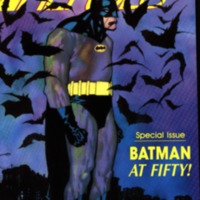
The cover of issue #167 of Amazing Heroes depicts an angry Batman, who scowls as he stands outside in front of a distant city skyline. Batman’s facial features are a little obscure; all we can really gather from his face is that he appears to be mad. This is also enforced by the fact that Batman’s fists are clenched. The skyline behind him is tiny; no monuments or tall buildings stick out. Because of this, we cannot necessarily guess the city Batman is in; all we can gather is that he is by an urban setting. The sky is also an ombre blue-purple, signaling to the viewer that it must be twilight. The most striking thing on the cover is the twenty or so bats, which are flying around Batman. On the top of the page, in yellow to contrast the blue background and to match the yellow highlights in Batman’s costume, it states “Amazing Heroes”. In the corner is a box stating “No. 167, June 15th, 1989” with the pricing as well. Towards the bottom right of the page are the words “Special Issue: Batman at 50!”
This special issue is a good tool for understanding the history of comics, especially its origins in pulp fiction. Batman is a prime example of this pulp fiction turned superhero character. Pulp magazines emerged in the early 20th century as a way to deal with the effects of urbanization of America. People struggled with this new way of living, many feeling as though America was straying away from its original beliefs and morals. Pulp stories usually revolved around a detective of some sort, who would fight crime, aka fight for moral superiority, in the urban slums. In the new technological age of the 20th century, superheroes replaced pulp fiction detectives, but they mainly served the same purpose— fighting crime and the perceived effects of urbanization. Superheroes also served to aid in the masculinity crisis that was a result of urbanization. Many men felt that since they no longer had a home and land to upkeep, they were somehow less than. This, coupled with xenophobia, increased crime, rapid technological changes, etc. made superheroes a possibility. Superheroes solved these ‘issues’ by asserting the perceived white male dominance over everything. These all-white superheroes did this by being superhuman and better at everything than anyone else. Overall, superheroes served as a way to escape from reality. For instance, many people saw Superman as a character to turn to when they were overwhelmed by rapid technological advancements since he was able to fly over anything or be faster than it. Batman becomes interesting in that he is more relatable for the everyday citizen since he does not actually have powers. Instead, he uses money and knowledge to gain control over technology to use for his own advantages. This periodical becomes interesting in that it goes in depth in the history of Batman and how he has interacted and changed throughout time. Batman serves as the second major superhero to come out (after Superman of course) and he still remains relevant today.
This special issue is a good tool for understanding the history of comics, especially its origins in pulp fiction. Batman is a prime example of this pulp fiction turned superhero character. Pulp magazines emerged in the early 20th century as a way to deal with the effects of urbanization of America. People struggled with this new way of living, many feeling as though America was straying away from its original beliefs and morals. Pulp stories usually revolved around a detective of some sort, who would fight crime, aka fight for moral superiority, in the urban slums. In the new technological age of the 20th century, superheroes replaced pulp fiction detectives, but they mainly served the same purpose— fighting crime and the perceived effects of urbanization. Superheroes also served to aid in the masculinity crisis that was a result of urbanization. Many men felt that since they no longer had a home and land to upkeep, they were somehow less than. This, coupled with xenophobia, increased crime, rapid technological changes, etc. made superheroes a possibility. Superheroes solved these ‘issues’ by asserting the perceived white male dominance over everything. These all-white superheroes did this by being superhuman and better at everything than anyone else. Overall, superheroes served as a way to escape from reality. For instance, many people saw Superman as a character to turn to when they were overwhelmed by rapid technological advancements since he was able to fly over anything or be faster than it. Batman becomes interesting in that he is more relatable for the everyday citizen since he does not actually have powers. Instead, he uses money and knowledge to gain control over technology to use for his own advantages. This periodical becomes interesting in that it goes in depth in the history of Batman and how he has interacted and changed throughout time. Batman serves as the second major superhero to come out (after Superman of course) and he still remains relevant today.
Creator
Editorial Team #167:
Executive Editor: Kim “Bruce” Thompson
Managing Editor: Chris “Dick” McCubbin
Art Director: Lynette “barbara” Alcorn-McCubbin
Editorial Assistance: Rudy “Bat-Mite” Minger
Editorial Intern: Alex “Ace” Chun
News Correspondent: Darren “Alfred” Cranston
Production Assistant: Roberta “Helena” Gregory
Typesetting: Linda Gorell, Arlene Easter, Mark Thompson
Circulation: Alison Yount, Michelle Byrd
Publisher: Fantagraphics Books, Inc.
Executive Editor: Kim “Bruce” Thompson
Managing Editor: Chris “Dick” McCubbin
Art Director: Lynette “barbara” Alcorn-McCubbin
Editorial Assistance: Rudy “Bat-Mite” Minger
Editorial Intern: Alex “Ace” Chun
News Correspondent: Darren “Alfred” Cranston
Production Assistant: Roberta “Helena” Gregory
Typesetting: Linda Gorell, Arlene Easter, Mark Thompson
Circulation: Alison Yount, Michelle Byrd
Publisher: Fantagraphics Books, Inc.
Source
MSU Special Collection Comic Art, PN6725.A47
Publisher
Publisher: Fantagraphics Books, Inc.
Date
1989-6
Contributor
Hannah Boyd
Rights
Rights Restrictions Apply
Relation
Representative Image: http://chambl91.msu.domains/CriticalFanscape/items/show/63
Table of Contents: http://chambl91.msu.domains/CriticalFanscape/items/show/62
Table of Contents: http://chambl91.msu.domains/CriticalFanscape/items/show/62
Format
10 and 1/4 inches by 6 and 5/8 inches
Language
English
Type
Periodical
Coverage
1981-1992
Files
Collection
Citation
Editorial Team #167:
Executive Editor: Kim “Bruce” Thompson
Managing Editor: Chris “Dick” McCubbin
Art Director: Lynette “barbara” Alcorn-McCubbin
Editorial Assistance: Rudy “Bat-Mite” Minger
Editorial Intern: Alex “Ace” Chun
News Correspondent: Darren “Alfred” Cranston
Production Assistant: Roberta “Helena” Gregory
Typesetting: Linda Gorell, Arlene Easter, Mark Thompson
Circulation: Alison Yount, Michelle Byrd
Publisher: Fantagraphics Books, Inc.
, “Amazing Heroes, Issue #167 Cover Page,” Critical Fanscape, accessed October 17, 2026, https://chambl91.msu.domains/CriticalFanscape/items/show/43.