Amazing Heroes Issue #11 Representative Page
Dublin Core
Title
Amazing Heroes Issue #11 Representative Page
Subject
Periodical
Comics Strips
Comics Strips
Description
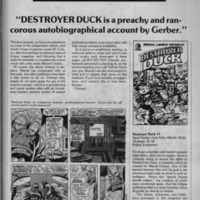
Kevin McConnell sheds his light on four distinct comic books in the eleventh issue of Amazing Heroes through his recurring piece: “Comics in Review.” In this segment, McConnell covers Jack Kerby and Kirby-Mike Thibodeaux’s “Captain Victory #5,” stating there is “no reason for [its] rigid conventionality.” McConnell then covers “Charlton Bullseye #9,” “a piquant amalgam of fan efforts.” The last review is of Gil Kane’s “Savage,” where McConnell warns readers who found Daredevil too “rough-and-tough” to stay away from Kane’s latest comic. Most notably, however, is McConnell’s initial review in the article - that of Steve Gerber’s “Destroyer Duck #1,” as the review discusses Gerber’s legal situation at the time and lays the foundation for the ongoing intellectual-property battle between comic book creators and companies who employed them.
In 1973, Steve Gerber created Howard the Duck — a widely-popular, anthropomorphic duck that had an initial thirty-three series run. However, just because Howard was created by Gerber, Gerber did not own Howard. As he initially created the character, Gerber worked for Marvel Comics, thus leaving the rights to Howard in Marvel’s hands. Having left Marvel and wanting Howard’s rights, Gerber created a new comic, “Destroyer Duck.” During the time Gerber created and published “Destroyer Duck #1,” he was locked in legal battle with Marvel over possession of Howard. As McConnell’s review explains, “Gerber’s message [in “Destroyer Duck #1”] is clear — he wants his duck back… Considering this, perhaps creators’ rights are … going to have to be re-evaluated.” And re-evaluated they were.
During the second half of the 1970s, the long-standing publisher-creator contract was about to change thanks to numerous comic book creator’s sharing the same beliefs that Gerber held. Since the industry began, creators were on a work-for-hire basis, meaning all work they contributed during their contract became the property of the publisher when finished. The most famous byproduct of this relationship, of course, is that of Jerry Seigel and Joe Shuster, who sold the rights of “Superman” to Detective Comics for an infinitesimally-small $130. Or, similarly, the creative work of Gerber staying with Marvel after his departure. Creators of the 1970s, however, were changing this one-sided affair. Demanding royalties, creative incentives, and a greater sense of entitlement to their work, this new generation of comic creators were not backing down to publishers — including Gerber and his fight for Howard. A new copyright law went into effect in 1978, clearing up any uncertainty between creators and publishers, and some creators were able to win greater creative concessions in the aftermath. However, the new copyright law was more flash than substance and, with no drastic change, creator-backlash continued, culminating in 1990 with the publication of “A Bill of Rights for Comics Creators;” a twelve-amendment article specifically listing the various rights and dignities of creators everywhere. With amendments like “The right to full ownership of what we fully create,” “The right of approval over the reproduction and format of our creative property,” and “The right to free movement of ourselves and our creative property to and from publishers,” the message was clear. Comic creators still believed the ownership of what they create should rest in their hands, not in the hands of the company they temporarily work for.
In 1973, Steve Gerber created Howard the Duck — a widely-popular, anthropomorphic duck that had an initial thirty-three series run. However, just because Howard was created by Gerber, Gerber did not own Howard. As he initially created the character, Gerber worked for Marvel Comics, thus leaving the rights to Howard in Marvel’s hands. Having left Marvel and wanting Howard’s rights, Gerber created a new comic, “Destroyer Duck.” During the time Gerber created and published “Destroyer Duck #1,” he was locked in legal battle with Marvel over possession of Howard. As McConnell’s review explains, “Gerber’s message [in “Destroyer Duck #1”] is clear — he wants his duck back… Considering this, perhaps creators’ rights are … going to have to be re-evaluated.” And re-evaluated they were.
During the second half of the 1970s, the long-standing publisher-creator contract was about to change thanks to numerous comic book creator’s sharing the same beliefs that Gerber held. Since the industry began, creators were on a work-for-hire basis, meaning all work they contributed during their contract became the property of the publisher when finished. The most famous byproduct of this relationship, of course, is that of Jerry Seigel and Joe Shuster, who sold the rights of “Superman” to Detective Comics for an infinitesimally-small $130. Or, similarly, the creative work of Gerber staying with Marvel after his departure. Creators of the 1970s, however, were changing this one-sided affair. Demanding royalties, creative incentives, and a greater sense of entitlement to their work, this new generation of comic creators were not backing down to publishers — including Gerber and his fight for Howard. A new copyright law went into effect in 1978, clearing up any uncertainty between creators and publishers, and some creators were able to win greater creative concessions in the aftermath. However, the new copyright law was more flash than substance and, with no drastic change, creator-backlash continued, culminating in 1990 with the publication of “A Bill of Rights for Comics Creators;” a twelve-amendment article specifically listing the various rights and dignities of creators everywhere. With amendments like “The right to full ownership of what we fully create,” “The right of approval over the reproduction and format of our creative property,” and “The right to free movement of ourselves and our creative property to and from publishers,” the message was clear. Comic creators still believed the ownership of what they create should rest in their hands, not in the hands of the company they temporarily work for.
Creator
Artist: Gene Colan and John Workman
Editor: Kim Thompson
Art Director: Peppy White
Assistant Editor: J. Collier
Consulting Editor: Dwight R. Decker
Advertising: J. Michael Catron
Contributing Writers: Dwight R. Decker, Jim Korkis, Rich Morrissey, Gene Reed, David Singer
Contributing Artists: Paul Abrams, Bill Anderson, Willie Blyberg, George Bryant, Sam De La Rosa, 'Bert, Hernandez, Matt Horwitz, G. Kracken, Gary Kwapisz, Kevin Nowlan, Bud Perkins
Editor: Kim Thompson
Art Director: Peppy White
Assistant Editor: J. Collier
Consulting Editor: Dwight R. Decker
Advertising: J. Michael Catron
Contributing Writers: Dwight R. Decker, Jim Korkis, Rich Morrissey, Gene Reed, David Singer
Contributing Artists: Paul Abrams, Bill Anderson, Willie Blyberg, George Bryant, Sam De La Rosa, 'Bert, Hernandez, Matt Horwitz, G. Kracken, Gary Kwapisz, Kevin Nowlan, Bud Perkins
Source
MSU Special Collection Comic Art, PN6725.A47
Publisher
Redbeard, Inc.
Date
05-1982
Contributor
Matthew Marshall
Rights
Rights Restrictions Apply
Format
8 inches by 11 inches, B&W
Language
English
Type
Periodical, TIFF File
Coverage
1981-1992
Still Image Item Type Metadata
Original Format
Comic Book
Physical Dimensions
8 inches by 11 inches
Files
Collection
Citation
Artist: Gene Colan and John Workman
Editor: Kim Thompson
Art Director: Peppy White
Assistant Editor: J. Collier
Consulting Editor: Dwight R. Decker
Advertising: J. Michael Catron
Contributing Writers: Dwight R. Decker, Jim Korkis, Rich Morrissey, Gene Reed, David Singer
Contributing Artists: Paul Abrams, Bill Anderson, Willie Blyberg, George Bryant, Sam De La Rosa, 'Bert, Hernandez, Matt Horwitz, G. Kracken, Gary Kwapisz, Kevin Nowlan, Bud Perkins, “Amazing Heroes Issue #11 Representative Page,” Critical Fanscape, accessed October 17, 2026, https://chambl91.msu.domains/CriticalFanscape/items/show/44.