Amazing Heroes Issue #102 Representative Page
Dublin Core
Title
Amazing Heroes Issue #102 Representative Page
Subject
Periodical
Comics Strips
Comics Strips
Description
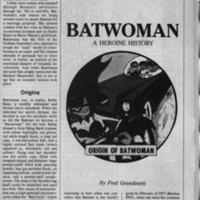
Only taking up three pages in this Batman-centered issue of Amazing Heroes, “Batwoman: A Heroine History” almost appears as an afterthought as opposed to a featured article. However, despite its length, Fred Grandinetti’s piece is broken down into three sections. “Origins,” where Grandinetti lays out how the heroine got her start, as well as her abilities. “Bat-Relations,” which touches on various relationships Batwoman held. And “Dead… Yet Alive,” where the context surrounding Batwoman’s death is discussed. While the article is mainly a historical recap of the heroine, much of the Grandinetti's discussed Batwoman-history directly reflects a larger narrative surrounding problematic female representation in the comic book industry during the mid-twentieth century.
Instead of being a symbol of strength and violence like their male counterparts, female superheroes emitted feminine qualities like love and domesticity. Hinted at in the “Origins” section of the feature, Batwoman’s abilities to fight crime reflect this conventional womanliness common among female superheroes of the time. Although the feature calls it her utility case, Batwoman carried a purse rather than wearing a utility belt like her male counterpart. And instead of arming herself with various weapons similar to the Dark Knight, she carries lipstick filled with tear gas, a make-up powder that makes others sneeze, and even an expanding hairnet. Similarly, DC’s most famous heroine Wonder Woman displayed the same conventional womanliness, often expressing themes of love and domesticity in her comics as opposed to the male-counterpart norms of ridding violence and crime.
This conventional womanliness is continued into the “Bat-Relations” section of the article, which highlights Batwoman’s relationship with Batman. After she is mentioned to have played the role of damsel in distress countless times in the comics, the feature discusses a specific comic where Batwoman pledged her love to Batman in the face of impending doom. While Batman initially reciprocated the feelings, he later retracted them after the danger had passed. Once again, the female stands in for feelings of love, romance, and domesticity, while the male counterpart continually prioritizes fighting crime and saving the day.
Furthermore, Batwoman’s love for Batman discussed in the “Bat-Relations” section highlights the prevalent masculine anxieties of the time. As Thomas Donaldson states in Ineffectual Lass Among the Legions of Superheros, “The industry degradation of female superheroes arose in direct response to a specific manifestation of postwar masculine anxiety, the condemnation of the comic book industry put forward by psychiatrist Fredric Wertham.” The main condemnation Donaldson is referring to is that of homosexuality between male superheroes, to which Wertham, the leader in the 1950s crusade against the comic industry, uses Batman and Robin’s relationship as prime evidence. Perhaps as a response to and commentary on these homosexual anxieties, Batman #122 (March 1959) was published - an issue that depicted a fictitious Batman and Batwoman marriage. In the issue, Dick Grayson has a nightmare where he sees the couple leaving the ceremony while Robin exclaims, “Gosh! What’ll become of me now?” Whether or not the creators were attempting to reassure everyone that Batman was heterosexual, this story directly uses Batman and Batwoman’s relationship as a source of anxiety for the young Robin.
Instead of being a symbol of strength and violence like their male counterparts, female superheroes emitted feminine qualities like love and domesticity. Hinted at in the “Origins” section of the feature, Batwoman’s abilities to fight crime reflect this conventional womanliness common among female superheroes of the time. Although the feature calls it her utility case, Batwoman carried a purse rather than wearing a utility belt like her male counterpart. And instead of arming herself with various weapons similar to the Dark Knight, she carries lipstick filled with tear gas, a make-up powder that makes others sneeze, and even an expanding hairnet. Similarly, DC’s most famous heroine Wonder Woman displayed the same conventional womanliness, often expressing themes of love and domesticity in her comics as opposed to the male-counterpart norms of ridding violence and crime.
This conventional womanliness is continued into the “Bat-Relations” section of the article, which highlights Batwoman’s relationship with Batman. After she is mentioned to have played the role of damsel in distress countless times in the comics, the feature discusses a specific comic where Batwoman pledged her love to Batman in the face of impending doom. While Batman initially reciprocated the feelings, he later retracted them after the danger had passed. Once again, the female stands in for feelings of love, romance, and domesticity, while the male counterpart continually prioritizes fighting crime and saving the day.
Furthermore, Batwoman’s love for Batman discussed in the “Bat-Relations” section highlights the prevalent masculine anxieties of the time. As Thomas Donaldson states in Ineffectual Lass Among the Legions of Superheros, “The industry degradation of female superheroes arose in direct response to a specific manifestation of postwar masculine anxiety, the condemnation of the comic book industry put forward by psychiatrist Fredric Wertham.” The main condemnation Donaldson is referring to is that of homosexuality between male superheroes, to which Wertham, the leader in the 1950s crusade against the comic industry, uses Batman and Robin’s relationship as prime evidence. Perhaps as a response to and commentary on these homosexual anxieties, Batman #122 (March 1959) was published - an issue that depicted a fictitious Batman and Batwoman marriage. In the issue, Dick Grayson has a nightmare where he sees the couple leaving the ceremony while Robin exclaims, “Gosh! What’ll become of me now?” Whether or not the creators were attempting to reassure everyone that Batman was heterosexual, this story directly uses Batman and Batwoman’s relationship as a source of anxiety for the young Robin.
Creator
Cover Artist: David Mazzucchelli
Managing Editor: Mark Waid
Art Director: Dale Crain
Production Manager: Kim Thompson
News Correspondent: J. Collier
Production Assistant: Theresa Moore
Typesetting: L.M. Gorell & Arlene Easter
Circulation: Julie Strnad
Managing Editor: Mark Waid
Art Director: Dale Crain
Production Manager: Kim Thompson
News Correspondent: J. Collier
Production Assistant: Theresa Moore
Typesetting: L.M. Gorell & Arlene Easter
Circulation: Julie Strnad
Source
MSU Special Collection Comic Art, PN6725.A47
Publisher
Fantagraphics Books, Inc.
Date
09-1986
Contributor
Matthew Marshall
Rights
Rights Restrictions Apply
Format
10 and 1/4 inches by 6 and 5/8 inches, B&W
Language
English
Type
Periodical, TIFF File
Coverage
1981-1992
Still Image Item Type Metadata
Original Format
Comic Book
Physical Dimensions
10 and 1/4 inches by 6 and 5/8 inches
Files
Collection
Citation
Cover Artist: David Mazzucchelli
Managing Editor: Mark Waid
Art Director: Dale Crain
Production Manager: Kim Thompson
News Correspondent: J. Collier
Production Assistant: Theresa Moore
Typesetting: L.M. Gorell & Arlene Easter
Circulation: Julie Strnad, “Amazing Heroes Issue #102 Representative Page,” Critical Fanscape, accessed October 17, 2026, https://chambl91.msu.domains/CriticalFanscape/items/show/45.