Amazing Heroes Issue #104 Representative Page
Dublin Core
Title
Amazing Heroes Issue #104 Representative Page
Subject
Periodical
Comics Strips
Comics Strips
Description
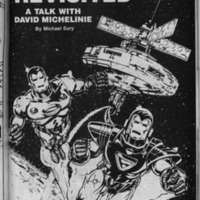
In this special Sci-Fi issue, perhaps the most recognizable name is Iron Man. With an eight-page profile on David Michelinie, the new writer of Iron Man, it becomes clear that Tony Stark was given dramatic changes in the 1980s. The sections include “The Origins of David Michelinie” which discusses how the writer got his start in the comic industry, “Iron Man,” a detailed history of the hero in the early ‘80s, “New Directions,” a section in which Michelinie talks about how he will handle the series moving forward, “Iron Man’s Armor,” a sneak peek into some future Stark technology, “James Rhodes,” a look at the future of Stark’s number two, “The Supporting Cast,” including talks of future female (and other) supporting characters, “Ant-Fans Rejoice!” a promise of Ant-Man reintroduction into the Iron Man narrative, “The Villains,” hinting at Iron Man’s potential foes, ending with “The Creative Team,” “Bozz Chronicles,” “Spider-Man,” and “Other Projects,” all of which discuss a few of Michelinie’s past projects.
Of the numerous sections written in the feature, perhaps the most historically relevant is “New Directions.” In the section, Michelinie talks about wrapping up storylines from the previous writers but then plans to move onto his own, new ideas, which include rebuilding Stark Enterprises. After the first year of issues, Micheline says, Stark Enterprises will go international. Then, Michelinie and Layton (another writer) also discussed putting Tony back into the political realm, stating: “This is a successful, brilliant, good-looking millionaire who wants to do good for the world. It seems natural that the political machines would be interested in this charismatic fellow.” Interestingly enough, this interplay between Stark, his company, and the political sphere becomes a recurring theme throughout the Iron Man series. Often times, the hero’s issues reflect the general public consensus, whether it be right or left winged.
Literally forged on the battlegrounds of Vietnam, Iron Man was originally a pro-war conservative, having once asserted “No one has the right to defy the wishes of the government! Not even Iron Man!” However, popular support for the Cold War declined after 1968. Iron Man’s military sales allowed for the series to be the perfect vehicle to discuss the changing political views surrounding the war. So, Iron Man partook in major political conversations following the pro-war decline. Stark began to distance himself from working with the U.S. government and cared more for the average citizen, eventually completely turning against the Vietnam War. One Iron Man comic, “Long Time Gone,” opens with Iron Man talking to himself, contemplating how his weapons have killed countless people overseas. Then, thinking of Vietnam, he wonders “What right do we have to be there in the first place?” Following Iron Man’s political shift, extensive amounts of fan mail came rolling in, with many for and many against Tony’s change, including some stating that the series had moved too far left. In the end, Iron Man has shifted back and forth between the two political realms for many years, and Michelinie’s decision to bring Stark back into the political conversation was nothing the series had not seen before.
Of the numerous sections written in the feature, perhaps the most historically relevant is “New Directions.” In the section, Michelinie talks about wrapping up storylines from the previous writers but then plans to move onto his own, new ideas, which include rebuilding Stark Enterprises. After the first year of issues, Micheline says, Stark Enterprises will go international. Then, Michelinie and Layton (another writer) also discussed putting Tony back into the political realm, stating: “This is a successful, brilliant, good-looking millionaire who wants to do good for the world. It seems natural that the political machines would be interested in this charismatic fellow.” Interestingly enough, this interplay between Stark, his company, and the political sphere becomes a recurring theme throughout the Iron Man series. Often times, the hero’s issues reflect the general public consensus, whether it be right or left winged.
Literally forged on the battlegrounds of Vietnam, Iron Man was originally a pro-war conservative, having once asserted “No one has the right to defy the wishes of the government! Not even Iron Man!” However, popular support for the Cold War declined after 1968. Iron Man’s military sales allowed for the series to be the perfect vehicle to discuss the changing political views surrounding the war. So, Iron Man partook in major political conversations following the pro-war decline. Stark began to distance himself from working with the U.S. government and cared more for the average citizen, eventually completely turning against the Vietnam War. One Iron Man comic, “Long Time Gone,” opens with Iron Man talking to himself, contemplating how his weapons have killed countless people overseas. Then, thinking of Vietnam, he wonders “What right do we have to be there in the first place?” Following Iron Man’s political shift, extensive amounts of fan mail came rolling in, with many for and many against Tony’s change, including some stating that the series had moved too far left. In the end, Iron Man has shifted back and forth between the two political realms for many years, and Michelinie’s decision to bring Stark back into the political conversation was nothing the series had not seen before.
Creator
Cover Artists: Doug Rice, Dale Crain
Managing Editor: Mark Waid
Art Director: Dale Crain
Production Manager: Kim Thompson
News Correspondent: J. Collier
Production Assistant: Theresa Moore
Typesetting: L.M. Gorell & Arlene Easter
Circulation: Rachel Enger
Managing Editor: Mark Waid
Art Director: Dale Crain
Production Manager: Kim Thompson
News Correspondent: J. Collier
Production Assistant: Theresa Moore
Typesetting: L.M. Gorell & Arlene Easter
Circulation: Rachel Enger
Source
MSU Special Collection Comic Art, PN6725.A47
Publisher
Fantagraphics Books, Inc.
Date
10-1986
Contributor
Matthew Marshall
Rights
Rights Restrictions Apply
Format
10 and 1/4 inches by 6 and 5/8 inches, B&W
Language
English
Type
Periodical, TIFF File
Coverage
1981-1992
Still Image Item Type Metadata
Original Format
Comic Book
Physical Dimensions
10 and 1/4 inches by 6 and 5/8 inches
Files
Collection
Citation
Cover Artists: Doug Rice, Dale Crain
Managing Editor: Mark Waid
Art Director: Dale Crain
Production Manager: Kim Thompson
News Correspondent: J. Collier
Production Assistant: Theresa Moore
Typesetting: L.M. Gorell & Arlene Easter
Circulation: Rachel Enger, “Amazing Heroes Issue #104 Representative Page,” Critical Fanscape, accessed October 17, 2026, https://chambl91.msu.domains/CriticalFanscape/items/show/46.