Amazing Heroes Issue #159 Table of Contents
Dublin Core
Title
Amazing Heroes Issue #159 Table of Contents
Subject
comics, comic strips
interviews
Superheroes
interviews
Superheroes
Description
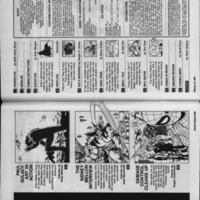
The table of contents for issue #159 of Amazing Heroes is on page 4-5. The left page, written vertically down the page says ‘contents’. Next to that are the three main articles of the piece. The first one is titled ‘Paul Gulacy: Art in Action’. Underneath the title is a short description of the article. Next to the title and description is an image of Coldblood-7’s silhouette. The article title underneath states ‘The Sidney Mellon Interview’ with the description underneath the title. The picture accompanying the description has the Wolverine falling forward as if he is leaping onto someone. The final article description listed on this page is titled ‘Damage Control Cleans Up’. The description is below. The picture accompanying this description is to the left. It depicts many things, such as Spiderman, a large boot, a hero flying in the background, etc. The right page is dedicated to all the smaller articles. They are titled as followed ‘Perspective’, ‘Newsline’, ‘Coming Distractions’, ‘Backstage’, ‘Firstlook’, ‘Doc’s Bookshelf’, ‘Video Views’, ‘Small Talk’, ‘Info Center’, ‘Comics in Review’, ‘Amazing Readers’, and ‘Strom’s Index’. To the left of this column is the area dedicated to the editorial team, index to ads, ad rates, and distributors.
This table of contents sheds light on many important themes of the times. An important theme is mutation. Both Coldblood-7 and the Wolverine are mutants. Mutation of the human form was used as a way to explore ‘otherness’. Many people have come to believe that mutants are used as a way to represent minorities in particular. The X-Men revitalization by John Bryne and Chris Claremont in 1975 is a prime example of this. This new X-Men squad consisted of people from all different countries—the Wolverine is from Canada, Colossus is from Russia, etc. Popular in the Marvel universe at the time was the idea of the ‘outsider’ who helped society even though society hated them. Many see this narrative as a good reflection of minorities. The X-Men was a used this popular narrative to alter our understanding of it. In previous years, minorities were portrayed as stereotypical, submissive, especially among African American characters. For instance, many minority characters were given the role of the sidekick, evil villain, etc. This was a way of maintaining this false idea of superiority of white people and the inferiority of minorities. In the 70s and onward though, this narrative changes and the minority superhero is given a space to interact and tell their own story. This is in large part due to the changing political climate. The 60s saw the Civil Rights Movement, resulting in public opinion becoming, for the most part, more accepting and diverse. The idea of ‘mutation’ was then used in this new political climate to talk about minorities in different ways. The idea of mutation is in no ways new, but it was used to give these superheroes their powers in ways that make the interior. Their power comes from within, not from the technology they use—their power is a part of them. A prime example of this is the Wolverine, who was injected with a chemical that altered his genetic makeup. In this way, the X-Men’s power is internal; they themselves are powerful, not their technology. This gave minorities a space to see their own power.
This table of contents sheds light on many important themes of the times. An important theme is mutation. Both Coldblood-7 and the Wolverine are mutants. Mutation of the human form was used as a way to explore ‘otherness’. Many people have come to believe that mutants are used as a way to represent minorities in particular. The X-Men revitalization by John Bryne and Chris Claremont in 1975 is a prime example of this. This new X-Men squad consisted of people from all different countries—the Wolverine is from Canada, Colossus is from Russia, etc. Popular in the Marvel universe at the time was the idea of the ‘outsider’ who helped society even though society hated them. Many see this narrative as a good reflection of minorities. The X-Men was a used this popular narrative to alter our understanding of it. In previous years, minorities were portrayed as stereotypical, submissive, especially among African American characters. For instance, many minority characters were given the role of the sidekick, evil villain, etc. This was a way of maintaining this false idea of superiority of white people and the inferiority of minorities. In the 70s and onward though, this narrative changes and the minority superhero is given a space to interact and tell their own story. This is in large part due to the changing political climate. The 60s saw the Civil Rights Movement, resulting in public opinion becoming, for the most part, more accepting and diverse. The idea of ‘mutation’ was then used in this new political climate to talk about minorities in different ways. The idea of mutation is in no ways new, but it was used to give these superheroes their powers in ways that make the interior. Their power comes from within, not from the technology they use—their power is a part of them. A prime example of this is the Wolverine, who was injected with a chemical that altered his genetic makeup. In this way, the X-Men’s power is internal; they themselves are powerful, not their technology. This gave minorities a space to see their own power.
Creator
Editorial Team #159:
Executive Editor: Kim “Dracula” Thompson
Managing Editor: Chris “Frankenstein” McCubbin
Art Director: Lynette “Vampirilla” Alcorn-McCubbin
Editorial Assistance: Charles “Invisible Man” Lieurance
News Correspondent: Darren “Wolfman” Cranston
Production Assistant: Mark Thompson
Typesetting: Linda Gorell, Arlene Easter
Circulation: Rachel Enger, Carol Kovinick-Hernandez
Publisher: Fantagraphics Books, Inc.
Executive Editor: Kim “Dracula” Thompson
Managing Editor: Chris “Frankenstein” McCubbin
Art Director: Lynette “Vampirilla” Alcorn-McCubbin
Editorial Assistance: Charles “Invisible Man” Lieurance
News Correspondent: Darren “Wolfman” Cranston
Production Assistant: Mark Thompson
Typesetting: Linda Gorell, Arlene Easter
Circulation: Rachel Enger, Carol Kovinick-Hernandez
Publisher: Fantagraphics Books, Inc.
Source
MSU Special Collection Comic Art, PN6725.A47
Publisher
Fantagraphics Books, Inc.
Date
1989-2
Contributor
Hannah Boyd
Rights
Rights Restrictions Apply
Relation
Cover: http://chambl91.msu.domains/CriticalFanscape/items/show/54
Representative Image: http://chambl91.msu.domains/CriticalFanscape/items/show/58
Representative Image: http://chambl91.msu.domains/CriticalFanscape/items/show/58
Format
10 and 1/4 inches by 6 and 5/8 inches
Language
English
Type
Periodical
Coverage
1981-1992
Files
Collection
Citation
Editorial Team #159:
Executive Editor: Kim “Dracula” Thompson
Managing Editor: Chris “Frankenstein” McCubbin
Art Director: Lynette “Vampirilla” Alcorn-McCubbin
Editorial Assistance: Charles “Invisible Man” Lieurance
News Correspondent: Darren “Wolfman” Cranston
Production Assistant: Mark Thompson
Typesetting: Linda Gorell, Arlene Easter
Circulation: Rachel Enger, Carol Kovinick-Hernandez
Publisher: Fantagraphics Books, Inc.
, “Amazing Heroes Issue #159 Table of Contents,” Critical Fanscape, accessed October 17, 2026, https://chambl91.msu.domains/CriticalFanscape/items/show/55.