Amazing Heroes Issue #141 Cover
Dublin Core
Title
Amazing Heroes Issue #141 Cover
Subject
Periodical
Comic strips
Comic strips
Description
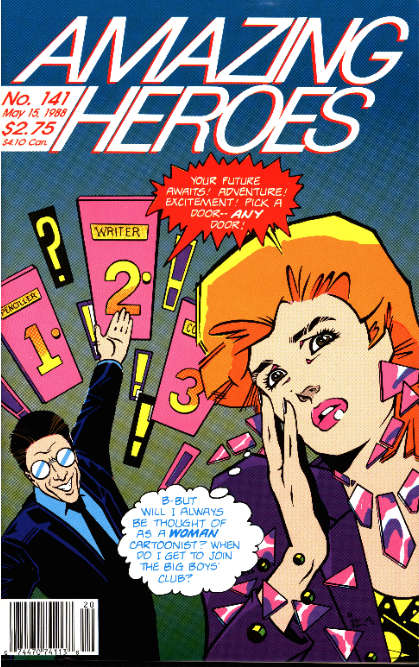
The 141st issue of the Amazing Heroes comic series focuses on the role of women in comics. The cover page features a picture of a woman in distress as she stops to think about what her role is in the comic book world. She is shown thinking to herself: “B – but will I always be thought of as a woman cartoonist? When do I get to join the big boys’ club?” There is also a picture of a man pointing to three different doors, two of which are labeled ‘Penciller’ and ‘Writer’. This man is saying: “Your future awaits! Adventure! Excitement! Pick a door – Any door!” While the man is smiling as he invites the woman to choose the door that will lead to her career path, the woman displays a look of hopelessness and despair, as she wonders whether she will be thought of as a woman writer, or a woman penciller, rather than simply a writer or penciller. While the man’s dialogue is spoken out loud, the woman keeps her thoughts to herself, suggesting that she knows she would face a backlash if she were to express these thoughts out loud.
The woman in this cover photo has a legitimate reason to feel worried about how comic book readers will perceive her. In the 1980s, women faced a lot of backlash in the comic book industry, both in real life and in the comic books themselves. In the real world, women were not offered jobs such as illustrators or writers, as it was believed that women weren’t talented enough to take on such a major role. In addition, the comic book industry was becoming increasingly appealing to young boys, so nobody thought women would be appropriate to hire as writers for a male-centered industry. Thus, when women did start getting roles in these positions, they were, as the woman in the cover photo worried about, seen as “woman cartoonists” and “woman writers”, rather than just “cartoonists” and “writers”. In addition, this woman’s worries about her role in the comic book industry carry over to the comic books themselves. Traditionally, female characters are seen as weak, helpless, passive, and overly feminine. Their only role is to be swept up and rescued by some hypermasculine superhero in order for the day to be saved. Thus, when female comic book characters are drawn to be more muscular or written to be more independent, they are seen simply as a threatening character, again negating the rest of their personalities and identities. This idea that a female character must have some sort of label or adjective attached to her has been a trend for decades, justifying the beliefs of this woman on the cover page. This issue as a whole addresses these concerns and, as seen later on in Heidi MacDonald’s article “House of Semi-Raging Women”, this issue stems from women having little control or say in how female characters are to be represented in comic books and in the general media in the first place.
The woman in this cover photo has a legitimate reason to feel worried about how comic book readers will perceive her. In the 1980s, women faced a lot of backlash in the comic book industry, both in real life and in the comic books themselves. In the real world, women were not offered jobs such as illustrators or writers, as it was believed that women weren’t talented enough to take on such a major role. In addition, the comic book industry was becoming increasingly appealing to young boys, so nobody thought women would be appropriate to hire as writers for a male-centered industry. Thus, when women did start getting roles in these positions, they were, as the woman in the cover photo worried about, seen as “woman cartoonists” and “woman writers”, rather than just “cartoonists” and “writers”. In addition, this woman’s worries about her role in the comic book industry carry over to the comic books themselves. Traditionally, female characters are seen as weak, helpless, passive, and overly feminine. Their only role is to be swept up and rescued by some hypermasculine superhero in order for the day to be saved. Thus, when female comic book characters are drawn to be more muscular or written to be more independent, they are seen simply as a threatening character, again negating the rest of their personalities and identities. This idea that a female character must have some sort of label or adjective attached to her has been a trend for decades, justifying the beliefs of this woman on the cover page. This issue as a whole addresses these concerns and, as seen later on in Heidi MacDonald’s article “House of Semi-Raging Women”, this issue stems from women having little control or say in how female characters are to be represented in comic books and in the general media in the first place.
Creator
Editor: Kevin Dooley
Art Director: Lynette Alcorn-McCubbin
Assistant Editor: Bruce Walrad
News Correspondent: Michael Johnson
Production Assistant: Mark Thompson
Typesetting: Linda Gorell, Arlene Easter, Donald K. Niven
Production Manager: Kim Thompson
Circulation: Rachel Enger
Publisher: Fantagraphics Books, Inc.
Printed at: Port Publications, WI
Art Director: Lynette Alcorn-McCubbin
Assistant Editor: Bruce Walrad
News Correspondent: Michael Johnson
Production Assistant: Mark Thompson
Typesetting: Linda Gorell, Arlene Easter, Donald K. Niven
Production Manager: Kim Thompson
Circulation: Rachel Enger
Publisher: Fantagraphics Books, Inc.
Printed at: Port Publications, WI
Source
MSU Special Collection Comic Art, PN6725.A47
Publisher
Publisher: Fantagraphics Books, Inc.
Date
1998-05
Contributor
Miranda Kalinowski
Rights
Rights Restrictions Apply
Format
10 and 1/4 inches by 6 and 5/8 inches
Language
English
Type
Periodical
Coverage
1981 - 1992
Files
Collection
Citation
Editor: Kevin Dooley
Art Director: Lynette Alcorn-McCubbin
Assistant Editor: Bruce Walrad
News Correspondent: Michael Johnson
Production Assistant: Mark Thompson
Typesetting: Linda Gorell, Arlene Easter, Donald K. Niven
Production Manager: Kim Thompson
Circulation: Rachel Enger
Publisher: Fantagraphics Books, Inc.
Printed at: Port Publications, WI, “Amazing Heroes Issue #141 Cover,” Critical Fanscape, accessed October 17, 2026, https://chambl91.msu.domains/CriticalFanscape/items/show/59.