Amazing Heroes Issue # 167, Table of Contents
Dublin Core
Title
Amazing Heroes Issue # 167, Table of Contents
Subject
comic books, strips
Superheroes
Costume
Batman Films
Superheroes
Costume
Batman Films
Description
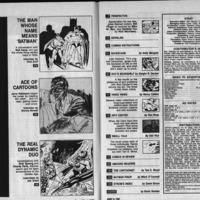
The table of contents for Amazing Heroes issue #167 can be found on page 4 and 5 in the periodical. It is split amongst two pages. The left page is dedicated to the main 3 articles. The left side of the left page simply says ‘contents’ vertically downward. Next to that are the three main articles. The first title is ‘The Man Whose Name Means Batman’ with an image of Batman and Robin next to it. Underneath the title is the description. Underneath this is the second other major article titled ‘Ace of Cartoons’ with a picture of the Joker right next to it. Underneath the title is the description of this article. Underneath this article is the last major article ‘The Real Dynamic Duo’ with the description of the article underneath. Next to that is a picture of Batman and Robin exploring the sea. This is all that is on the left page. The right page has all the minor articles with short descriptions under some of them. Some of the minor articles listed also have pictures depicted next to them. The section articles are as followed, ‘Perspective’, ‘Newsline’, ‘Coming Distractions’, ‘Backstage’, ‘Doc’s Bookshelf’, ‘Info Center’, ‘Small Talk’, ‘Comics in Review’, ‘Amazing Readers’, ‘The Cartoonist’, ‘Batman Pinup’, and ‘Storm’s Index’. On the right side of the page are the staff section with the editorial team, contributor’s info, index to advertisers, ad rates, and distributors. This table of contents is a good reflection on the history of Batman, as it is almost solely dedicated to him.
One theme that is prevalent in this table of contents is the interest in the origins of Batman. Batman started up in 1939 in DC Comics as a result of the success of Superman. Companies were seeing that the character Superman was taking off, and bringing a lot of money to the corporation as a result. DC Comics responded to this with the introduction of Batman, who was a vigilante out to stop corruption in the cities. This is a result of the fear many Americans were feeling at the time over the urbanization. Before the 40s, many people lived in rural areas, but with the industrial boom and immigration boom, more and more people migrated to the cities. With this rapid growth of the cities though, many became fearful that America’s morality would suffer and that crime would be on the rise. This led to the increase of the ‘detective story’. These detective’s jobs were to eradicate violence and crime in the city. Batman pays homage to this type of story in that he mirrored these detective characters in almost all ways, except that he dressed in a bat suit and fought crime in secret. Batman was also interesting in that his origin story revolved around trauma. This was a way of exploring ‘what could have been’. The 40s was a bleak time for many; immigrants came to America hoping for a good life but ended up working in bad conditions, people lived in the city with no roaming area, etc. Trauma was everywhere, and Batman was used to showing that even despite the trauma, you could thrive and be a force for good. Batman was a way of exploring the times and was used to mitigate become the bleak circumstances many people found themselves in the city.
One theme that is prevalent in this table of contents is the interest in the origins of Batman. Batman started up in 1939 in DC Comics as a result of the success of Superman. Companies were seeing that the character Superman was taking off, and bringing a lot of money to the corporation as a result. DC Comics responded to this with the introduction of Batman, who was a vigilante out to stop corruption in the cities. This is a result of the fear many Americans were feeling at the time over the urbanization. Before the 40s, many people lived in rural areas, but with the industrial boom and immigration boom, more and more people migrated to the cities. With this rapid growth of the cities though, many became fearful that America’s morality would suffer and that crime would be on the rise. This led to the increase of the ‘detective story’. These detective’s jobs were to eradicate violence and crime in the city. Batman pays homage to this type of story in that he mirrored these detective characters in almost all ways, except that he dressed in a bat suit and fought crime in secret. Batman was also interesting in that his origin story revolved around trauma. This was a way of exploring ‘what could have been’. The 40s was a bleak time for many; immigrants came to America hoping for a good life but ended up working in bad conditions, people lived in the city with no roaming area, etc. Trauma was everywhere, and Batman was used to showing that even despite the trauma, you could thrive and be a force for good. Batman was a way of exploring the times and was used to mitigate become the bleak circumstances many people found themselves in the city.
Creator
Editorial Team:
Executive Editor: Kim “Bruce” Thompson
Managing Editor: Chris “Dick” McCubbin
Art Director: Lynette “barbara” Alcorn-McCubbin
Editorial Assistance: Rudy “Bat-Mite” Minger
Editorial Intern: Alex “Ace” Chun
News Correspondent: Darren “Alfred” Cranston
Production Assistant: Roberta “Helena” Gregory
Typesetting: Linda Gorell, Arlene Easter, Mark Thompson
Circulation: Alison Yount, Michelle Byrd
Publisher: Fantagraphics Books, Inc.
Executive Editor: Kim “Bruce” Thompson
Managing Editor: Chris “Dick” McCubbin
Art Director: Lynette “barbara” Alcorn-McCubbin
Editorial Assistance: Rudy “Bat-Mite” Minger
Editorial Intern: Alex “Ace” Chun
News Correspondent: Darren “Alfred” Cranston
Production Assistant: Roberta “Helena” Gregory
Typesetting: Linda Gorell, Arlene Easter, Mark Thompson
Circulation: Alison Yount, Michelle Byrd
Publisher: Fantagraphics Books, Inc.
Source
MSU Special Collection Comic Art, PN6725.A47
Publisher
Publisher: Fantagraphics Books, Inc.
Date
1989-6
Contributor
Hannah Boyd
Rights
Rights Restrictions Apply
Relation
Cover: http://chambl91.msu.domains/CriticalFanscape/items/show/43
Representative Image: http://chambl91.msu.domains/CriticalFanscape/items/show/63
Representative Image: http://chambl91.msu.domains/CriticalFanscape/items/show/63
Format
10 and 1/4 inches by 6 and 5/8 inches
Language
English
Type
Periodical
Coverage
1981-1992
Files
Collection
Citation
Editorial Team:
Executive Editor: Kim “Bruce” Thompson
Managing Editor: Chris “Dick” McCubbin
Art Director: Lynette “barbara” Alcorn-McCubbin
Editorial Assistance: Rudy “Bat-Mite” Minger
Editorial Intern: Alex “Ace” Chun
News Correspondent: Darren “Alfred” Cranston
Production Assistant: Roberta “Helena” Gregory
Typesetting: Linda Gorell, Arlene Easter, Mark Thompson
Circulation: Alison Yount, Michelle Byrd
Publisher: Fantagraphics Books, Inc.
, “Amazing Heroes Issue # 167, Table of Contents,” Critical Fanscape, accessed October 17, 2026, https://chambl91.msu.domains/CriticalFanscape/items/show/62.