Amazing Heroes Issue # 167 Representative Image
Dublin Core
Title
Amazing Heroes Issue # 167 Representative Image
Subject
comic books, strips
Superheroes
Batman films
Costume
Superheroes
Batman films
Costume
Description
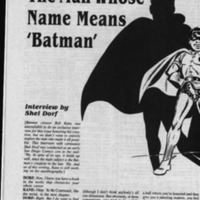
This depicts the beginning of the article “Bob Kane: The Man Whose Name Means Batman”. The title is written in large print, taking up almost half of the page. Next to the title is the shadow of Robin, with Robin right underneath the shadow. Robin is in costume and standing with his hands on his hips as he stares off into space. His costume consists of a dramatic cape, a leotard, gloves, and shoes. It is also important to note the lack of pants. On his face is a half mask obscuring his eyes. His expression can only be described as being valiant. Another thing to note is the youth that exudes from Robin. Robin is clearly a younger man, maybe even in his early 20s or younger. Below, towards the left side of the page, it states “Interview by Shel Dorf”. It then goes on to state that Bob Kane was not available for a new interview, so an old interview with Shel Dorf, a cartoonist, is reprinted here. The introduction states that even though this is an old interview from the 70s, it still holds true since the interview itself focuses on the creation of Batman in the 30s. Batman is an important figure in comics in that he shows the enduring impact superheroes can have on society.
Batman has served the test of time mainly in the fact that he has an ever-changing role. Understanding this is important in contextualizing the cultural narrative surrounding comics in that Batman became a part of culture due to his roles. Batman has probably served more roles than any other character, and he has also adapted with the times to stay relevant. For instance, in the 70s, when space exploration was taking off, Batman and Robin time traveled, become mutated, etc. Also, with the emergence of the practice of going to the movies, Batman would become one of the first superhero characters to get his own movie. This reflected the increasing idea of pop culture and media as technology now allowed for figures to become icons. Batman is also an interesting reflection on the idea of the ‘impressionable youth’. In Batman’s beginning, he was quite violent and was often depicted with weapons. Towards the 40s though, more and more people became concerned that Batman’s violent actions would infect the youths. Shortly after, Batman comics became squeaky clean; he no longer killed; he no longer was portrayed with guns. Batman was also softened with the introduction of the character Robin, who served the role of innocent apprentice/sidekick. This ‘cleansing’ of Batman comics has to do with the larger cultural narrative at the time, as many people were fearful that the rapid urbanization of the cities was stripping humanity of its moral compass. By the 80s though, mass media was no longer so innocent and the Batman character was used as a way to contextualize with the ever-changing world around them. With the Cold War, race riots, problems in the middle east, etc. people struggled to make sense of the world, and characters with deep psychological psychoses were used to do this.
Batman has served the test of time mainly in the fact that he has an ever-changing role. Understanding this is important in contextualizing the cultural narrative surrounding comics in that Batman became a part of culture due to his roles. Batman has probably served more roles than any other character, and he has also adapted with the times to stay relevant. For instance, in the 70s, when space exploration was taking off, Batman and Robin time traveled, become mutated, etc. Also, with the emergence of the practice of going to the movies, Batman would become one of the first superhero characters to get his own movie. This reflected the increasing idea of pop culture and media as technology now allowed for figures to become icons. Batman is also an interesting reflection on the idea of the ‘impressionable youth’. In Batman’s beginning, he was quite violent and was often depicted with weapons. Towards the 40s though, more and more people became concerned that Batman’s violent actions would infect the youths. Shortly after, Batman comics became squeaky clean; he no longer killed; he no longer was portrayed with guns. Batman was also softened with the introduction of the character Robin, who served the role of innocent apprentice/sidekick. This ‘cleansing’ of Batman comics has to do with the larger cultural narrative at the time, as many people were fearful that the rapid urbanization of the cities was stripping humanity of its moral compass. By the 80s though, mass media was no longer so innocent and the Batman character was used as a way to contextualize with the ever-changing world around them. With the Cold War, race riots, problems in the middle east, etc. people struggled to make sense of the world, and characters with deep psychological psychoses were used to do this.
Creator
Editorial Team #167:
Executive Editor: Kim “Bruce” Thompson
Managing Editor: Chris “Dick” McCubbin
Art Director: Lynette “barbara” Alcorn-McCubbin
Editorial Assistance: Rudy “Bat-Mite” Minger
Editorial Intern: Alex “Ace” Chun
News Correspondent: Darren “Alfred” Cranston
Production Assistant: Roberta “Helena” Gregory
Typesetting: Linda Gorell, Arlene Easter, Mark Thompson
Circulation: Alison Yount, Michelle Byrd
Publisher: Fantagraphics Books, Inc.
Executive Editor: Kim “Bruce” Thompson
Managing Editor: Chris “Dick” McCubbin
Art Director: Lynette “barbara” Alcorn-McCubbin
Editorial Assistance: Rudy “Bat-Mite” Minger
Editorial Intern: Alex “Ace” Chun
News Correspondent: Darren “Alfred” Cranston
Production Assistant: Roberta “Helena” Gregory
Typesetting: Linda Gorell, Arlene Easter, Mark Thompson
Circulation: Alison Yount, Michelle Byrd
Publisher: Fantagraphics Books, Inc.
Source
MSU Special Collection Comic Art, PN6725.A47
Publisher
Publisher: Fantagraphics Books, Inc.
Date
1989-6
Contributor
Hannah Boyd
Rights
Rights Restrictions Apply
Relation
Cover: http://chambl91.msu.domains/CriticalFanscape/items/show/43
Table of Contents: http://chambl91.msu.domains/CriticalFanscape/items/show/62
Table of Contents: http://chambl91.msu.domains/CriticalFanscape/items/show/62
Format
10 and 1/4 inches by 6 and 5/8 inches
Language
English
Type
Periodical
Coverage
1981-1992
Files
Collection
Citation
Editorial Team #167:
Executive Editor: Kim “Bruce” Thompson
Managing Editor: Chris “Dick” McCubbin
Art Director: Lynette “barbara” Alcorn-McCubbin
Editorial Assistance: Rudy “Bat-Mite” Minger
Editorial Intern: Alex “Ace” Chun
News Correspondent: Darren “Alfred” Cranston
Production Assistant: Roberta “Helena” Gregory
Typesetting: Linda Gorell, Arlene Easter, Mark Thompson
Circulation: Alison Yount, Michelle Byrd
Publisher: Fantagraphics Books, Inc.
, “Amazing Heroes Issue # 167 Representative Image,” Critical Fanscape, accessed October 17, 2026, https://chambl91.msu.domains/CriticalFanscape/items/show/63.