Amazing Heroes #4 Cover
Dublin Core
Title
Amazing Heroes #4 Cover
Subject
Periodical
Comic Strips
Comic Strips
Description
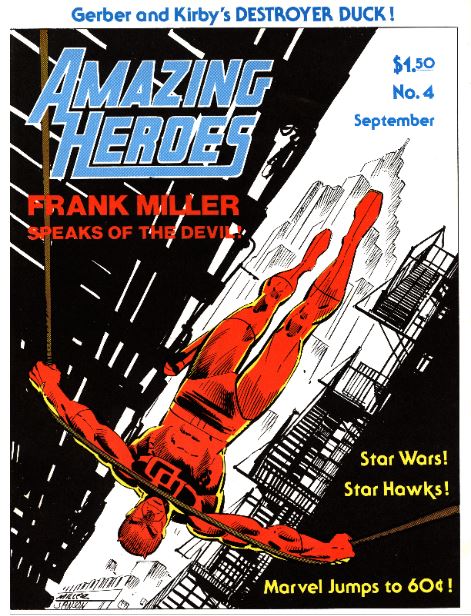
Issue number four of the Amazing Heroes fanzine, published in September of 1981, features the superhero Daredevil on its front cover. Dressed in a red bodysuit and highlighted in yellow, Daredevil appears to be mid-stunt and is presented diagonally across the page and upside down amongst the black and white silhouettes of buildings in a city skyline. Underneath the blue Amazing Heroes title and in red text to match Daredevil’s suit, the issue promises an interview with Frank Miller, an artist and writer for Daredevil, through saying “Frank Miller Speaks of the Devil!” The image was created and is signed by Frank Miller and Klaus Janson in the lower left corner. At the top of the issue in blue font, the issue cover says “Gerber and Kirby’s DESTROYER DUCK!” In the upper righthand corner in similar blue text, the issue price ($1.50) is listed along with the issue number (No. 4) and the month (September). Next to Daredevil’s figure in the lower left side of the cover, yellow text reads “Star Wars! Star Hawks!” Below Daredevil’s figure and the rope he uses for his stunt, a caption in yellow text reads “Marvel Jumps to 60¢!” Overall, the cover is encased in a black outline with a white border on the outside.
Daredevil, a character from Marvel, was first published in 1964. Miller, who is featured in this article through an interview, began working on the comic in 1979. After Miller’s start on the series, Daredevil and Miller himself became immensely popular. While Daredevil became Marvel’s second most popular comic, Frank Miller himself became an icon of the industry. While Miller stopped writing and drawing as actively for the comic in 1982, he went on to be involved with the character with the graphic novel Daredevil: Born Again, published in 1989. Daredevil himself continued on and a movie was released in 2003. As a character, Daredevil, alter ego Matt Murdock, sprung from a typical desire to defend the innocent from violence in his home, a predominantly Irish neighborhood called Hell’s Kitchen. The son of a boxer, Murdock promised his father to stay away from physical violence and studies to become an attorney. However, after Murdock is blinded after a radioactive waste accident and his father dies through organized crime in Hell’s Kitchen, Murdock trains to become Daredevil as he practices law as an attorney. Despite his loss of vision, Murdock’s other senses are heightened and he gains a sixth radar sense. Murdock swears to fight off organized crime, run largely by the Kingpin, in his home, both through his role as a lawyer and as a vigilante for justice. These two identities are closely linked, as both display Daredevil’s desire for justice, yet his role as a vigilante outside of the law causes him guilt and internal conflict. Like many superheroes, Daredevil works hard to keep his identity hidden, yet his uncle, who is a reporter, and his girlfriend know his alter ego. However, massive havoc is wreaked in Murdock’s life and in Hell’s Kitchen when crime lord The Kingpin learns Daredevil’s identity, eventually creating a complex story arc after the Kingpin is jailed and Daredevil claims his identity as the Kingpin while criminals fight for the title. Overall, the Daredevil comics have a rich and complex history, and Miller is a very well known contributor to the comics that helped launch them and himself to fame.
Daredevil, a character from Marvel, was first published in 1964. Miller, who is featured in this article through an interview, began working on the comic in 1979. After Miller’s start on the series, Daredevil and Miller himself became immensely popular. While Daredevil became Marvel’s second most popular comic, Frank Miller himself became an icon of the industry. While Miller stopped writing and drawing as actively for the comic in 1982, he went on to be involved with the character with the graphic novel Daredevil: Born Again, published in 1989. Daredevil himself continued on and a movie was released in 2003. As a character, Daredevil, alter ego Matt Murdock, sprung from a typical desire to defend the innocent from violence in his home, a predominantly Irish neighborhood called Hell’s Kitchen. The son of a boxer, Murdock promised his father to stay away from physical violence and studies to become an attorney. However, after Murdock is blinded after a radioactive waste accident and his father dies through organized crime in Hell’s Kitchen, Murdock trains to become Daredevil as he practices law as an attorney. Despite his loss of vision, Murdock’s other senses are heightened and he gains a sixth radar sense. Murdock swears to fight off organized crime, run largely by the Kingpin, in his home, both through his role as a lawyer and as a vigilante for justice. These two identities are closely linked, as both display Daredevil’s desire for justice, yet his role as a vigilante outside of the law causes him guilt and internal conflict. Like many superheroes, Daredevil works hard to keep his identity hidden, yet his uncle, who is a reporter, and his girlfriend know his alter ego. However, massive havoc is wreaked in Murdock’s life and in Hell’s Kitchen when crime lord The Kingpin learns Daredevil’s identity, eventually creating a complex story arc after the Kingpin is jailed and Daredevil claims his identity as the Kingpin while criminals fight for the title. Overall, the Daredevil comics have a rich and complex history, and Miller is a very well known contributor to the comics that helped launch them and himself to fame.
Creator
Executive Editor: Michael Catron
Art Director: Peppy White
Editorial Assistant: Laura K. Beal
Contributing Writers: Michael Catron, Donald Pallumbo, and David M. Singer
Contributing Artists: Fred Hembeck and Gary Kwaspisz
Cover Art: Frank Miller and Klaus Janson
Art Director: Peppy White
Editorial Assistant: Laura K. Beal
Contributing Writers: Michael Catron, Donald Pallumbo, and David M. Singer
Contributing Artists: Fred Hembeck and Gary Kwaspisz
Cover Art: Frank Miller and Klaus Janson
Source
MSU Special Collection Comic Art, PN6725.A47
Publisher
Zam, Inc.
Date
September 1, 1981
Contributor
Brooke Bloomfield
Rights
Rights Restrictions Apply
Relation
Companion to Amazing Heroes #4 Table of Contents, http://chambl91.msu.domains/CriticalFanscape/admin/items/show/id/78
Companion to Amazing Heroes #4 Representative Image, http://chambl91.msu.domains/CriticalFanscape/admin/items/show/79
Companion to Amazing Heroes #4 Representative Image, http://chambl91.msu.domains/CriticalFanscape/admin/items/show/79
Format
8 3⁄8 inches by 10 7⁄8 inches, color
Language
English
Type
Periodical, .jpg
Coverage
1981-1992
Still Image Item Type Metadata
Original Format
Comic Book
Physical Dimensions
8 3⁄8” x 10 7⁄8”
Files
Collection
Citation
Executive Editor: Michael Catron
Art Director: Peppy White
Editorial Assistant: Laura K. Beal
Contributing Writers: Michael Catron, Donald Pallumbo, and David M. Singer
Contributing Artists: Fred Hembeck and Gary Kwaspisz
Cover Art: Frank Miller and Klaus Janson, “Amazing Heroes #4 Cover,” Critical Fanscape, accessed October 17, 2026, https://chambl91.msu.domains/CriticalFanscape/items/show/77.