Amazing Heroes #4 Table of Contents
Dublin Core
Title
Amazing Heroes #4 Table of Contents
Subject
Periodical
Comic Strips
Comic Strips
Description
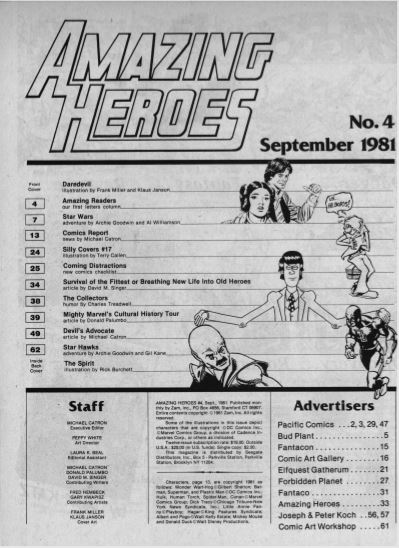
The table of contents for Amazing Heroes issue number four, published September 1981, contains sections for articles listed with page numbers and decorated with drawings representing the pieces contained within the fanzine, the staff of Amazing Heroes fanzine, and advertisers presented within the fanzine. The table of contents lists the cover, created by Frank Miller and Klaus Janson, “Amazing Readers,” the fanzine’s “first letters column,” “Star Wars” by Archie Goodwin and Al Williamson, “Comics Report” by Michael Catron, “Silly Covers #17” illustrated by Terry Callen, “Coming Distractions,” described as “a new comics checklist,” “Survival of the Fittest or Breathing New Life Into Old Heroes” by David M. Singer, “The Collectors” by Charles Treadwell, “Mighty Marvel’s Cultural History Tour” by Donald Palumbo, “Devil’s Advocate,” an interview with Frank Miller, written by Michael Catron, and “Star Hawks” by Archie Goodwin and Gil Kane. Finally, the table of contents ends by crediting the artist Rick Burchett for creating “The Spirit,” the illustration for the back cover. The staff list credits Michael Catron as the executive director, Peppy White as the art director, Laura K. Beal as the editorial assistant, Michael Catron, Donald Palumbo, and David M. Singer as contributing writers, Fred Hembeck and Gary Kwapisz as contributing artists, and Frank Miller and Klaus Janson as the cover artists.
The Daredevil comics, a featured point of discussion in this issue, did not reach high popularity until Frank Miller began writing and drawing for the series. During this time, Daredevil became Marvel’s second most popular comic among many successful titles. In what is considered the Silver Age of Marvel comics, Marvel released many new titles, and Daredevil was only one of them. Recognizing strong popular culture influences of the era, such as the Beatles, Stan Lee took initiative to create a recognizable style behind Marvel’s publishing. In this era, Marvel worked to create a connection with readers through featuring many names of the creative team in the comic's credits (this issue makes a similar move by listing many staff credits) and endowing said staff with familiar nicknames. Stan Lee and Marvel as a whole also encourage and responded to letters to the editors, giving fans an innately personal sense of their contribution to the comics they read, just as this fanzine provides space for reader opinion in their “Amazing Readers” section. Moreover, Stan Lee promoted continued readership through continual and progressing storylines and encouraged readers to purchase different titles by having their favorite superhero play a cameo role in another comic. Though Miller frowned on having Daredevil pair up with other Marvel characters, before Miller worked on Daredevil, he was known to team up with Spiderman and the X-Men. Daredevil himself, a lawyer and an extralegal crime-fighting vigilante who was blinded in a radioactive waste accident, did not enjoy this particular success until Miller worked on the title and took the comic in new creative directions. Though Daredevil did not enjoy commercial success until later on, Stan Lee’s advertising strategies in the Silver Age of comics made Marvel comics widely known and made their titles immensely popular. Moreover, these marketing strategies cleared leaked over into other fields within comics, including fanzines such as this issue of Amazing Heroes.
The Daredevil comics, a featured point of discussion in this issue, did not reach high popularity until Frank Miller began writing and drawing for the series. During this time, Daredevil became Marvel’s second most popular comic among many successful titles. In what is considered the Silver Age of Marvel comics, Marvel released many new titles, and Daredevil was only one of them. Recognizing strong popular culture influences of the era, such as the Beatles, Stan Lee took initiative to create a recognizable style behind Marvel’s publishing. In this era, Marvel worked to create a connection with readers through featuring many names of the creative team in the comic's credits (this issue makes a similar move by listing many staff credits) and endowing said staff with familiar nicknames. Stan Lee and Marvel as a whole also encourage and responded to letters to the editors, giving fans an innately personal sense of their contribution to the comics they read, just as this fanzine provides space for reader opinion in their “Amazing Readers” section. Moreover, Stan Lee promoted continued readership through continual and progressing storylines and encouraged readers to purchase different titles by having their favorite superhero play a cameo role in another comic. Though Miller frowned on having Daredevil pair up with other Marvel characters, before Miller worked on Daredevil, he was known to team up with Spiderman and the X-Men. Daredevil himself, a lawyer and an extralegal crime-fighting vigilante who was blinded in a radioactive waste accident, did not enjoy this particular success until Miller worked on the title and took the comic in new creative directions. Though Daredevil did not enjoy commercial success until later on, Stan Lee’s advertising strategies in the Silver Age of comics made Marvel comics widely known and made their titles immensely popular. Moreover, these marketing strategies cleared leaked over into other fields within comics, including fanzines such as this issue of Amazing Heroes.
Creator
Executive Editor: Michael Catron
Art Director: Peppy White
Editorial Assistant: Laura K. Beal
Contributing Writers: Michael Catron, Donald Pallumbo, and David M. Singer
Contributing Artists: Fred Hembeck and Gary Kwaspisz
Cover Art: Frank Miller and Klaus Janson
Art Director: Peppy White
Editorial Assistant: Laura K. Beal
Contributing Writers: Michael Catron, Donald Pallumbo, and David M. Singer
Contributing Artists: Fred Hembeck and Gary Kwaspisz
Cover Art: Frank Miller and Klaus Janson
Source
MSU Special Collection Comic Art, PN6725.A47
Publisher
Zam, Inc
Date
September 1, 1981
Contributor
Brooke Bloomfield
Rights
Rights Restrictions Apply
Relation
Companion to Amazing Heroes #4 Cover, http://chambl91.msu.domains/CriticalFanscape/admin/items/show/77
Companion to Amazing Heroes #4 Representative Image, http://chambl91.msu.domains/CriticalFanscape/admin/items/show/79
Companion to Amazing Heroes #4 Representative Image, http://chambl91.msu.domains/CriticalFanscape/admin/items/show/79
Format
8 3⁄8 inches by 10 7⁄8 inches, black and white
Language
English
Type
Periodical, .jpg
Coverage
1981-1992
Still Image Item Type Metadata
Original Format
Comic book
Physical Dimensions
8 3⁄8” x 10 7⁄8”
Files
Collection
Citation
Executive Editor: Michael Catron
Art Director: Peppy White
Editorial Assistant: Laura K. Beal
Contributing Writers: Michael Catron, Donald Pallumbo, and David M. Singer
Contributing Artists: Fred Hembeck and Gary Kwaspisz
Cover Art: Frank Miller and Klaus Janson, “Amazing Heroes #4 Table of Contents,” Critical Fanscape, accessed October 17, 2026, https://chambl91.msu.domains/CriticalFanscape/items/show/78.