Amazing Heroes #4 Representative Image
Dublin Core
Title
Amazing Heroes #4 Representative Image
Subject
Periodical
Comic strips
Comic strips
Description
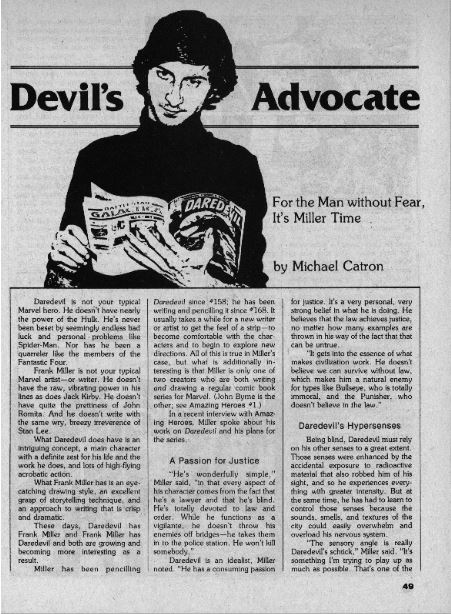
This Amazing Heroes fanzine issue number 4, published in September of 1981, boasts an interview with Frank Miller, who drew and wrote for the comic book Daredevil starting in 1979. This interview titled Devil’s Advocate, written by Michael Catron, details some of Miller’s stances on the superhero Daredevil, which Miller was both drawing and co-writing at the time of the interview. The sections within this interview include a brief introduction to Miller as an artist and writer, then continues to include sections titled “A Passion for Justice,” :Daredevil’s Hypersenses,” “Miller’s Concept of DD,” “Making Daredevil Less Grim,” “A Christian Superhero,” “Daredevil and Batman,” “Drawing Daredevil,” “Photographs and Color Holds,” “O’Neil’s Contribution,” and ends with a section detailing “Supporting Characters,” including “Matt Murdock,” “Foggy Nelson,” “Elektra,” “The Black Widow,” “Heather Glenn,” “The Kingpin,” and “Other Characters.” A small, final section details Daredevil’s adventures in the near future in the “Upcoming Issues” section. This transcribed interview includes panels from the Daredevil comics, notable including a sub-section called “The Devil Vs. Angel Dust” which includes panels from the Daredevil issue called Child’s Play, which had not been accepted by the Comic Code Authority.
Frank Miller began his comic book career on Gold Key’s Twilight Zone and then moved to work on DC Comics’ Weird War Tales, Marvel’s John Carter and Warlord of Mars, The Amazing Spiderman, and finally became a regular artist of the Daredevil series before also becoming a writer of the same series. Miller brought much popularity to the Daredevil series- before he started on it, Daredevil enjoyed very little readership and popularity, yet, after Miller worked on the series, Daredevil became Marvel’s second most popular comic, behind The Uncanny X-Men. Miller himself also became a massive icon in the industry through his work on Daredevil. Miller took many unique and creative steps with the series, such as making the style more “concise,” feeling that many comics contained too many words. Inspired by Japanese comics and manga’s heavily visual storytelling, Miller even created an issue of Daredevil told entirely through images and no captions, speech bubbles, or words. Miller worked to plot Daredevil story arcs many issues ahead, carefully tracking the consequences of Matt Murdock’s actions. Additionally, Miller attempted to portray a greater moral complexity in Daredevil’s character, showing him as an isolated individual, torn between his identity as a lawyer and his identity as a vigilante. Miller also worked to disassociate Daredevil from the rest of the Marvel universe, never allowing for Daredevil to team up with other popular Marvel characters, such as Spiderman or The Avengers. Additionally, Miller took a strong stance against censorship following the rejection of a Daredevil story called "Child’s Play" by the Comics Code Authority. The story, which is discussed in the interview dealt with drug usage, particularly the drug PCP, or angel dust, violating the Comics Code Authority's rules of showing drug use. After the issue’s rejection and Marvel’s hesitancy to publish the issue without approval, Miller maintained that the message of the story was strongly anti-drug, and thus it was nonsense that the Comics Code Authority refused to approve it. This solidified Miller’s stance on censorship, but the issue was later published under the approval of the Comics Code Authority with some required revisions.
Frank Miller began his comic book career on Gold Key’s Twilight Zone and then moved to work on DC Comics’ Weird War Tales, Marvel’s John Carter and Warlord of Mars, The Amazing Spiderman, and finally became a regular artist of the Daredevil series before also becoming a writer of the same series. Miller brought much popularity to the Daredevil series- before he started on it, Daredevil enjoyed very little readership and popularity, yet, after Miller worked on the series, Daredevil became Marvel’s second most popular comic, behind The Uncanny X-Men. Miller himself also became a massive icon in the industry through his work on Daredevil. Miller took many unique and creative steps with the series, such as making the style more “concise,” feeling that many comics contained too many words. Inspired by Japanese comics and manga’s heavily visual storytelling, Miller even created an issue of Daredevil told entirely through images and no captions, speech bubbles, or words. Miller worked to plot Daredevil story arcs many issues ahead, carefully tracking the consequences of Matt Murdock’s actions. Additionally, Miller attempted to portray a greater moral complexity in Daredevil’s character, showing him as an isolated individual, torn between his identity as a lawyer and his identity as a vigilante. Miller also worked to disassociate Daredevil from the rest of the Marvel universe, never allowing for Daredevil to team up with other popular Marvel characters, such as Spiderman or The Avengers. Additionally, Miller took a strong stance against censorship following the rejection of a Daredevil story called "Child’s Play" by the Comics Code Authority. The story, which is discussed in the interview dealt with drug usage, particularly the drug PCP, or angel dust, violating the Comics Code Authority's rules of showing drug use. After the issue’s rejection and Marvel’s hesitancy to publish the issue without approval, Miller maintained that the message of the story was strongly anti-drug, and thus it was nonsense that the Comics Code Authority refused to approve it. This solidified Miller’s stance on censorship, but the issue was later published under the approval of the Comics Code Authority with some required revisions.
Creator
Executive Editor: Michael Catron
Art Director: Peppy White
Editorial Assistant: Laura K. Beal
Contributing Writers: Michael Catron, Donald Pallumbo, and David M. Singer
Contributing Artists: Fred Hembeck and Gary Kwaspisz
Cover Art: Frank Miller and Klaus Janson
Art Director: Peppy White
Editorial Assistant: Laura K. Beal
Contributing Writers: Michael Catron, Donald Pallumbo, and David M. Singer
Contributing Artists: Fred Hembeck and Gary Kwaspisz
Cover Art: Frank Miller and Klaus Janson
Source
MSU Special Collection Comic Art, PN6725.A47
Publisher
Zam, Inc.
Date
September 1, 1981
Contributor
Brooke Bloomfield
Rights
Rights Restrictions Apply
Relation
Companion to Amazing Heroes #4 Table of Contents, http://chambl91.msu.domains/CriticalFanscape/admin/items/show/78
Companion to Amazing Heroes #4 Cover, http://chambl91.msu.domains/CriticalFanscape/admin/items/show/77
Companion to Amazing Heroes #4 Cover, http://chambl91.msu.domains/CriticalFanscape/admin/items/show/77
Format
8 3⁄8 inches wide by 10 7⁄8 inches, black and white
Language
English
Type
Periodical, .jpg
Coverage
1981-1992
Still Image Item Type Metadata
Original Format
Periodical
Physical Dimensions
8 3⁄8” x 10 7⁄8”
Files
Collection
Citation
Executive Editor: Michael Catron
Art Director: Peppy White
Editorial Assistant: Laura K. Beal
Contributing Writers: Michael Catron, Donald Pallumbo, and David M. Singer
Contributing Artists: Fred Hembeck and Gary Kwaspisz
Cover Art: Frank Miller and Klaus Janson, “Amazing Heroes #4 Representative Image,” Critical Fanscape, accessed October 17, 2026, https://chambl91.msu.domains/CriticalFanscape/items/show/79.