Amazing Heroes #187 Cover
Dublin Core
Title
Amazing Heroes #187 Cover
Subject
Periodical
Comic strips
Comic strips
Description
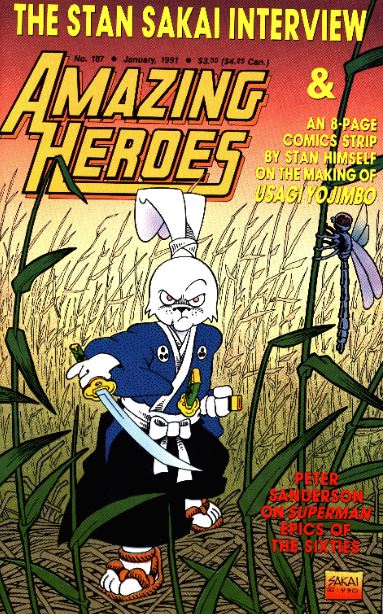
Issue number 187 of Amazing Heroes, published in January of 1991 bares a cover showing Usagi, a samurai rabbit featured in a comic created by Stan Sakai. This cover, drawn by Stan Sakai himself and featuring Usagi Yojimbo in a field at sunset, wearing a blue robe and posed towards the audience with a drawn sword, also boasts an interview with Stan Sakai, the creator of Usagi, as well as an eight-page strip drawn by Sakai detailing the making of Usagi. The cover also details an article regarding “Peter Sanderson on Superman Epics of the Sixties.” Usagi first appeared as a character in 1984, and gained his own series in 1987, solidly situated in the wave of Japanese cultural influence in the 1980s.
While there was a wave of popularity regarding Japanese cultural influence in both the sixties and the eighties, Japanese influence had not always been portrayed positively in the world of comic books. During World War II, Japanese characters appeared mostly as racist caricatures. Before the bombing of Pearl Harbor, Japanese characters were still presented in a largely racist light, yet after the attack, racist depictions in comic books only grew as the Japanese were increasingly portrayed as the enemy in war-based comic books. The United States’ villainization of the Japanese left Japanese characters consistently portrayed as “ghastly yellow demons... or buck-toothed little monkeys with oversized spectacles,” but never resembling humans. Before the aforementioned waves of positive Japanese cultural influence, Japanese portrayals in comic books was largely presented as blatant racism. However, as these waves of popularity rose in the sixties and the eighties, the influence of Japanese culture made itself present in the United States through the serialization of Japanese created and inspired magazines, such as Giant Robot to the rabbit samurai Usagi Yojimbo presented on the cover of this issue of Amazing Heroes. The influence of serialization, an important aspect of ultra-popular Japanese mangas, greatly affected American alternative comics, but also came to affect long-form American comics, such as graphic novels. Thus, the expanded serialization of these comics can, in part, be attributed to the growth of popularity of English translations of Japanese manga. As one can note due to the popularity of this Usagi Yojimbo and the Teenage Mutant Ninja Turtles, post World War II “story manga” influenced the popularity of such animal-warrior comics. Usagi Yojimbo, created in 1984 and appearing on this cover of Amazing Heroes in January of 1991, was a massive figure standing for the popularity of Japanese-inspired comics. The interview contained within this issue, featuring Stan Sakai, the Japanese creator of Usagi, allows Sakai to discuss his attachment to Japanese culture within his work on Usagi. Sakai claims a connection to Japanese culture through his art and coloring style, as well as his push for relative historical accuracy within his narratives. The character started as a small story in a separate magazine, but eventually grew in popularity to appear in his own regular comic beginning in 1987. Growing in popularity, Usagi also made a guest appearance with the Teenage Mutant Ninja Turtles, another set of anthropomorphic, Japanese inspired fighters. TMNT was created by two Americans, and Usagi’s contribution to their storyline helps to make an argument for both the influence of Japanese culture and manga in general, as well as support an argument for the particular influence of Usagi as a character, as does Usagi’s appearance on this particular issue of Amazing Heroes. Therefore, Usagi and his appearance within this magazine helps to contextualize the influential popularity of Japanese culture and manga within American comics within the course of the eighties.
While there was a wave of popularity regarding Japanese cultural influence in both the sixties and the eighties, Japanese influence had not always been portrayed positively in the world of comic books. During World War II, Japanese characters appeared mostly as racist caricatures. Before the bombing of Pearl Harbor, Japanese characters were still presented in a largely racist light, yet after the attack, racist depictions in comic books only grew as the Japanese were increasingly portrayed as the enemy in war-based comic books. The United States’ villainization of the Japanese left Japanese characters consistently portrayed as “ghastly yellow demons... or buck-toothed little monkeys with oversized spectacles,” but never resembling humans. Before the aforementioned waves of positive Japanese cultural influence, Japanese portrayals in comic books was largely presented as blatant racism. However, as these waves of popularity rose in the sixties and the eighties, the influence of Japanese culture made itself present in the United States through the serialization of Japanese created and inspired magazines, such as Giant Robot to the rabbit samurai Usagi Yojimbo presented on the cover of this issue of Amazing Heroes. The influence of serialization, an important aspect of ultra-popular Japanese mangas, greatly affected American alternative comics, but also came to affect long-form American comics, such as graphic novels. Thus, the expanded serialization of these comics can, in part, be attributed to the growth of popularity of English translations of Japanese manga. As one can note due to the popularity of this Usagi Yojimbo and the Teenage Mutant Ninja Turtles, post World War II “story manga” influenced the popularity of such animal-warrior comics. Usagi Yojimbo, created in 1984 and appearing on this cover of Amazing Heroes in January of 1991, was a massive figure standing for the popularity of Japanese-inspired comics. The interview contained within this issue, featuring Stan Sakai, the Japanese creator of Usagi, allows Sakai to discuss his attachment to Japanese culture within his work on Usagi. Sakai claims a connection to Japanese culture through his art and coloring style, as well as his push for relative historical accuracy within his narratives. The character started as a small story in a separate magazine, but eventually grew in popularity to appear in his own regular comic beginning in 1987. Growing in popularity, Usagi also made a guest appearance with the Teenage Mutant Ninja Turtles, another set of anthropomorphic, Japanese inspired fighters. TMNT was created by two Americans, and Usagi’s contribution to their storyline helps to make an argument for both the influence of Japanese culture and manga in general, as well as support an argument for the particular influence of Usagi as a character, as does Usagi’s appearance on this particular issue of Amazing Heroes. Therefore, Usagi and his appearance within this magazine helps to contextualize the influential popularity of Japanese culture and manga within American comics within the course of the eighties.
Creator
Executive Editor: Kim "NOW" Thompson
Managing Editor: Thomas "Then" Harrington
Art Director: Mark "Later" Thompson
News Correspondents: Sam "Before" Kujava and Clark "After" Humphrey
Production Assistants: Roberta "Early" Gregory and Logan E. "Late" Bender
Typesetting/Proofreading: Craig "Eventually" Maynard
Circulation: Sharon "Always" Kingsford, Carys "Never" Kresny, and Shanna "Eternally" Brown
Managing Editor: Thomas "Then" Harrington
Art Director: Mark "Later" Thompson
News Correspondents: Sam "Before" Kujava and Clark "After" Humphrey
Production Assistants: Roberta "Early" Gregory and Logan E. "Late" Bender
Typesetting/Proofreading: Craig "Eventually" Maynard
Circulation: Sharon "Always" Kingsford, Carys "Never" Kresny, and Shanna "Eternally" Brown
Source
MSU Special Collection Comic Art, PN6725.A47
Publisher
Fantagraphics Books, Inc.
Date
January 1, 1991
Contributor
Brooke Bloomfield
Rights
Rights Restrictions Apply
Relation
Companion to Amazing Heroes #187 Table of Contents, http://chambl91.msu.domains/CriticalFanscape/admin/items/show/83
Companion to Amazing Heroes #187 Representative Image, http://chambl91.msu.domains/CriticalFanscape/admin/items/show/85
Companion to Amazing Heroes #187 Representative Image, http://chambl91.msu.domains/CriticalFanscape/admin/items/show/85
Format
6-5/8 inches wide by 10-1/4 inches, color
Language
English
Type
Periodical, .jpg
Coverage
1981-1992
Still Image Item Type Metadata
Original Format
Comic book
Physical Dimensions
6-5/8" by 10-1/4"
Files
Collection
Citation
Executive Editor: Kim "NOW" Thompson
Managing Editor: Thomas "Then" Harrington
Art Director: Mark "Later" Thompson
News Correspondents: Sam "Before" Kujava and Clark "After" Humphrey
Production Assistants: Roberta "Early" Gregory and Logan E. "Late" Bender
Typesetting/Proofreading: Craig "Eventually" Maynard
Circulation: Sharon "Always" Kingsford, Carys "Never" Kresny, and Shanna "Eternally" Brown , “Amazing Heroes #187 Cover,” Critical Fanscape, accessed October 17, 2026, https://chambl91.msu.domains/CriticalFanscape/items/show/80.