Amazing Heroes #125 Cover
Dublin Core
Title
Amazing Heroes #125 Cover
Subject
Periodical
Comic strips
Comic strips
Description
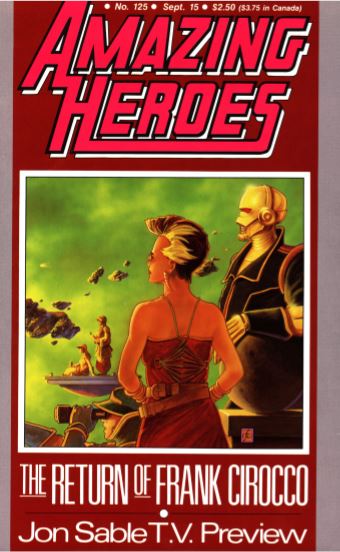
Amazing Heroes issue number 125 was published on September 15th of 1987. The red cover is capped on the right and left side by two lavender-gray colored blocks and has an image framed in white in the middle of the cover. The image, a piece created by Frank Cirocco, a figure in the underground comix movement, features two main figures, a golden robot with red eyes and a black and gold vest and wrist cuffs and a rounded boulder underneath his arm and a woman with short blonde hair, dressed in a red dress and light brown belt, standing against a cloudy, green background. On the same ship as these two figures, a man in a green cap is peering into the distance through binoculars. In the background, small rocks are broken off of a larger boulder and float through the sky. Additionally, two more individuals stand on a small space ship in the distance. Below this image in white text, the issue proclaims “The Return of Frank Cirocco,” indicating the interview with Frank Cirocco that is contained within the issue. Below this caption, white lettering reads “Jon Sable T.V. Preview.”
Occurring largely in the 1960s through the 1980s, underground comix, discussed in this issue through the presence of Frank Cirocco, was notorious for both sexism and feminism in comics culture. The movement was largely centered in the San Francisco Bay area of California and saw far less censorship than typical comics of the era, though some notable but relatively mild censorship still occurred, such as the case of the Tijuana Bibles comics that were largely sold under the counter. Thus, these comix were notorious for sexual content and leading with the concept that sex sells. Sexism was heavily presented in these comix, as violence against women was regularly portrayed and treated as humorous. However, through feminist titles such as It Ain’t Me, Babe, Pudge, Wimmen’s Comix, Tits and Clits, and Dynamite Damsels, feminist content was represented and forefronted women’s pleasure, experiences, and gender inequalities, though many feminists of the era still rejected the highly sexual content. Despite this, many of these comix still referenced and discussed prominent feminist works of the period. However, these comix’s focus on the relationship between liberation and taboo subjects were largely meant to push against purity narratives that implied women were asexual, and any sexual desire implied either their “otherness” or their broken nature. The comix referenced not only gender inequalities, but the struggles and often discouraging nature behind remaining in an activist role in the era, particularly in the character Freida in Dynamite Damsels, who experiences burnout and contradictory feelings regarding her feminist position, though humor in these comix was also used largely to release the tensions felt by feminists of the period. Thus, while sexism was common in these underground comix, there were clear feminist movements and creators within the movement as a whole. These comix also largely explored lesbian identities, especially Pudge and Dynamite Damsels, though many comix discussed both lesbian women and the presence of non-white women within the feminist movement, thus working to acknowledge these intersections within the movement. While these feminist comix still depicted sexuality, they worked to reframe sexuality to prioritize women and women’s experiences.
Occurring largely in the 1960s through the 1980s, underground comix, discussed in this issue through the presence of Frank Cirocco, was notorious for both sexism and feminism in comics culture. The movement was largely centered in the San Francisco Bay area of California and saw far less censorship than typical comics of the era, though some notable but relatively mild censorship still occurred, such as the case of the Tijuana Bibles comics that were largely sold under the counter. Thus, these comix were notorious for sexual content and leading with the concept that sex sells. Sexism was heavily presented in these comix, as violence against women was regularly portrayed and treated as humorous. However, through feminist titles such as It Ain’t Me, Babe, Pudge, Wimmen’s Comix, Tits and Clits, and Dynamite Damsels, feminist content was represented and forefronted women’s pleasure, experiences, and gender inequalities, though many feminists of the era still rejected the highly sexual content. Despite this, many of these comix still referenced and discussed prominent feminist works of the period. However, these comix’s focus on the relationship between liberation and taboo subjects were largely meant to push against purity narratives that implied women were asexual, and any sexual desire implied either their “otherness” or their broken nature. The comix referenced not only gender inequalities, but the struggles and often discouraging nature behind remaining in an activist role in the era, particularly in the character Freida in Dynamite Damsels, who experiences burnout and contradictory feelings regarding her feminist position, though humor in these comix was also used largely to release the tensions felt by feminists of the period. Thus, while sexism was common in these underground comix, there were clear feminist movements and creators within the movement as a whole. These comix also largely explored lesbian identities, especially Pudge and Dynamite Damsels, though many comix discussed both lesbian women and the presence of non-white women within the feminist movement, thus working to acknowledge these intersections within the movement. While these feminist comix still depicted sexuality, they worked to reframe sexuality to prioritize women and women’s experiences.
Creator
Managing Editor: Kevin Dooley
Art Director: Doug Erb
Executive Director: Kim Thompson
News Correspondents: Dave Hall and Donald K. Niven
Production Assistants: Audu Paden and Coco Shinomiya
Typesetting: L.M. Gorell and Arlene Easter
Circulation: Rachel Enger
Art Director: Doug Erb
Executive Director: Kim Thompson
News Correspondents: Dave Hall and Donald K. Niven
Production Assistants: Audu Paden and Coco Shinomiya
Typesetting: L.M. Gorell and Arlene Easter
Circulation: Rachel Enger
Source
MSU Special Collection Comic Art, PN6725.A47
Publisher
Fantagraphics Books, Inc.
Date
September 15, 1987
Contributor
Brooke Bloomfield
Rights
Rights Restrictions Apply
Relation
Companion to Amazing Heroes 125 Table of Contents, http://chambl91.msu.domains/CriticalFanscape/admin/items/show/87
Companion to Amazing Heroes 125 Representative Image, http://chambl91.msu.domains/CriticalFanscape/admin/items/show/88
Companion to Amazing Heroes 125 Representative Image, http://chambl91.msu.domains/CriticalFanscape/admin/items/show/88
Format
6-5/8 inches wide by 10-1/4 inches, color
Language
English
Type
Periodical, .jpg
Coverage
1981-1992
Still Image Item Type Metadata
Original Format
Comic book
Physical Dimensions
6-5/8 inches wide by 10-1/4 inches
Files
Collection
Citation
Managing Editor: Kevin Dooley
Art Director: Doug Erb
Executive Director: Kim Thompson
News Correspondents: Dave Hall and Donald K. Niven
Production Assistants: Audu Paden and Coco Shinomiya
Typesetting: L.M. Gorell and Arlene Easter
Circulation: Rachel Enger, “Amazing Heroes #125 Cover,” Critical Fanscape, accessed October 17, 2026, https://chambl91.msu.domains/CriticalFanscape/items/show/86.