Amazing Heroes #187 Representative Image
Dublin Core
Title
Amazing Heroes #187 Representative Image
Subject
Periodical
Comic strips
Comic strips
Description
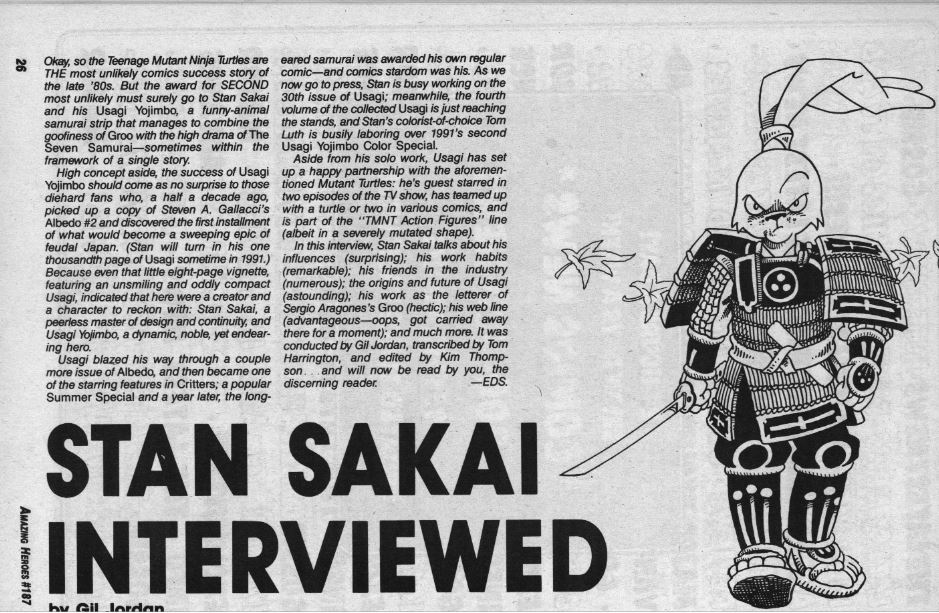
Issue number 187 of the Amazing Heroes fanzine was published in January of 1991. This issue contains an interview with Stan Sakai written by Gil Jordan, creator of the Usagi comics, from pages 26 to 35, titled “Stan Sakai Interviewed.” The pages include black and white drawings from Stan Sakai, both of his characters from the Usagi Yojimbo comics and other works, background on the creator, the evolution of Usagi as both a character and the comic as a whole, and his personal thoughts, plans, and details on his creative processes. The interview is transcribed, representing questions and answers between Gil Jordan, the interviewer, and Stan Sakai. The title page of the interview contains the black, boldface title, “Stan Sakai Interviewed,” a drawing of Usagi in heavy armor and sandals with his sword drawn and leaves creating a waving line in the air behind him. There is a text-based description containing a brief description of the history of Usagi Yojimbo comics. In this interview, Sakai largely describes his personal history in and out of the comic book industry.
Stan Sakai was born Kyoto, Japan in 1953. As a young child, Sakai’s family moved to Hawaii. Sakai describes that he grew up with comic books, and comic books fostered his love of reading and art. His enthusiasm drove his work and connections within the industry, even long after he was new to the industry. Usagi Yojimbo, the comic Sakai is featured for in this issue, was first published as an independent comic in 1985. The popularity of Usagi Yojimbo largely rode a wave of immense Japanese and manga influence in comics culture in the 1980s, which was preceded by a wave of influence in the 1960s. Each of these influential waves affected American comics culture in many distinct ways, from content to serialization. Many such Japanese popular culture inspired comics were published in this era, including Lone Wolf and Cub and Mai the Psychic Girl. This broad appreciation for Japanese animation pushed Usagi’s success throughout the 1980s and 1990s. Usagi is heralded by the interview as “the second most unlikely success of the late eighties,” only behind the Teenage Mutant Ninja Turtles. Usagi and the Teenage Mutant Ninja Turtles, sharing the common theme of anthropomorphic fighters, even shared licensing for a time as Usagi appeared on the Teenage Mutant Ninja Turtles television show. Before even working on Usagi, Sakai created freelance art for advertising, book illustrations, and record covers. Additionally, Sakai taught calligraphy, leading him to letter the comic Groo the Wanderer. Previous to Usagi’s premiere as an independent comic, Sakai first presented the samurai rabbit as an eight-page story in another comic. Though Usagi is commonly classified as a manga or a funny animal comic, Sakai does not necessarily label it as such, and cites a heavier influence from Japanese ninja and samurai-inspired movies. Yet, Sakai does say that the rabbit, or Usagi in Japanese, is an important figure, usually showing cleverness and bravery, in Japanese myths and legends. The comic started as a historical book featuring real historical figures, and Usagi himself was based on a 17th-century samurai named Miyamoto Musashi. Aside from Usagi, Sakai has also lettered for The Amazing Spiderman and worked on the Strange Tales comics with Marvel, among other works.
Stan Sakai was born Kyoto, Japan in 1953. As a young child, Sakai’s family moved to Hawaii. Sakai describes that he grew up with comic books, and comic books fostered his love of reading and art. His enthusiasm drove his work and connections within the industry, even long after he was new to the industry. Usagi Yojimbo, the comic Sakai is featured for in this issue, was first published as an independent comic in 1985. The popularity of Usagi Yojimbo largely rode a wave of immense Japanese and manga influence in comics culture in the 1980s, which was preceded by a wave of influence in the 1960s. Each of these influential waves affected American comics culture in many distinct ways, from content to serialization. Many such Japanese popular culture inspired comics were published in this era, including Lone Wolf and Cub and Mai the Psychic Girl. This broad appreciation for Japanese animation pushed Usagi’s success throughout the 1980s and 1990s. Usagi is heralded by the interview as “the second most unlikely success of the late eighties,” only behind the Teenage Mutant Ninja Turtles. Usagi and the Teenage Mutant Ninja Turtles, sharing the common theme of anthropomorphic fighters, even shared licensing for a time as Usagi appeared on the Teenage Mutant Ninja Turtles television show. Before even working on Usagi, Sakai created freelance art for advertising, book illustrations, and record covers. Additionally, Sakai taught calligraphy, leading him to letter the comic Groo the Wanderer. Previous to Usagi’s premiere as an independent comic, Sakai first presented the samurai rabbit as an eight-page story in another comic. Though Usagi is commonly classified as a manga or a funny animal comic, Sakai does not necessarily label it as such, and cites a heavier influence from Japanese ninja and samurai-inspired movies. Yet, Sakai does say that the rabbit, or Usagi in Japanese, is an important figure, usually showing cleverness and bravery, in Japanese myths and legends. The comic started as a historical book featuring real historical figures, and Usagi himself was based on a 17th-century samurai named Miyamoto Musashi. Aside from Usagi, Sakai has also lettered for The Amazing Spiderman and worked on the Strange Tales comics with Marvel, among other works.
Creator
Executive Editor: Kim "NOW" Thompson
Managing Editor: Thomas "Then" Harrington
Art Director: Mark "Later" Thompson
News Correspondents: Sam "Before" Kujava and Clark "After" Humphrey
Production Assistants: Roberta "Early" Gregory and Logan E. "Late" Bender
Typesetting/Proofreading: Craig "Eventually" Maynard
Circulation: Sharon "Always" Kingsford, Carys "Never" Kresny, and Shanna "Eternally" Brown
Managing Editor: Thomas "Then" Harrington
Art Director: Mark "Later" Thompson
News Correspondents: Sam "Before" Kujava and Clark "After" Humphrey
Production Assistants: Roberta "Early" Gregory and Logan E. "Late" Bender
Typesetting/Proofreading: Craig "Eventually" Maynard
Circulation: Sharon "Always" Kingsford, Carys "Never" Kresny, and Shanna "Eternally" Brown
Source
MSU Special Collection Comic Art, PN6725.A47
Publisher
Fantagraphics Books, Inc.
Date
January 1, 1991
Contributor
Brooke Bloomfield
Rights
Rights Restrictions Apply
Relation
Companion to Amazing Heroes #187 Cover, http://chambl91.msu.domains/CriticalFanscape/admin/items/show/id/80
Companion to Amazing Heroes #187 Table of Contents, http://chambl91.msu.domains/CriticalFanscape/admin/items/show/id/83
Companion to Amazing Heroes #187 Table of Contents, http://chambl91.msu.domains/CriticalFanscape/admin/items/show/id/83
Format
6-5/8 inches wide by 10-1/4 inches, black and white
Language
English
Type
Periodical, .jpg
Coverage
1981-1992
Still Image Item Type Metadata
Original Format
Comic book
Physical Dimensions
6-5/8 inches wide by 10-1/4 inches
Files
Collection
Citation
Executive Editor: Kim "NOW" Thompson
Managing Editor: Thomas "Then" Harrington
Art Director: Mark "Later" Thompson
News Correspondents: Sam "Before" Kujava and Clark "After" Humphrey
Production Assistants: Roberta "Early" Gregory and Logan E. "Late" Bender
Typesetting/Proofreading: Craig "Eventually" Maynard
Circulation: Sharon "Always" Kingsford, Carys "Never" Kresny, and Shanna "Eternally" Brown , “Amazing Heroes #187 Representative Image,” Critical Fanscape, accessed October 17, 2026, https://chambl91.msu.domains/CriticalFanscape/items/show/85.