Amazing Heroes Issue #6 Page 29
Dublin Core
Title
Amazing Heroes Issue #6 Page 29
Subject
Periodical
Comics Strips
Comics Strips
Description
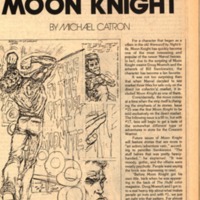
This black-and-white page and subsequent article was the inspiration behind the cover, which features Moon Knight. At the top of the page, centered and occupying about a quarter of the page’s space, is the title: “A New Phase for Moon Knight”. The only portion of the text that is bolded is the character’s name, Moon Knight. Below this, on a single line, reads “By Michael Catron”, a well-known contributor to Amazing Heroes. Underneath this, on the left side of the page, are four penciled images, all done by Bill Sienkiewicz for the eighteenth issue of Moon Knight. The first image is the largest, with a man yelling “No”, his head and chest thrust back in a scream, facing a sign that reads “COME TO THE CITADEL AT MIDNITE”. To the right of this are three images; the top is an image of the same man reaching forward, the center is the hand touching the letters, and the bottom image is the man putting his fingers to his mouth, tasting the substance used to write the message. To the right of these four hand-drawn images is five paragraphs, just a handful of the sections that make up the article. These five paragraphs introduce and contextualize the character and its changing style, along with featuring quotes from the penciler, Bill Sienkiewicz.
The character of Moon Knight is not, in fact, a traditional hero; he has three secret identities, and he was, in fact, originally intended to be both a villain and a “psycho” – in other words, an anti-hero. While it came off as a little too self-indulgent and heavy and was subsequently made to be more adventure-based, it still retained the idea that, as series scripter and creator Doug Moench explained, anyone who chooses to become a superhero must be a little “nuts”. He is joined by other famous comic book anti-heroes, like the X-Men’s Wolverine, the Watchmen’s Rorshach, Ghost Rider, Judge Dredd, and Deadpool, many of which were popularized during the Bronze Age of comics (about 1970-1985). Many of these anti-heroes displayed the three traits found in the ”Dark Triad of personality” – narcissism, psychopathy, and Machiavellianism. These traits are not necessarily used to vilify anti-heroes; instead, they provide insight into why people often utilize these traits for survival, and how art imitates life – or, in this case, how the nuance behind one’s actions can strongly affect others’ perceptions of their behavior. This turning of the tides toward more realistic portrayals of superheroes was informed in part by political events and social issues of the 1970s and 1980s, like racism, women’s rights, and the presidency of Ronald Reagan. In particular, the rise of the comic book anti-hero can be attributed to the United States’s involvement in Vietnam in the late 1960s/early 1970s. The war was highly contested from its conception, and many of the crimes committed during it led to disdain for soldiers and veterans. As a result, the American public shied away from these traditional heroes, instead prioritizing flawed, complex characters with unique backgrounds – anti-heroes. This desire for flawed heroes perfectly paved the way for less traditional heroes, often tormented or suffering mental health issues, like Moon Knight.
The character of Moon Knight is not, in fact, a traditional hero; he has three secret identities, and he was, in fact, originally intended to be both a villain and a “psycho” – in other words, an anti-hero. While it came off as a little too self-indulgent and heavy and was subsequently made to be more adventure-based, it still retained the idea that, as series scripter and creator Doug Moench explained, anyone who chooses to become a superhero must be a little “nuts”. He is joined by other famous comic book anti-heroes, like the X-Men’s Wolverine, the Watchmen’s Rorshach, Ghost Rider, Judge Dredd, and Deadpool, many of which were popularized during the Bronze Age of comics (about 1970-1985). Many of these anti-heroes displayed the three traits found in the ”Dark Triad of personality” – narcissism, psychopathy, and Machiavellianism. These traits are not necessarily used to vilify anti-heroes; instead, they provide insight into why people often utilize these traits for survival, and how art imitates life – or, in this case, how the nuance behind one’s actions can strongly affect others’ perceptions of their behavior. This turning of the tides toward more realistic portrayals of superheroes was informed in part by political events and social issues of the 1970s and 1980s, like racism, women’s rights, and the presidency of Ronald Reagan. In particular, the rise of the comic book anti-hero can be attributed to the United States’s involvement in Vietnam in the late 1960s/early 1970s. The war was highly contested from its conception, and many of the crimes committed during it led to disdain for soldiers and veterans. As a result, the American public shied away from these traditional heroes, instead prioritizing flawed, complex characters with unique backgrounds – anti-heroes. This desire for flawed heroes perfectly paved the way for less traditional heroes, often tormented or suffering mental health issues, like Moon Knight.
Creator
Article Writer: Michael Catron
Creative Team:
Executive Editor: Michael Catron
Art Director: Peppy White
Contributing Writer: George Guay
Contributing Artists: Bill Anderson, Rudi Franke, Doug Hazelwood, Mark Heike, Gary Kwapisz, Mark Lamport, Kevin Nowlan, Mike O'Neal
Cover Art: Bill Sienkiewicz
Creative Team:
Executive Editor: Michael Catron
Art Director: Peppy White
Contributing Writer: George Guay
Contributing Artists: Bill Anderson, Rudi Franke, Doug Hazelwood, Mark Heike, Gary Kwapisz, Mark Lamport, Kevin Nowlan, Mike O'Neal
Cover Art: Bill Sienkiewicz
Source
MSU Special Collection Comic Art, PN6725.A47
Publisher
Zam, Inc.
Date
1981-11
Contributor
Holly Simon
Rights
Rights Restriction Apply
Format
10 1/4 x 6 1/8 in.
Language
English
Type
Periodical
Identifier
OMIT
Coverage
1981-1992
Files
Collection
Citation
Article Writer: Michael Catron
Creative Team:
Executive Editor: Michael Catron
Art Director: Peppy White
Contributing Writer: George Guay
Contributing Artists: Bill Anderson, Rudi Franke, Doug Hazelwood, Mark Heike, Gary Kwapisz, Mark Lamport, Kevin Nowlan, Mike O'Neal
Cover Art: Bill Sienkiewicz, “Amazing Heroes Issue #6 Page 29,” Critical Fanscape, accessed October 17, 2026, https://chambl91.msu.domains/CriticalFanscape/items/show/84.