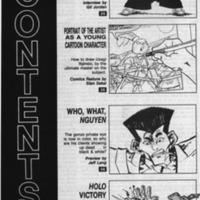
Amazing Heroes #187 Table of Contents
Dublin Core
Title
Amazing Heroes #187 Table of Contents
Subject
Periodical
Comic strips
Comic strips
Description
Amazing Heroes issue number 187, published in January of 1991, uses an interview with Stan Sakai, creator of the samurai rabbit Usagi Yojimbo, as a headlining feature and includes many titles regarding manga and Japanese inspired article. Within this table of contents, the featured articles are “Stan the (Bunny) Man” (page 26) featuring Stan Sakai, interviewed by Gil Jordan, “Portrait of the Artist as a Young Cartoon Character” Stan Sakai (page 36), “Who, What, Nguyen,” Jeff Lang (page 46), and “Holo Victory” Thomas Harrington (page 52). The table of contents also includes “Perspective,” Mark Braun (page 6), “Newsline,” (page 7), “Coming Distractions,” (page 15), “Backstage I,” Andy Mangels (page 55), “Infernal Gall,” Adam-Troy Castro (page 63), “Silver and Gold,” Peter Sanderson (page 67), “Cover Gallery,” Don Rosa (page 72), “Comics in Review,” (page 75), “Amazing Readers,” (page 95), “The Cartoonist,” Wood (page 96), and “Strom’s Index,” Dave Strom (page 98). The table of contents also gives credit to Stan Sakai for creating the cover image.
There are considered to be two waves of broad Japanese cultural influence, the first wave taking place in the 1960s and the second in the 1980s, considered to have had an impact on the United States. This particular issue of Amazing Heroes was published in 1991 and the manga-inspired theme of this issue can be contributed to the wave of manga-enthusiasm that continued in through the late eighties to the early nineties. Usagi Yojimbo, featured along with his creator, Stan Sakai, was borne of this second wave of Japanese cultural influence. The global influence of Japanese mangas was largely pushed by the population’s interest in Japanese animation, sometimes called Japanimation, and American comic book publishers saw and grasped the opportunity to further this trend. Thus, the 1980s saw many manga-inspired comics, such as Ronan and Zot!, as well as many translated editions of original mangas, such as Lone Wolf and Cub and Mai the Psychic Girl. This wave of popularity leaked into the early 1990s as well, when this particular issue of Amazing Heroes was published, but this era of influence can also be seen through translations of the popular Akira comics.
First published in Japan in 1982, Akira was translated for English speaking audiences later in the 1980s. While this publication could not quite break manga into the popular consciousness of American literature, its translation certainly had a massive effect on American comic book culture, and largely contributed to manga’s spike in popularity during the 1980s. The success of these mangas and manga-inspired comics can help the decision to feature Stan Sakai and Usagi in this issue of Amazing Heroes. Initially, manga and anime were viewed as a juvenile form of entertainment, much like American comic books, but as their popularity rose, the existing genres of manga expanded as sales increased. The reasons for manga’s popularity is complex and varied, but as the 1980s progressed, manga was seen as not only popular and fashionable, but as a serious topic for academic essays and studies. Thus, Usagi Yojimbo and his creator, Stan Sakai, are firmly situated within the second large wave of Japanese cultural influence in the eighties, along with many other mangas and manga-inspired comics.
There are considered to be two waves of broad Japanese cultural influence, the first wave taking place in the 1960s and the second in the 1980s, considered to have had an impact on the United States. This particular issue of Amazing Heroes was published in 1991 and the manga-inspired theme of this issue can be contributed to the wave of manga-enthusiasm that continued in through the late eighties to the early nineties. Usagi Yojimbo, featured along with his creator, Stan Sakai, was borne of this second wave of Japanese cultural influence. The global influence of Japanese mangas was largely pushed by the population’s interest in Japanese animation, sometimes called Japanimation, and American comic book publishers saw and grasped the opportunity to further this trend. Thus, the 1980s saw many manga-inspired comics, such as Ronan and Zot!, as well as many translated editions of original mangas, such as Lone Wolf and Cub and Mai the Psychic Girl. This wave of popularity leaked into the early 1990s as well, when this particular issue of Amazing Heroes was published, but this era of influence can also be seen through translations of the popular Akira comics.
First published in Japan in 1982, Akira was translated for English speaking audiences later in the 1980s. While this publication could not quite break manga into the popular consciousness of American literature, its translation certainly had a massive effect on American comic book culture, and largely contributed to manga’s spike in popularity during the 1980s. The success of these mangas and manga-inspired comics can help the decision to feature Stan Sakai and Usagi in this issue of Amazing Heroes. Initially, manga and anime were viewed as a juvenile form of entertainment, much like American comic books, but as their popularity rose, the existing genres of manga expanded as sales increased. The reasons for manga’s popularity is complex and varied, but as the 1980s progressed, manga was seen as not only popular and fashionable, but as a serious topic for academic essays and studies. Thus, Usagi Yojimbo and his creator, Stan Sakai, are firmly situated within the second large wave of Japanese cultural influence in the eighties, along with many other mangas and manga-inspired comics.
Creator
Executive Editor: Kim "NOW" Thompson
Managing Editor: Thomas "Then" Harrington
Art Director: Mark "Later" Thompson
News Correspondents: Sam "Before" Kujava and Clark "After" Humphrey
Production Assistants: Roberta "Early" Gregory and Logan E. "Late" Bender
Typesetting/Proofreading: Craig "Eventually" Maynard
Circulation: Sharon "Always" Kingsford, Carys "Never" Kresny, and Shanna "Eternally" Brown
Managing Editor: Thomas "Then" Harrington
Art Director: Mark "Later" Thompson
News Correspondents: Sam "Before" Kujava and Clark "After" Humphrey
Production Assistants: Roberta "Early" Gregory and Logan E. "Late" Bender
Typesetting/Proofreading: Craig "Eventually" Maynard
Circulation: Sharon "Always" Kingsford, Carys "Never" Kresny, and Shanna "Eternally" Brown
Source
MSU Special Collection Comic Art, PN6725.A47
Publisher
Fantagraphics Books, Inc.
Date
January 1, 1991
Contributor
Brooke Bloomfield
Rights
Rights Restrictions Apply
Relation
Companion to Amazing Heroes #187 Cover, http://chambl91.msu.domains/CriticalFanscape/admin/items/show/80
Companion to Amazing Heroes #187 Representative Image,
http://chambl91.msu.domains/CriticalFanscape/admin/items/show/85
Companion to Amazing Heroes #187 Representative Image,
http://chambl91.msu.domains/CriticalFanscape/admin/items/show/85
Format
6-5/8" by 10-1/4", black and white
Language
English
Type
Periodical, .tif
Coverage
1981-1992
Still Image Item Type Metadata
Original Format
Comic book
Physical Dimensions
6-5/8 inches wide by 10-1/4 inches
Files
Collection
Citation
Executive Editor: Kim "NOW" Thompson
Managing Editor: Thomas "Then" Harrington
Art Director: Mark "Later" Thompson
News Correspondents: Sam "Before" Kujava and Clark "After" Humphrey
Production Assistants: Roberta "Early" Gregory and Logan E. "Late" Bender
Typesetting/Proofreading: Craig "Eventually" Maynard
Circulation: Sharon "Always" Kingsford, Carys "Never" Kresny, and Shanna "Eternally" Brown , “Amazing Heroes #187 Table of Contents,” Critical Fanscape, accessed October 17, 2026, https://chambl91.msu.domains/CriticalFanscape/items/show/83.