Amazing Heroes Issue #152 Table of Contents
Dublin Core
Title
Amazing Heroes Issue #152 Table of Contents
Subject
Periodical
Comics Strips
Comics Strips
Description
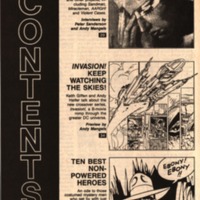
This issue of Amazing Heroes features a Table of Contents that spans two pages. It is done in black and white ink, with the first page featuring the word “Contents” in a verticle column – white text on a black background – going down the left-hand side of the page. To the right, there are three pictures with article titles and short descriptions. The top article is “Black Orchid in Bloom”, next to a rendition of said character. Underneath this is an animation of an airship, next to the headline “Invasion! Keep Watching the Skies!” Finally, there is a photo of a man in a wide-brimmed hat and a mask screaming “Ebony! Ebony!!” The accompanying title is “Ten Best Non-Powered Heroes”. The other articles in the issue, as seen in the left-hand column of page five, are “Perspective” by Gary D. Robinson (page six), “Newsline” (page seven), “Coming Distractions” (page 13), “Doc’s Bookshelf” by Dwight R. Decker (page 49), “Video Views” by Michael Eury (page 53), “Cover Gallery” by Don Rosa (page 56), “Small Talk” by Edd Vick (page 59), “Comics in Review” (page 63), “Amazing Readers” (page 73), and “Strom’s Index” by David Strom (page 82). The right-hand side lists staff, then contributor info, then an advertisers index, ad rates, and distribution information.
This 1988 issue of Amazing Heroes focuses on weirder elements of comic book culture – the odd artsy-ness of Black Orchid, superheroes without powers, the DC crossover series Invasion!. One noticeable quality found among the Neil Gaiman and Dave McKean-related works is the ethereal “fairy”-ness of it all. Gaiman admittedly was influenced by fairy tales when writing Sandman and Black Orchid, and these influences can be found throughout both the article and the artwork within it. Interestingly, these comics – so impressed upon by fairy tales – were not at all intended for children, as one would think. Instead, Gaiman was seen as a visionary and a pioneer for introducing these elements – fantasy and horror – into his mature comic books. Part of the appeal of his work, especially at its inception, was its combination of grit and fear with creativity and unearthliness. Additionally, Gaiman tends to utilize archetypes to explore themes within his comics; for instance, he considers both the Sandman and Black Orchid to be (relative) archetypes. This allows him to push boundaries and explore their characterization even further, as their status as archetypes makes them easier to understand from the beginning. He makes it so that Sandman, for instance, is not bound by human perspectives or morality; instead, he can provide insight into less heroic actions. Black Orchid, meanwhile, is an opposite archetype; she is innocent and pure, like a child that’s on the cusp of growing up. She is even, at one point, made to explore the Arkham Asylum, as a way of contrasting her good-naturedness with the terror of the asylum. This can be seen in Dave McKean’s art as well; Black Orchid is not shown as tough or as a fighter, but instead always looks anguished and is surrounded by watercolors and other fantasy-esque imagery. Gaiman and McKean utilize fantasy and archetypes to present a revitalized version of comic books, one that appeals to mature audiences.
This 1988 issue of Amazing Heroes focuses on weirder elements of comic book culture – the odd artsy-ness of Black Orchid, superheroes without powers, the DC crossover series Invasion!. One noticeable quality found among the Neil Gaiman and Dave McKean-related works is the ethereal “fairy”-ness of it all. Gaiman admittedly was influenced by fairy tales when writing Sandman and Black Orchid, and these influences can be found throughout both the article and the artwork within it. Interestingly, these comics – so impressed upon by fairy tales – were not at all intended for children, as one would think. Instead, Gaiman was seen as a visionary and a pioneer for introducing these elements – fantasy and horror – into his mature comic books. Part of the appeal of his work, especially at its inception, was its combination of grit and fear with creativity and unearthliness. Additionally, Gaiman tends to utilize archetypes to explore themes within his comics; for instance, he considers both the Sandman and Black Orchid to be (relative) archetypes. This allows him to push boundaries and explore their characterization even further, as their status as archetypes makes them easier to understand from the beginning. He makes it so that Sandman, for instance, is not bound by human perspectives or morality; instead, he can provide insight into less heroic actions. Black Orchid, meanwhile, is an opposite archetype; she is innocent and pure, like a child that’s on the cusp of growing up. She is even, at one point, made to explore the Arkham Asylum, as a way of contrasting her good-naturedness with the terror of the asylum. This can be seen in Dave McKean’s art as well; Black Orchid is not shown as tough or as a fighter, but instead always looks anguished and is surrounded by watercolors and other fantasy-esque imagery. Gaiman and McKean utilize fantasy and archetypes to present a revitalized version of comic books, one that appeals to mature audiences.
Creator
Executive Editor: Kim "Reed" Thompson
Managing Editor: Chris "Ben" McCubbin
Art Director: Lynette "Sue" Alcorn-McCubbin
Associate Editor: Bruce "Johnny" Walrad
News Correspondents: Michael Johnson, Darren Cranston
Production Assistant: Mark Thompson
Typesetting: Linda Gorell, Arlene Easter
Circulation: Rachel Enger, Carol Kovinick-Hernandez
Managing Editor: Chris "Ben" McCubbin
Art Director: Lynette "Sue" Alcorn-McCubbin
Associate Editor: Bruce "Johnny" Walrad
News Correspondents: Michael Johnson, Darren Cranston
Production Assistant: Mark Thompson
Typesetting: Linda Gorell, Arlene Easter
Circulation: Rachel Enger, Carol Kovinick-Hernandez
Source
MSU Special Collection Comic Art, PN6725.A47
Publisher
Fantagraphics Books, Inc.
Date
1988-11
Contributor
Holly Simon
Rights
Rights Restriction Apply
Format
10 1/4 x 6 1/8 in.
Language
English
Type
Periodical
Identifier
OMIT
Coverage
1981-1992
Files
Collection
Citation
Executive Editor: Kim "Reed" Thompson
Managing Editor: Chris "Ben" McCubbin
Art Director: Lynette "Sue" Alcorn-McCubbin
Associate Editor: Bruce "Johnny" Walrad
News Correspondents: Michael Johnson, Darren Cranston
Production Assistant: Mark Thompson
Typesetting: Linda Gorell, Arlene Easter
Circulation: Rachel Enger, Carol Kovinick-Hernandez, “Amazing Heroes Issue #152 Table of Contents,” Critical Fanscape, accessed October 17, 2026, https://chambl91.msu.domains/CriticalFanscape/items/show/93.