Amazing Heroes Issue #152 Page 21
Dublin Core
Title
Amazing Heroes Issue #152 Page 21
Subject
Periodical
Comics Strips
Comics Strips
Description
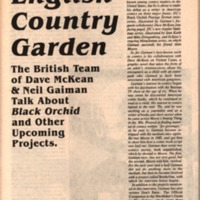
The twenty-first page of this issue is entitled “From an English Country Garden.” This text is seen in the top left-hand half of the page, in black text over an uncolored background. Underneath this large titled, in slightly smaller letters, reads “The British Team of Dave McKean & Neil Gaiman Talk about Black Orchid and Other Upcoming Projects.” Below this is about half a page of blankness, and then, at the very bottom, it reads “November 1, 1988” in extremely small text. The right-hand column, at the very top, features the name “Neil Gaiman” in black text in a hard-to-read text box with diagonal stripes. Underneath this, it says “Interviewed by Peter Sanderson”, and then proceeds with a four-paragraph, italicized introduction to Gaiman and his prior writings and current projects. Underneath this, there is a simple “21”, indicating the page number. Surprisingly, the page features no decoration – there are no illustrations and no photographs, despite Gaiman working repeatedly with illustrator Dave McKean. Instead, the page is simply text heavy, with the only thing close to decoration being the border around Gaiman’s name. Later pages of the article do feature illustrations, making the choice to admit them on the title page a surprising one.
This interview with Neil Gaiman and Dave McKean, the creators of a late-1980s rendition of Black Orchid, offers insight to readers as to what it takes to join the comic industry, and just how making a comic can come together. Their non-traditional style and unique storytelling methods paved the way for the artsier Vertigo comics, and inklings of this can be found within this article. In addition to discussing Black Orchid, this interview examines other projects done by Gaiman and McKean, like the now-revered Sandman series. Both Gaiman and McKean discuss their transition into comic creation and their thoughts on current trends in the industry. One question asked was this: “Do you prefer writing superheroes as explicitly godlike beings in contrast with…otherwise normal human beings who possess unusual powers?”, to which Gaiman replies that he does not really see himself fitting in the field of comic books at all. This deferment – Gaiman, a comics and superhero creator choosing not to align himself with those art forms – shows the remnants of the recently-ended Bronze Age of comics, where adult comic book fans are moving away from traditional stories and into new, unique formats. Accordingly, the creators are trying to posit themselves as more high-brow, to fit into this new demographic. This is exemplified in McKean’s artwork for Black Orchid and other series as well; gone is the cartoon-y, exaggerated animation style that’s considered a mainstay in popular comics. Instead, the Black Orchid style is artsy, angsty, watercolor-esque, and thought-provoking. By presenting Black Orchid in this style, the authors are indirectly demonstrating that, despite being a comic book, they see this as a more elevated use of the medium, one that separates them from traditional superheroes or comic books. They are attempting to disassociate their comics from the more stigmatized, “childish” comics in order to preserve a more high-brow reputation.
This interview with Neil Gaiman and Dave McKean, the creators of a late-1980s rendition of Black Orchid, offers insight to readers as to what it takes to join the comic industry, and just how making a comic can come together. Their non-traditional style and unique storytelling methods paved the way for the artsier Vertigo comics, and inklings of this can be found within this article. In addition to discussing Black Orchid, this interview examines other projects done by Gaiman and McKean, like the now-revered Sandman series. Both Gaiman and McKean discuss their transition into comic creation and their thoughts on current trends in the industry. One question asked was this: “Do you prefer writing superheroes as explicitly godlike beings in contrast with…otherwise normal human beings who possess unusual powers?”, to which Gaiman replies that he does not really see himself fitting in the field of comic books at all. This deferment – Gaiman, a comics and superhero creator choosing not to align himself with those art forms – shows the remnants of the recently-ended Bronze Age of comics, where adult comic book fans are moving away from traditional stories and into new, unique formats. Accordingly, the creators are trying to posit themselves as more high-brow, to fit into this new demographic. This is exemplified in McKean’s artwork for Black Orchid and other series as well; gone is the cartoon-y, exaggerated animation style that’s considered a mainstay in popular comics. Instead, the Black Orchid style is artsy, angsty, watercolor-esque, and thought-provoking. By presenting Black Orchid in this style, the authors are indirectly demonstrating that, despite being a comic book, they see this as a more elevated use of the medium, one that separates them from traditional superheroes or comic books. They are attempting to disassociate their comics from the more stigmatized, “childish” comics in order to preserve a more high-brow reputation.
Creator
Executive Editor: Kim "Reed" Thompson
Managing Editor: Chris "Ben" McCubbin
Art Director: Lynette "Sue" Alcorn-McCubbin
Associate Editor: Bruce "Johnny" Walrad
News Correspondents: Michael Johnson, Darren Cranston
Production Assistant: Mark Thompson
Typesetting: Linda Gorell, Arlene Easter
Circulation: Rachel Enger, Carol Kovinick-Hernandez
Managing Editor: Chris "Ben" McCubbin
Art Director: Lynette "Sue" Alcorn-McCubbin
Associate Editor: Bruce "Johnny" Walrad
News Correspondents: Michael Johnson, Darren Cranston
Production Assistant: Mark Thompson
Typesetting: Linda Gorell, Arlene Easter
Circulation: Rachel Enger, Carol Kovinick-Hernandez
Source
MSU Special Collection Comic Art, PN6725.A47
Publisher
Fantagraphics Books, Inc.
Date
1988-11
Contributor
Holly Simon
Rights
Rights Restrictions Apply
Format
10 1/4 x 6 1/8 in.
Language
English
Type
Periodical
Identifier
OMIT
Coverage
1981-1992
Files
Collection
Citation
Executive Editor: Kim "Reed" Thompson
Managing Editor: Chris "Ben" McCubbin
Art Director: Lynette "Sue" Alcorn-McCubbin
Associate Editor: Bruce "Johnny" Walrad
News Correspondents: Michael Johnson, Darren Cranston
Production Assistant: Mark Thompson
Typesetting: Linda Gorell, Arlene Easter
Circulation: Rachel Enger, Carol Kovinick-Hernandez
, “Amazing Heroes Issue #152 Page 21,” Critical Fanscape, accessed October 17, 2026, https://chambl91.msu.domains/CriticalFanscape/items/show/94.